Wednesday, August 17, 2011

"To the Globe I Rowed"

Not me, but I will happily send someone a very fine and exciting postcard from London if you are the first to identify the source of the quotation. And, I'll send more postcards if subsequent people can tell me cool stuff about the source.

So, I didn't row, but I tool the tube to Waterloo a good bit early to take a walk on the Queen's Walk along the river. Even on a weekday, there's lots happening, especially at low tide. Here's a man making a sculpture on the tidal beach. Amazing and ephemeral.

The theater is such a cool space. The boxes just at either side of the stage are specially painted. I didn't get to go up there, because I am a groundling. Best five pounds anyone's spent lately, I bet.

Here's what the stage looks from my camera held above my head. I'm pretty close, and the sun was shiny which felt good, but made things a little glary for the camera.

And here are the heavens. Don't they look heavenly? Actually, they sort of remind me of the color of the ceiling of the chapel royal at Hampton Court Palace, except the chapel was a slightly different blue. Still, they both have lots of starry decorative stuff.

And here's a straight on of the stage, but you can't quite see the stage because I'm not quite tall enough holding the camera. Still, it gives you a sense, I hope.

I saw All's Well today. The play's not one of my favorites, but then, I don't think anyone much lists it in their top three, even. And it's certainly not as wonderful as Faustus, but then, Faustus is a pretty darned amazing play. (I've never understood why anyone would think that the person who wrote Faustus also wrote Shakespeare's works. They just don't feel at all alike to me, structurally, especially. And surely Marlowe's works are enough of an accomplishment for any writer?)

The standout player of the play for me, though, was Janie Dee as the Countess. She's got real stage presence.

The program did a nice job talking about how the play forces us to question how we like fairy tale endings, which is as good a sense of things as any.

I walked towards the other tube station on the way out, and saw the actual, real Globe site. There's the place. Right there.

The placard explains the site a bit, and says that there are different colored bricks laid where the archaeological dig found building foundations.

In this picture, I'm trying to show the reddish/brown bricks that denote where the building foundations were.

Pretty darned cool!

Tuesday, August 16, 2011

Palatially Weird

I went to Kensington Palace today, but not very directly. I started with a look at the book and tube maps and decided to get on the Bakerloo line south to Oxford Circus and transfer there to the Circle line and get off at Notting Hill Gate.

That much went well. I got a little lost around Notting Hill, but that's partly because I was having such fun in the neighborhood. It really felt like a neighborhood much more than where I live does. There were interesting looking stores, ones that look useful for living in an area, rather than just convenience type stores to pick up a quick something on the way from the station, which is what's mostly around Paddington.

I should have had a clue, because just a stop or two before Notting Hill Gate is a stop called Lancaster Gate. But, as usual, I'm clueless.

I finally made it to Kensington Gardens, and stopped for some food. And then I needed a restroom, because life is like that, so I followed a sign that said a restroom was 750 meters on. And when I found the restroom, I realized that I recognized the area, because it is right near Lancaster Gate, which is one of the gates close to where I am living. Yes, like two blocks away close. Duh.

Much relieved, I walked back to the Palace and used my year membership thingy to go on in.

Now, I've been to a number of palaces before, not only in the UK, but in Japan, so I have some ideas about what touring palaces is like. At a usual palace tour, you learn something about the building of the palace, and what important people have lived there, and what important events have happened there. Then you admire the architecture and the art.

This is unlike my ideas. It's not bad, just different.

You see, this is a special display becuase they are doing major work on the palace, so they've done this special display, and you can tell they've put a huge amount of work into it.

They have this handout at the start, and the idea is that as you go through the room displays, you'll read what's there and find seven princesses. And in you go, to a somewhat darkened room labeled something about being the room of tears.

So I immediately think, was Anne Boleyn a princess? No. How about Elizabeth, the Winter Queen! But no, it's someone named Mary. Yeah, no, different Mary, this one is Mary II, and I realize that makes sense because James II had started the building of this palace, so of course they'll focus on recent history. (Well, recent for some of us, anyway.)

But why was Mary II crying into all these lachrymatory? She was queen for gosh sake, and H8 was already dead, so what's with the tears?

Then I read up on the information they had on Mary II and learned about her not having kids and such. And things made sense.

The other princesses were Charlotte, Caroline, Victoria, Margaret, Diana, and Anne. The picture at left is from the display about Margaret and Diana, which the exhibit calls "The Dancing Princesses." As you can tell, it was pretty dark (and was throughout), so hard to take pictures (no flash allowed).

And since I'm pretty weak on British history after, say, 1660, I learned a lot about people who don't necessarily catch my attention (I would have noticed Victoria, though). And that's neat.

What I missed, though, was the usual history of the building and so on. Here's the everpresent Charles I (I think) in one room, barely visible, and not well-labeled. I'm sure I missed noticing lots because of the lighting. And that's especially a shame because this palace felt in some ways the most relaxed. I was standing pretty darned close to this painting to take that picture.

And then I walked home through the park, which I enjoyed a lot. I've noticed there's something strange for me about this park: I usually expect to see lots of pine and other gymnosperms. But I don't seem to see them here.

Still, it's a beautiful park, and as soon as I shake the cold, I'm going to try a short run.

Observations from a Traveler

Guide Book Index!

My guide books suck. Why do they suck, you ask? They're organized geographically, so you're supposed to say, "what do I want to see in the west of London" or "what do I want to see in Wales?"

That's fine as far as it goes, but it assumes the traveler has a sense of the geography enough to know what counts as west of London or Wales or whatever. And for the traveler who doesn't have this sense (and I can't be the only geographically challenged person around), it needs a good index, an index that lists pretty much everything one might wish to find. And that's where this guidebook is seriously lacking. It has an index, but it doesn't show lots of stuff.

And keys to maps should be on the same page as the map, so you don't have to flip pages.

APPS!

I have two really helpful travel apps. One is CityMaps2Go (I think it was $1.99). It lets you download maps of cities, etc (I have a county map for home downloaded, since my city is too small, and it works fine) ahead of time, so that you can pull them up on the go, without wifi access.

The resizing feature isn't perfect, because just when I can read street names without my reading glasses, it resizes them smaller. But mostly, it's really helpful. Okay, and for London it needs little underground signs!

The other really helpful app so far is a tube map. I got a free one called TubeMap) and it's really helpful. What's especially cool is that when it's got wifi it checks different update things to give information about what lines are doing what, and that's been really helpful with weekend closures!

***

I am clueless about the specifics of the off-prime and so on train travel. I have a feeling I'm looking for tickets and the website thinks I really want only the cheapest (which would be fine, but not necessary), and says there are none when/where I want to go.

***

The "I'm an idiot" section: I got something called "fabric conditioner" rather than detergent when I went to get stuff to wash clothes with. Fortunately, I'm more rinsing out the clothes than trying to get out deep stains or mud or whatever. Still, I didn't take time to get out my reading glasses to read the fine print. :(

(I've been handrinsing my clothes since the original three hours to do laundry if the machine is ever free thing. I wash/rinse some clothes just about every day, and hang them and in a day or two they're dry. And well-conditioned, apparently.)

***

I've been here a while now, taken trains to different places and stuff (and looked out the window), walked around the city and others, and in all this time, I think I've seen one gas station (on the way to Stonehenge).

Where to English people go to gas up?

When I was a kid, I read a second book by the guy who wrote Jonathan Livingston Seagull about this pilot who was flying around in company with this other pilot, doing air shows, whatever, and he finally realized that the other pilot didn't need to buy fuel for his plane. (And that was supposed to take you to the revelation that the other pilot was the second coming or something? I was a kid, I don't remember.) Anyway, maybe English people are like that second pilot?

***

I would totally read a blog by a Yeoman Warder or a London Cathedral/Museum worker, like WaiterRant except for folks who deal with tourists in London.

Monday, August 15, 2011

I went to the Tower again today. I was only going to spend half a day, but then I spent the whole day, because there's so much to see.

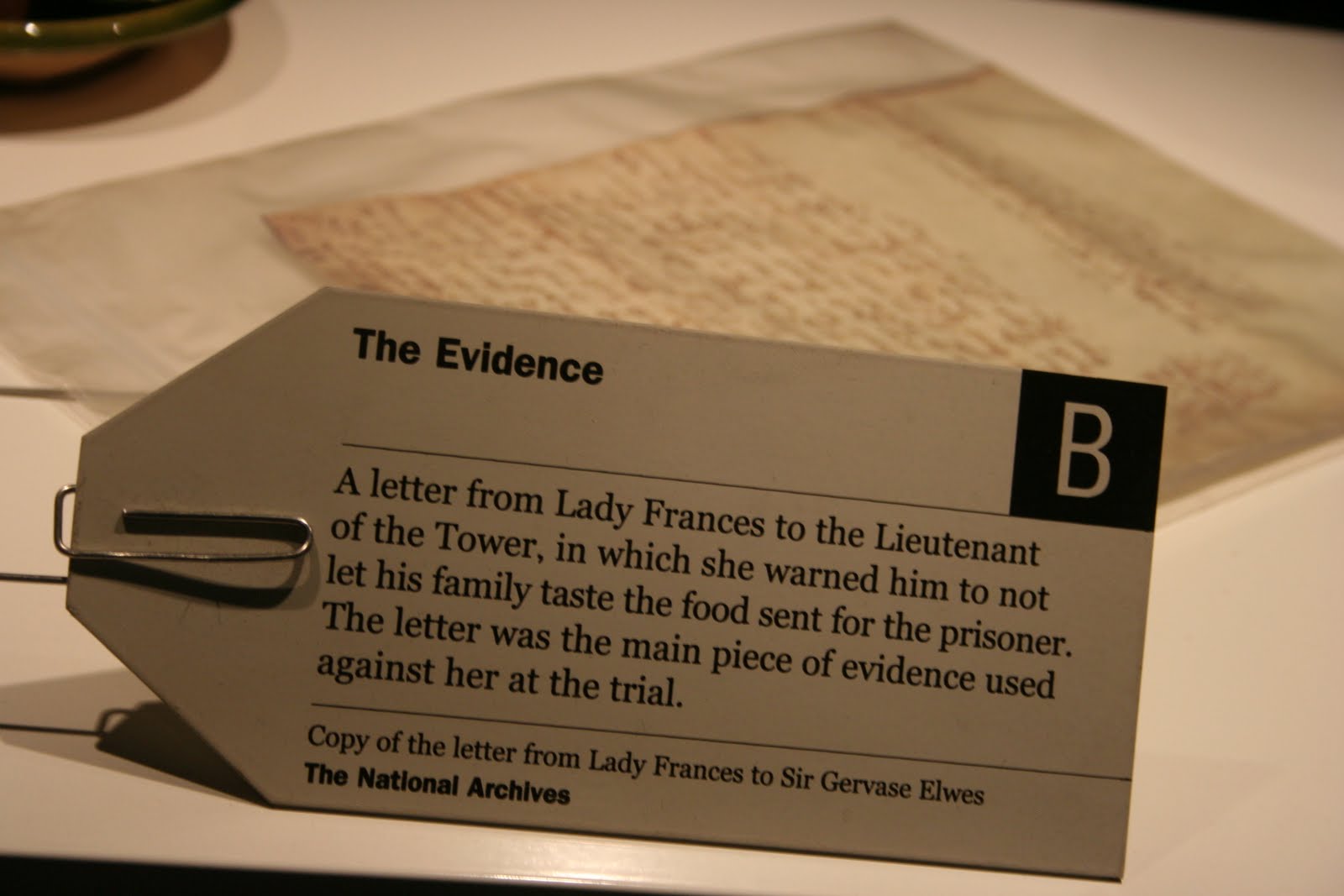
There's this. It's part of the Overbury display, which isn't nearly as in depth it should be (see, I did that on purpose!) How many other people have spent more than 15 minutes trying to figure out one Frances Howard from another? How about taken the time to figure out that Carr wasn't the Somerset who built/owned Somerset House? Only me?

I didn't take a picture of where Overbury is buried because it's in the Chapel Royal, and the guide said not to take pictures. (And do YOU want to get in trouble with the people who guard the Tower? I don't.)

I also took several pictures of some of the carved graffiti. I imagine some people had a lot of time on their hands, eh? But, they also must have had some fairly sharp objects in order to cut into the stone.

I took pictures of armor. When I look at this, I have to ask, how did the wearer see out? (I think actually it's tilt armor, so he'd be on a trained horse in the list, and pretty much run along with the lance more or less aimed.)

***

I also walked up the stairs to the top of the Monument, 300+ steps in a tight spiral. I have a feeling that restoration folks were quite fit!

Sunday, August 14, 2011

About a Perfect Day

I went to a performance of Faustus at the Globe today. You'll be glad to know that I didn't feel nearly as lost as at the National Theater. The Globe, oddly enough, feels easier for a beginner.

I was a groundling, and went in a bit before the show began.

Words fail. But since words are what I have (I didn't take my camera, but will next time--yes, there's a next time!), here goes.

The building is glorious. It's so fun to walk in and be looking, just about eye level, at the thrust stage, to see the galleries rising around, and to see the boxes painted, the back of the stage painted with trompe-l'oeil decorations. The fake marble columns were my favorite.

I've read, as many of you have, lots and lots about theatrical practices and effects in an amphitheater type space. And there they were, playing out before me. I enjoyed looking around (though, I didn't try to pick any sweet young things up for the evening's entertainment, but only because I have you, dear readers!), watching people getting ready, and later watching people react to different stuff on stage.

I ended up two people back from the catwalk type area in front of the main thrust stage, which was a great place to be. There was lots of action played out there, and you could really see the actors. But I have a feeling other places would have felt as good, because the actors definitely played to the audience around the stage.

There were lots of pissing jokes, what can I say. In fact, the play was funny, almost too funny, through most of it. But it worked. They made the pranks seem appropriately wasteful and stupid. (Because, seriously, if you can do all this amazing magic, how about doing something useful, like curing plague or making good, potable water? Just a thought.)

It's apparent though, that the real meat of the play, the parts that matter most are at the beginning, where Faustus makes his deal, where Mephistophilis tells him honestly about hell (that whole medieval not being allowed to lie or trick you about your soul thing), and at the end, where he despairs. Between one and the other, it's sort of a song and dance to entertain and make sure you realize that Faustus isn't doing anything worthwhile with his abilities.

In some ways, a lot of plays are like that, but Faustus today struck me especially. Is that a flaw or no? Well, in this production, things were well done, so it was certainly entertaining enough.

It also made the Pope especially hateful by showing Bruno's aftereffects of torture.

But by the end of the play, the demons were too familiar, and thus not really horrifying, and the puppet thing was just weird. (The puppet dance at the very end was especially weird, but fun.)

You can tell a good play when the audience is slow to leave the theater, and this audience was slow, and hung about the bookstore in a huge crowd (yes, I was part of the crowd).

***

The play ended in early afternoon (gosh, I love seeing a play outdoors), and the way back to the subway or tube station passed Southwark Cathedral, and it was open, so in I went. I visited the grave markers of Lancelot Andrewes (you have to love his name! More kids named Lancelot!) and John Gower. And I had a lovely and informative conversation with one of the church docents (I'm not sure what to call her), who told me about a monument to a Mohican (sp?) who'd come to England in the early 18th century to ask the King to keep the colonists from messing with the tribal lands anymore, but who died without getting an audience. The marker was unveiled by E2 and a tribal leader from the Mohicans in 1996, a sort of long delayed (over delayed, no doubt) meeting. It's cool to hear stories like that.

One thing I really love about the docents (or whatever) at the various churches I've seen: they all seem to love their parish as a living community, and are wonderfully informative in such a friendly way.

***

One last thing. I feel pretentious calling the subway the "tube" and stupid calling it the "subway" because everyone else calls it the "tube." I think there's no way for me to feel unfake or unstupid in some linguistics matters.

I Came, I Saw, I Made it Back

I don't know why I haven't been in more of a hurry to go to Stratford-upon-Avon, but I haven't. I really like Shakespeare's works, after all. They blow me away. But I guess I'm suspicious about the way it's a fandom or something? Or maybe I feel inadequate because I'm lousy at quoting passages (and I know people who don't do lit studies at all and can quote long passages)?

But anyway, yesterday was the day.

Usually, to get to S-u-A from London, you go to the Marlybone station and get on a train to Stratford. At least, I think that's what happens. My guidebook (which I'm liking less and less, alas) tells me that Chiltern offers direct service from London, Marlybone.

However, right now, there's major train infrastructure work going on, and Marlybone station is closed. Not to worrry, though, because there's a sign there, so that I knew where to go when I'd taken the subway to Marlybone: back to Paddington.

I tried to buy a ticket at the machine, but I got confused. (I feel incredibly inadequate about buying tickets at machines, but I did buy my Oxford ticket and have reloaded my Oyster card, so I'm learning.) I went to a ticket counter, and she first said it was 25 L (pretend that's a pound sign), but then said no, I had to go through Birmingham, and it's 40 L.

I got on the next train to Birmingham. Take a moment to look at a map.

The train to Birmingham wasn't, let's say, an express. No. It stopped at every little station along the way, pretty much, even the ones that were too small to have anything more than a platform, a ticket machine, and warning signs about stealing. At least I got to see some scenery, though, right!

At Birmingham, I waiting for the next train, and asked the ticket guy (who wasn't very busy) about return trains, and learned that the last return train leaves at 8:06, and that there are trains for London, Paddington every half hout through the day at 6 and 36. Okay, so that's easy.

I got on the train to S-u-A, and off we went. You can tell some of these are extra small stops because some of them are "request" stops. Someone has to ask the driver ahead to stop there. And we stopped at all of them.

It took almost four hours to get there instead of the usual 2.

But then I was there. Yes, there I was. So I started walking for the church to see the burial site. Along the way, I saw the Hall Croft, one of the houses that the Shakespeare Trust has, so I went through that (very interesting) and got a Trust thing for the houses in town, and a handy map of the town.

I went on the church, and was lucky enough to get there between weddings (because, duh, summer Saturday!), and went and saw the monument and grave marker. I guess I hadn't quite understood. Usually you see pictures of the monument, and some comment about the nearby grave. But the grave marker is one of four family grave markers on the floor, in the usual slap of stone with cut inscription way, and they're right up near the altar.

I like the way the church tries to balance between Shakespeare stuff and itself as a living part of a living community now. So they have these two part displays, one about Shakespeare (his baptism, marriage, burial) and the other about how important this is in the community life of the present church.

I didn't take pictures inside the church. We've all seen pictures, right? Maybe I should have taken one of the grave marker.

I walked on, and saw that the King Edward VI school was open for the day, and giving tours. That's the school that Shakespeare may have gone to, given that it was the only grammar school operating in the area at the time, and his father was one of the town guild guys who were associated with the school. So I donated 2 L to go on the tour, given by a student.

And it was fun, and cool. He showed us the older buildings, but the school has newer buildings, too.

And then I walked on and went to Nash House and New Place. They're doing an archaeological dig at New Place right now!

Shakespeare had the house built after he'd inherited the Birth House from his father and had made a boatload of money from the plays and being a sharer in the company. You really get a sense of how much money he'd made from the comparative size of New Place and the old house, which was still a pretty decent size.

Anyway, New Place had had a medieval structure, and then the Shakespeare structure, and then someone had decided to tear that down and put up a Georgian (I think), and then that got torn down, and now, archaeology! In this picture, the gray area in the middle is supposedly the medieval level floor. Below that, they've found regular soil and no more good stuff.

From the Nash House, I went on to the Birthplace Trust and the Birthplace house.

I was disappointed in the Trust exhibit, I have to say. It was way too "crowd control" and way less "look at this and learn something." Maybe that works well for most people. Anyway, you go into this area, and there's a little film thingy, and it tells you about Shakespeare a bit. And then when it's done, and door thing opens, and you're allowed to go into the next area, which also has a film thingy. Some of them have displays. But the areas are dark, and the displays are covered so you only really see them while the light is on them. So you get maybe a minute to look at the First Folio copy they have. Maybe that's enough for some people?

But the film thingy means that everyone gets the same bit of information, and that you can't read a bit more for more information. And I didn't find the information they gave sufficient to give context for what I imagine regular folks would really appreciate (and I've taught for a long time, and have some clue about regular folks, I think).

The house, on the other hand, is cool. And all along, in all the houses, the guides are great at answering questions and providing information. I love the museum guides I've run into. One good question gets them started on interesting stuff, but not too much.

And that was my day in S-u-A. It was almost five when I finished at the house, so I took a taxi (my first, and not a regular looking London cab, alas) to the train station (it would have been a do-able walk, but I wanted time to buy some food).

I got on the train at 5:20. We got to Birmingham, and the next train was at 7:15. Not 6:36 or 7:06. I don't know why. And I got on the 7:15, and then made it back to London at 9:50. So it was a long day, but a very good one, too.

I enjoyed Stratford more than I expected too. It's cheesy, sort of like Ashland, Oregon on steroids, but also less high-falutin' and more a community feel with the church and the school as part of things.

Friday, August 12, 2011

Relics

Today, I went to walk through Lincoln Inn and the fields and Gray's Inn, then went to the Sir John Soanes Museum, and finally, back to the British Museum to specially visit the Treasures of Heaven exhibit.

My thanks to those who suggested the Soanes Museum, I never would have found it without the suggestions, but it was well worth the time. Soanes was an architect, and the Museum is notable for a couple things. First, he has bunches of cool Hogarth paintings, including the series the Rake's Progress, which I got to see. The paintings are in a paintings room where there are moveable panels with paintings hung on the backs, and on the front of the next area, and such, and the Rake's Progress are behind one of the panels, but the guard was showing folks, so I got to see.

Second, Soane was an architect, and collected all sorts of architectural models, bits of building decorations, plaster casts, and even the Sarcophagus of Seti I. And through much of the house (which is really three Georgian houses combined now, with additions on the back parts), these things are all over, just all over. (If this museum ever gets together with the Victoria and Albert, there will be a singularity of clutter.)

Third, since Soane was an architect, and a successful one, he built additions onto his house, and then bought up the yard of the next house over to build in, and so on. And he does amazing things with natural light in the spaces he built. There are rooms with a floor above them, but because he's arranged the lighting so well, the natural light is perfectly fine during the day. (Some rooms didn't seem to have artificial lighting lit that I could tell.) It really shows what you can do with well-placed windows (he had some early plate glass ones) and skylight dome thingies.

The Inns of Court, well, I had to visit a couple of these, right? I'm not sure I need to visit the other two, but we'll see. Maybe I'll decide to. I was surprised that I could walk around inside the walls (though not in the buildings). But coolness. Think of all those students from the Inns who went to plays! And the plays written and performed for the Inns' celebrations!

But the relics. The relics. Mostly, there were a lot of reliquaries, many empty, and lots of incredible stuff associated with relics and relic practices.

Best part: I saw a vernicle! (That's a pilgrim's badge representing Veronica holding the cloth with the image of Jesus that appeared after she wiped his face with the cloth. The cloth itself is at Rome, so it was a badge a pilgrim could get when they visited Rome. Sort of like those National Park things people stick on their walking sticks.)

No doubt, you're immediately remembering my stunningly relistic portrait of Chaucer's Pardoner, with the Vernycle on his hat! I thought you would! And now I've seen a real one. (And also badges for Santiago, Jerusalem, and Canterbury!)

Gosh, maybe I should offer to let the British Museum display my picture, so that people will make the connection to Chaucer's pilgrims?

Towards the end of the exhibit, there were several reliquaries with relics of the True Cross (they always capitalize it) and thorns from the crown. The pieces of the cross are always tiny, which surprised me, somehow.

One of the interesting points the exhibit made was that Jesus being resurected meant that there weren't any body parts you could use as relics, except his umbilicus (there was an empty reliquary for that! It showed Jesus as a baby on Mary's lap, and where his belly button would have been was a little red glass? container for the relic! Wonderful) and of course, the multiple foreskins (though the exhibit didn't mention them). There was also a reliquary for manger bits, as if someone had thought to put the manger in their attic, just in case this little baby became important!

And then there were reliquaries with multiple relics, mostly wrapped in a bit of cloth with a vellum or parchment label. You couldn't actually see the relics (except for the cross and thorn pieces, and one supposed skull bit from Thomas Kemp, which were displayed in crystal containers), but only the bit of cloth wrapping and the label (which I couldn't read, but I'm worse than bad at medieval scripts).

And that got me to thinking about what it would take to convince someone that something was really a relic. Chaucer's characters' reactions to the Pardoner give a sense that regular folks could have doubts about the veracity of someone purporting to have a relic.

And then, once you get more than a couple relics in a single reliquary, the importance of naming or seeing any individual one (unless it's a bit of the cross or a thorn) seems to get very low. Now maybe that's just the display, but I would think if I had a piece of St. So and Such, I'd put it on the display card, even in a list, so that people would know. But it's as if at a certain point, St. So and Such just really isn't that important, even though s/he may have a Cathedral or attested miracles "back home."

Finally, there was a small display of secular relic stuff, led, as you'd expect for London, by a lock of Charles I's hair. And other memorial rings and stuff remembering him. (Charles I is way bigger in London than he was in my imagination, I think because of the Restoration and Great Fire and stuff. But then, once the theaters close, my imagination tended to stop.)

Totally Off Topic Advice Asked

I need some help.

I need an idea for a birthday gift. My nephew will be turning 15 soon. Any ideas from London or stuff?

In general, he likes golf, but he has everything golfy he needs or wants, so far as I can tell. My Mom thinks I should go to some golf course and get something, but 1) my sense is that golf courses are mostly not going to be near subway or train stops, and 2) golf interests me not at all.

He also likes to downhill ski. But no one else in his family does it (for a variety of reasons), so he mostly goes with a school club or when his Dad has a couple hours on a weekend. (They live less than an hour from a small ski place.) We went skiing together one time last winter, and I had fun, and think he did, too. (And he was wonderfully helpful getting me started skiing and stuff, since I hadn't been in ages.)

My idea is to give him a day of skiing at one of the areas not too far from his house.

But I'd love London ideas. Or other ideas.

Thanks.

ps. I love pseudoephedrine. I hope whoever figured it out for cold relief is making boatloads of money because it's the bestest thing ever!

Thursday, August 11, 2011

Politics

A quick view of ONE of the several ceramics rooms at the Victoria and Albert. There are a LOT of ceramics in here!

I don't pretend to understand US politics. But I'm totally out of my league trying to follow the political reactions to the London riots. There are so many points of view, and I am only rarely seeing people of color talking from their point of view on TV. (I have seen a couple, just not many.) But I have this sense that recent events look very different from different points of view.

I had a lovely conversation yesterday with a museum caretaker at the Victoria and Albert, mostly about other things to see and such, but also touching on the riots.* I tend to shake my head and comment about how hard it is for someone who's not a Londoner to really understand what's up. And then if someone wants to tell me about their experience, they know I'm trying to understand. The caretaker mostly talked about where he lived, and seeing smoke rising not far from his home.

I've mostly stayed home today (after going out and getting some pseudoephedrine) because I've got such a nastily stuffed nose and a cough, but I may go out for a walk in Hyde Park in a little bit. (I feel like I need a little exercise, but not too much, and not indoors.) But I've watched the parliamentary discussion, and it's pretty interesting and confusing. There seems to be a lot of standard things one says, or asks (such as, "Does the Prime Minister not agree that...?"). And as the discussion has gone on, the room has gradually emptied quite a bit, so that it looks like once people get heard on TV, they feel free to leave or something.


*If things are quiet, sometimes, I say to the caretaker, "Does it ever get old?" with a vague wave around, and sometimes they just smile and shake their heads, but often enough, they talk about what they like best in the museum, and that's helpful to me, especially in a really big museum.

Several people have mentioned the Sir John Soane museum as being really worth seeing, so I'll probably head there. I also want to go to Stratford and Dover, but I really, really don't feel like sitting on a train right now.

(Not to worry: my glands aren't the least swollen, and I only feel totally stuffed up and coughy, but not achy or with an upset stomach. But a stuffed nose is a pain in the nose!)


Wednesday, August 10, 2011

Bleargh

I seem to have caught a cold. My head is leaking. :(

I hope I haven't been passing it along to people ahead of knowing about it.

Tuesday, August 09, 2011

Three Things


I've been getting worried messages on fb and such, wondering if I'm in the riot area. And I'm happy to say, so far, I'm not. That doesn't mean things can't change, but so far, I'm not near.

I went out of town for the day today (more in a bit), and when I came back, having been newsless all day, I was curious about my neighborhood. But there's the usual mixed age, mixed race crowd of people relaxing at the outdoor pub seating (and I presume others are inside), walking here and there, often dragging suitcases, talking on cell phones (I should say "mobiles"), and just being in the area.

My super-duper-please-don't-fail-me-now system of staying out of trouble is to not worry if lots of regular folks are about, and to try not to be where regular folks aren't, if I can help it. And that goes double in places where I'm unfamiliar with things (and I am here, for sure). And if there's trouble, and I don't want to be in it, go the other way. (There might be a time when I really should choose to be in some trouble. I hope I will know that time, and have the courage to step up.)

***

My day to day was just about as perfect as one could wish. I took the train to Oxford, where Brian and his Better Half guided me around, pointing out the coolness, patiently waiting while I took my usual pictures, showed me around his college (how cool is it to have a "college" at Oxford!), and then took me out to a really good lunch, which set me up for spending more time wandering around and going to see the Ashmolean.

Speaking of trouble (remember, way back when?), this is a marker of where Latimer and Ridley (and later, Cranmer) were burned at the stake during the reign of Mary I. I think I hadn't put together the Oxford where they were burned at the stake with the Oxford that's a place I might visit, somehow. Does that make sense?

Here's a green at Trinity. Isn't that amazing. I got sort of amazed by Trinity for a while, and didn't remember to take pictures. It's so exactly what you might expect an Oxford college to be.

This is part of what was the Divinity Lecture place (if I'm remembering correctly. There's a chair here that was built from Sir Frances Drake's famous ship, The Hind, that went around the world!

Look, a chair! I'm interested in Drake a bit because when I was a kid, Drake was the one English name that made it into my history class other than the 13 colonies and Revolutionary War. So this is way cooler for me than it may be for you.

This is Mob Quad inside Merton College, which, I'm told, is one of the very first of the quads Oxford is famous for.

Here's a message board up at Merton, just to show that there's something in common with the colleges and universities I'm more familiar with: it's an activities and who to call for peer counseling sort of board.

So, those are my Oxford pictures. Way cool, and totally unlike any college/university I've ever been to before.

And once again, thanks to Brian and his Better Half for the tour!

***

The show! You're wondering how A Woman Killed with Kindness was last night, aren't you?

Mixed. The staging was really interesting. It was played in maybe the early 20th century, with two partial house interiors side by side. On the left, the home of Sir Charles Mountford and his sister, Susan. That side looks sort of Georgian, with that sort of wall feel, rounded stair, and so on. On the right is the interior of John Fankford and his new wife, Anne. This house looks much more early 20th century. I think they're trying to say something about old/not as old money.

I haven't read the play in lo these many years, so I don't remember if there are big dumbshow sequences, but there were in this production. It was sort of effective, but also distracting at times. I had difficulty following what was happening on both sides of the stage at the same time, sometimes.

I was up in the balcony, and also found it weird to look from that angle, and had some difficulty hearing one or two of the actors well.

I guess for me, the biggest failure was that the play didn't hit me.

Let me admit that I'm the biggest whuss in the world when it comes to crying when people die in literature. I get teary eyed just thinking about Cyrano. But I didn't get teary eyed at this play, and I guess it just didn't hit me strongly enough.

***

I'm a theater noob, and that was brought home to me last night. I can probably count the number of professional plays I've seen without taking off my shoes. I didn't grow up seeing plays with my family (though we did go see musicals a lot, but not plays per se). I remember the first play I saw, with a junior high school program that took us to a matinee of Cyrano. The next time, they took us to Caesar and Cleopatra. Both made a big impression on me, but I wasn't the kind of kid who had a lot of motivation to go out and do stuff like that on my own. (When I was supposed to read Julius Caesar in high school, I got totally, totally confused.)

Back to my noobness. I got to the theater early, and got lost in the theater complex. It's huge. And then I was worried because there was an overhead announcement about the play about to begin, but I couldn't figure out to get where my seats were, and then when I asked, the woman said we couldn't go in yet. And finally I realized that there must be another play in the complex that started earlier. I'm always one of the people at the theater who looks totally lost and out of place, you know? I have friends who always look totally cool and knowledgable, and I'm just not them. (Happily, they put up with me.)

And then we finally got in, and that was cool.

Monday, August 08, 2011

Big City Living

The other day walking in the subway station, I saw a big poster ad for a Toulouse-Lautrec show at a museum at Somerset House. Being me I thought, Robert Carr's house still survives what with all the scandal and all? But no, different Somerset. And it's not really the same house, I think, so much as built up in the same place with the same name.

Still, it's a Tudor era palace (or was), started by the Duke of Somerset (Carr was an Earl, I think?), then taken over and used as a house for Princess Elizabeth (before she was Queen Elizabeth), and then by Stuart queens. Eventually the navy took over, and now it's this big museumy complex thing. And way cool.

What you may not know is that I really, really like Lautrec's works. I do. Even though he's practically still alive and everything.

So I put it high on my list, as in, let's do this in the morning, because Monday's are free. So that's where I started my morning this morning.

And it was very good. The Lautrec exhibit was just wonderful, and put together very well with lots of good pieces and helpful descriptions.

And as I was walking through, I thought a lot about how very lucky I am to be in London right now when this specific exhibit is happening. Let's face it, exhibits like this get put together and sometimes travel, but only to pretty big cities. And I don't normally live in a big city.

I do live only a few hours by car (and I have a car in the US) from a couple of big cities, though, and I bet they do have good visiting exhibits. And it's my own damned fault that I haven't gotten to know those cities well (or even at all). With my horrid sense of direction, I'm lousy at finding my way in new cities. (But I can follow a transit map!) I really should, though, just get a friend or three together and visit shows just to do it. (Then I saw that New Kid has a post up about a Chron article about someone visiting a small town on a campus visit, and I hope I wasn't being as obnoxiously condescending.)

The museum had a fair bit of other stuff, including one of the really great Van Gogh pieces with his ear bandaged, a Picasso that was stunning, and so on.

As I was walking through that part, I saw a familiar face and thought, hey, I know that guy! (Well, "know" in the sense that I've seen the painting before.) It took me a moment, and I realized it was a portrait of Castiglione. (The Wikipedia page shows Raphael's portrait.)

But, I thought, shouldn't that be in Italy? But I went closer, and learned that it was a copy by Rubens (gosh, maybe I'm getting him confused with Rembrandt? I think by Rubens.)

I don't know if it's Castiglione or Raphael's talent (or Rubens' talent in copying Raphael), but since I've seen that picture, I've always thought the Castiglione would be an incredible person to have met or had a conversation with over dinner (well, were my Italian better, anyway). There's just something about the eyes and the way they work in his face.

***

After visiting the Lautrec exhibit, I went on to an exhibit about the Tudor palace and the barge, and they have an 18th or 19th century naval barge on display there so that people can see what a barge for important people travelling on the Thames would have looked like, and it was so fancy! So now I have that in mind when I think about Wolsey or H8 going down to Hampton Court Palace.

Then I was going to walk to the Embankment station, but along the way I found this little Embankment park, and stupidly decided that I'd walk to my second stop of the day, the Imperial War Museum. Now, I'm ashamed to say that I could get lost in my own closet, so of course I didn't find the most direct route. (I'm not really sure there's a direct route anywhere in London.) But I finally made it, had some lunch, and looked at WWI and WWII stuff until I had had enough of war stuff and came home. I'm not much good for tanks and such, though I'd be more interested in armor and such. I did see a rifle that was presented to (and used by) Lawrence of Arabia, and I went through the Children in War exhibit, which was pretty good. I couldn't bear to go through the Holocaust exhibit. I get too emotional (and have been to a couple Holocaust museums) and I just didn't have the energy to do that today.

And now. Now I am refreshed a bit, and rested, and about to go out for night life! Yes, I'm heading to the theater to see A Woman Killed with Kindness! (I know! I'm excited!)

Sunday, August 07, 2011

Tudor Living

With friends like Henry VIII, who needed enemies? So it went for Thomas Wolsey.

As you'd expect, I went to visit his house. Except it wasn't his house for long, though while he owned it, he did some building (or hired people to do some building), because Henry decided he'd like it, and that was apparently that. But Henry didn't like it well enough, so he, too, built more, and made it even more splendid.

And then, of course, Henry died. Time passes, and William and Mary added a whole big wing, changed the gardens, and changed it from a Tudor feeling palace to a Tudor plus palace.

At any time, though, people need to eat. Here's a picture of a kitchen fire area. It was lit, and really put out a lot of heat!

I was interested to see the soot marking up the side, and well to the wood beam looking ceiling. It's a wonder it didn't burn! (Maybe it did, and more than once? I don't know.)

And here are plates. They served something like 600 people at a time when the king was holding court. And then the local resources would run short, and he'd go off to another palace. Life was tough... for the people who had to pack and manage things!

I love ceiling decorations, and this place has the most amazing ones. The best are in the Chapel Royal, but you're not allowed to take pictures in there so I don't have pictures from in them. (But I found a link! And it's official!)

This is a picture from the big Tudor room where courtiers would hang out, hoping they could beg the monarch for whatever favor they could get. It's huge, just huge, and the ceiling is amazing.

And then you get to the later part, the part that William and Mary had built. This is from Mary's apartment, the room where her guards would have hung out. Check out the supporters (?) for the fireplace.

And here's where William sat. (They ruled jointly, but they had separate apartments. Totally outside my experience of married folks I know.)

And here's a totally different sort of chair.

And a garden. I asked a guard, and they have a garden staff of about 40 all year around. Wow. That's a lot of weeding and planting, isn't it?

If you look carefully at the center of this picture (you might have to click to make it bigger), you can see some costumed performers. It was a special day of stuff celebrating the William and Mary era, much of it in the gardens.

Then it was time to go home. To get there, I went to the Waterloo station and took a separate train that ended right near, and walked over a bridge, and there I was.

But here's the Thames! I'm guessing Wolsey would have taken a boat of some sort up and down, and it would have been quicker than a wagon or carriage, right? (And probably more comfortable.) I'm grateful to have subways and trains, since I don't think anyone would want to row me up and down the Thames on a whim.

A cool thing: I finally realized that if I buy a year's membership, it's cheaper (assuming I go back to the Tower) than buying separate tickets to each of the four royal palaces. So that was good!

***

Today, I went to have lunch with the cousin of a friend, and it was lovely, and nice, and in all ways a wonderful way to spend the day. They took me to see Kenwood House, which has a wonderfully intimate art collection. It's the perfect size, small enough to walk through and take time, and big enough to totally engage the mind. I love seeing pictures of people I've read about! There was one of Richard Sackville, the wastrel gambler first husband of Anne Clifford! And he looked every bit the fop! (In fact, here's a link to the picture I saw! Check out the shoes and stockings!)

***

ps. For anyone who's worried, I wasn't near the Tottenham riot last night. I only found out about it on the TV.

Friday, August 05, 2011

Whan that August...

Yes, I did Chaucer's pilgrims one better and actually got there. And it was amazing, beautiful, horrifying.

I can't quite believe how much I've enjoyed the three big churches I've visited so far, each so different.

Canterbury. Well, I have to say, I love a good story, and the history of Canterbury is absolutely full of them. I learned about St. Augustine of Canterbury, and Queen Bertha and King Ethelbert and the founding of the English church at Canterbury. (I totally think Prince Charles should choose a really good name like Ethelbert of Ethelred should he become king. He should NOT become George VII. And you can tell him I said so.)

Among the most famous stories associated with Canterbury is the assassination of Thomas Becket. Becket's stuff was all destroyed during the reformation (boo hiss!), but this modern altar and sculpture was put in the place where he was said to have died. The art piece represents the sword that got broken in killing him, and also the side ones (with shadow) represent the four swords, and then there's the cross imagery, and it's all jagged and violent.

According to the guides, Becket's grave was down below, in the Norman part of the Cathedral. I went down there, into the crypt, but you're not supposed to take pictures there, so I didn't. (You are allowed to take pictures in the Cathedral proper, though.)

After Becket's death and such, the Cathedral built onto the east end, for a shrine, called the Corona Shrine, since one of Becket's relics was the crown of his skull. (I saw a piece down in the treasury that has a bone fragment that the label says MAY be a fragment from Becket. It was miniscule.) The candle in this picture marks where they think Becket's shrine was, before the breaking up. If you look carefully, you can see there's a sort of dip worn into the floor. The guide said that was from pilgrims. And beyond, you can see the grave monument of Edward the Black Prince (the one on the right).

I became fascinated with Edward the Black Prince when I took my first Chaucer class and learned a little about him as a culture hero. So it's pretty darned amazing to me to see his monument and his achievements. It amazes me to think that things survive from 1376.

Here's the creature under Edward's foot in the monument. I would guess it's supposed to be a dog, since guinea pigs are from the Americas.


Here are Edward's "achievements," stuff he supposedly carried. Amazing that it's survived.

After Edward, we get to Henry IV. My "knowledge" of history is overwhelmingly informed by Shakespeare, so I tend to think H4 is a jerk. And Richard 2 spoke just amazingly beautiful poetry, even if he was a schmuck as a king.

But, of course, Shakespeare was writing great drama, and not history or historiography, so R2 was a lousy king, and probably didn't even speak fluent English for all I know. (I've read that Henry 5 was the first Plantagenet king to speak English as his first language. Anyone know?)

At any rate, Richard was Edward the Black Prince's kid, and Henry 4 was Richard's cousin, and Edward's nephew, so one of the stories the guide told as possible was that Henry had wanted to be buried across from Edward as a sort of penance for killing his son. (Richard is buried in Westminster, on the edge of Edward the Confessor's chapel. Been there!)

The stories don't end there, though. Down towards the nave a bit, just before the choir area, there's on one side, the tomb of Henry Chichele, and on the other, looking at it, the chair that the arch-bishop of Canterbury sits in when at services. If you're like me, you're thinking Henry who? And that, my friends, is why it's always good to chat with the local docents and guards.

Do you remember the opening of Henry 5, where the Archbishop of Canterbury and the Bishop of Eli are planning how to set Henry up as the heir to France so that he'll go to war and then won't get all tax-hungry at the church? Well, Chichele would have been THAT Archbishop of Canterbury. Except, according to the stuff posted at the Cathedral, he couldn't have been at that particular council (so it's not his fault). He was, however, at the Battle of Agincourt, and was so horrified by it that he started All Souls College at Oxford in part to pray for the dead of the conflict with the French, which, according to the guide, is responsible for taking care of his tomb.

This second picture is from the lower bunk of his tomb, the momento mori part, that's supposed to remind us of what we'll become, even though we get to dress all fancy in life. And that's supposedly the point of sitting the current Archbishop of Canterbury (at whatever time) across from this tomb, so that he'll remember what's really important, and not get all nasty.

That takes us through the middle ages, but there's one more great story here. Have you been watching the TV show The Tudors? I've seen two episodes now, on late night TV here, and coincidently, last night's late episode had Henry sending an emissary to France to try to get Reginald Pole arrested and returned to him, since he'd rejected Henry's pre-eminence in the church and run away to France. But then Henry died, and so did his son Edward, and guess who came to the throne? That's right! Queen Mary! And Mary was Catholic, and guess who became the new Archbishop of Canterbury! Reginald Pole! And he's buried here, too, having died a few hours after Mary herself (which was lucky, because Elizabeth would have treated him horribly, I'm guesing).

Here's a bonus! It's a Harris Hawk (an American native, but popular for falconry). Did you know there's someone who's official work involves scaring off pigeons around Canterbury Cathedral? Well, there is, and this is his hawk. Coolness! That's something you won't see on just every tour!

As I was getting towards leaving mode, a choir came into the Cathedral, and went into the choir area and started practicing. So I sat in the nave for a while, just listening. The choir area is behind this huge screen thing, and the building is massive, and yet, the music was beautiful and clear. I sat and tried to imagine what it would have been like to attend a mass and hear the monastic choir singing in Latin and such.

So I stayed for the Evensong service, which was held in the upper area, which meant we were sitting in the area where (I think) monks would have sat back in the day. It was pretty neat, and beautiful. I've now been to more church services (2) in the past month than in the past er, well, a long time.

I don't know if it's a new thing or not, but the Church of England seems friendly and inclusive, much more than I expected.

Amusing or Worrisome

There's a social media thingy set up for students at the Study Abroad Program I'll be teaching with this fall, and they invited faculty folks, and it looks like students, and probably folks who are staff and such.

There are occasional postings by staff folks about trips, what to bring, preparation, and so on.

And then there are posts by the students. I'm going to make it sound like these are discrete, but of course there's a lot of overlap. At first there were introductory posts, and then posts about what to bring and such, what majors are people, and so forth. And then posts about travel, about who wants to go where together, or where it's too scary because someone's parents said so. And now there are the party posts. Who likes to party? And then answers about how hard people are going to party.

Naturally, I have to wonder. First, does a real partier bother with social media? I'm wondering, for example, does Charlie Sheen have a page where he talks about how he's such a hard partier? (I realized, as I was trying to write that sentence, that I have little sense of who is a famous partier or not these days. I originally started with Mick Jagger, but I'm guessing he takes his fiber and gets his sleep more regularly now, than not. The infamous partiers I remember reading about when I was a kid, the sorts who regularly trashed hotel rooms and got in stoned driving scandals or whatever, are all either dead or much quieter than they used to be.)

To what extent is talking about how hard one parties a matter of bragging? And how many people don't answer those because they don't think of themselves as partiers no matter how much they go out or not?

It would be more work than it's worth to look at which students posted about studies and which about travel and which about parties, and see what sort of overlap there is. Do social media type students answer everything, or are they fairly selective?

And finally, do they not realize that the official social media thing set up by the college is a weird place to talk about how hard they party, or do they just not care?

And there's a weird disconnect between someone talking about how hard they party and another post about how someone's parents told them it is too dangerous to go to [European City] and told them they couldn't go. (Probably they aren't the same students posting, right?)

Thursday, August 04, 2011

Observations

I bought an umbrella today. Yes, it's rained after 10 days. So I've had ten beautiful days. And I spent most of today at the Victoria and Albert (fantastic, more on that in a bit), so I wasn't in the rain anyway.

It's been warm and beautiful here. And I've been riding subways. I love subways. I probably wouldn't if I had to commute every day for 20 years, but I don't, so I do. But they get a little warm in the warmth.

So here's the thing. It's amazing that they've got ventilation down there. I can't imagine the planning that goes into making subway systems work, with ventilation, trains going in all different directions, people going in all different directions, and so forth.

What I've noticed with the warmth and the subways: I sweat. I feel the sweat dripping down the side of my face. My back is sometimes totally wet from carrying a backback (becaues I am SUCH a tourist).

And I am the only person on the subway who doesn't look freshly showered and powdered. It's amazing. I'm in a light shirt and light slacks, and there are people in wool suits and such, and they look totally fresh, and I'm dripping sweat. (I don't usually sweat in extreme ways, so far as I've noticed, and I don't think I'm having a hot flash every time I get on the subway.)

***

Another observation: I'm trying to figure out how to get myself some places, and figuring out train schedules is just not easy. What I'd really like is a schedule on line that looks like an old schedule, giving times when the train leaves such and so station, and so on, in a row, and then columns of trains, so it's a whole table, and you can figure out when you want to leave, and how often trains come and so on.

Instead, I've been trying to figure things out through this official site, and you have to put in when you want to go, and which station, and so on. But how do I know which station a train to MysteryCity uses?

I THINK I've sort of figured out how to get myself to Canterbury. If so, I'll go there tomorrow. If not, I'll find out, and go somewhere else or something.

***

I did make it to Stonehenge yesterday, by taking a tourist thing. It was okay, but not fabulous. I'm slow looking at stuff, and we had been held up by traffic, so I didn't get to just stand and stare long enough.

And to be honest, I think I was expecting something even bigger. Then one of my friends commented on fb about This is Spinal Tap and now my brain is sort of stuck there. Anyway, I'm sharing a stereotypical tourist picture I took.

***

Several folks have recommended the Victoria and Albert Museum as one of their favorites, so today I went. And I have to say to all those friends, you were right! It's a marvelous museum! I spent a ton of time looking at the sculptures and all sorts of medieval and early modern stuff.

One of my tricks when I go somewhere is to ask the local guard at a museum what their favorite thing is. Sometimes, you get great ideas. Today, the guard I asked said I shouldn't miss the ceramics. (It's a hit or miss thing, what can I say?) So after I'd wandered through what I really wanted to see, I headed up to the sixth floor on a lift (I'm down with all the lingo, yeah, like that.)

Now, when I think of a ceramics display in a museum, I'm thinking of something like what I saw in Japan, where there's a piece in a case with a description talking about the glaze and such.

Or maybe something like in the British Museum, where there are ancient Greek pots, and there's a little description of each, talking about black figure or red figure and so on.

That's what I'm contemplating as I ride the elevator up.

I got out of the elevator, turned, and faced these two IMMENSE floor to ceiling cases running in the center of the room, with equally large cases on the outer walls of the room, filled with ceramics like a nightmare of what you wouldn't want to have to dust. And that was the first room.

It was overwhelming. That's not to say some weren't stunningly beautiful, but mostly it looked like everyone's imaginary Victorian grandmother's fantasy china and kitsch pieces had gotten together and bred wildly. There were tea sets and figurines, and blue on white, and so on and on, for three or four rooms (I got lost among the rooms).

All I could think was: someone had to dust around those before they became museum pieces, and I'm really glad it wasn't me.

And then of course, I thought: EARTHQUAKE!

Did I ever tell you about the cow creamers and the earthquake?

When I was a little kid, my Mom had a cow creamer (usually it's a cow shaped ceramic piece with a hole in the back for putting milk/cream in, and a hole in the mouth to pour the milk through, and a tail curved into a handle) that had been a great grandmother's. And so, of course, she loved this, and I loved it, and somehow, she began to collect a few cow creamers. She had about 15 maybe, and decided she was done, and wanted to be able to display them. There was a blank area of wall in the kitchen, so she determined that there were no wires behind it, and decided to knock the wall out and put in a little niche.

So one morning, she put a hole in the plasterboard, and discovered that there were wires behind it. Oops. But then she rewired around, and built the niche, all before my Dad got home (because he would have said "I told you so" or something). Then she put in glass shelves, and on the glass shelves she put the cow creamer collection.

I know what you're thinking, but that's because you probably don't know my Mom. When she put each cow creamer in place, she glued it down. And she fixed the glass shelves in place.

And when the earthquake came, and it did, she lost one cow creamer, and nothing else in the house. (Yay for earthquake preparedness!)

I'm putting the Victoria and Albert (along with the Tower and British Museum, so far) on my list of places to visit again. It's just that good (and that big! I didn't see nearly all of it!)

Am I boring everyone?

Tuesday, August 02, 2011

Sights to See

I know I sound like the most stereotypically crazy tourist, raving about this and that. I'm going to sound even more like that today. Today, I visited St. Paul's Cathedral. Now, I chose to visit Westminster Abbey first, and that probably suggests something about my taste. I chose the medieval church over the late 17th century one. I wanted to see where all those kings and Chaucer, Spenser, etc. are buried, before where Nelson or Wellington are buried.

And Westminster was amazing, and beautiful, and moving. And so is St. Paul's, though in totally different ways. St. Paul's feels open and huge, but somehow not overwhelming all the time, until you stop and really look up.

In a way, there are two big sections to St. Paul's. The west part is less decorated, maybe neo-classical feeling. And the east part (from the dome on through the altar and chapel areas) got mosaics in the Victorian era. The mosaics are beautiful, but so very unnecessary. What I mean is, the west part looks clean and almost simplistic, but not. The walls are white, and the windows clear, and light, and the dimensions feel perfect. And then the mosaics got put in on the west part, and I can only imagine the loss of that feeling of openness and light. But I guess the Victorians thought it was way better. Here's a link to a picture, so you can see what I mean.

Even so, it's all beautiful. I went on a tour, so I learned some about what's where and why, and I always enjoy that. The tour guide showed us the American Chapel, which was put up in the repair of the east part of the Cathedral after WWII's damage.

One of the sad things about the Cathedral is that it pretty much burned in the Great Fire of 1666. Thus, the graves of people such as Philip Sidney, John Donne, Christopher Hatton, and lots of other early moderns were destroyed. Somewhere under there, I guess, is Sidney.

And that, of course, brings me to thinking about the whole tourist, getting to the "real" bit. I don't actually want to get TOO close to Sidney's grave, but I missed the sense I had at Chaucer's memorial, that he was somewhere very close, and Spenser, and Elizabeth, Henry Frederick, etc.

There are more recent gravesites and memorials, mostly in the crypt, and dominated by Wellington's and Nelson's. (It's amazing how BIG Nelson and Wellington must have been in the early 19th century. I can't imagine a military leader that big, maybe Churchill or Roosevelt?)

The highlight, after Donne's memorial (which survived, though not at his grave), was the climb to the Galleries. There are three galleries. The first and lowest is inside, and called "The Whispering Gallery." Then you walk up more stairs and get to the first outside gallery, called the Stone Gallery. And finally, you walk up more stairs and get to the highest gallery, called the Golden Gallery. Here's a link to an outside picture of St. Paul's dome. Take a look. You can see the area with the white stone railing around just below these little square windows. That's the Stone Gallery. At the top of the dome part, there's another area with a wrought iron looking railing, and that's the Golden Gallery.

You're not allowed to take pictures inside the Cathedral, but you are from outside, so I did. And here are a few!

From the Stone Gallery, here's a look at the Globe reconstruction (hey, Shakespeare has to get in here somehow!).

In order to get up to the Galleries, you walk up stairs, a lot of stairs. And then there are some more stairs, and you're at the inside gallery. Then there are more and more stairs, these narrow, little iron stairs, and then stone stairs, and so on.

You want to see some stairs, don't you?

And some more stairs, this time looking down.

And here's a shot looking up from the gallery.

From St. Paul's, I went to the Museum of London, but I was tuckered and my feet were tired, so I didn't get as much out of it as I would have it I'd done things the other way around. (On the other hand, I would have had a harder time with all those stairs, probably?)

Monday, August 01, 2011

Hair and Razors

I spent my day today at the National Portrait Gallery and the National Gallery.

A few years ago now, I heard David Scott Kastan give a fascinating paper on beards. Basically, he'd gotten to thinking about all the beard comments in plays and such, and wondered how many men wore beards. So he looked at a lot of named portraits, and did some counting, and found that something like 80% of the men who were named in portraits were shown with a beard in the early modern period. (Caveat: I'm vaguely remembering the statistic. And I'm not quite remembering how he defined his period. But the point is, most of the men who were named in portraits--and thus who might reasonably be thought to be an attempt to represent a specific man as he appeared--are shown with beards.)

So, of course, I was paying attention to beards. It's like all the men have them from, say, H8 to Charles 2, and suddenly most men stop wearing beards after Charles 2. And with Charles 2, I noticed, men especially start wearing really big hair, serious hair, hair that would make your most stereotypical 80s hair band type jealous. Or wigs, I'm willing to guess, in a lot of cases.

Did all the royalists come back from France with big hair and a preference for French theatrical practices? How could the big hair/wig fashion really get started? And who's providing hair for the wigs? Are they real hair?

And then slowly, wigs start getting small and powdered, and then disappearing altogether.

I was especially interested in just what you'd expect. I saw the Holbein "Ambassadors," (that's a link to the National Gallery site) because I was looking for it, and the anamorphosis worked a LOT better for me in person than it ever has on a page. But still, why put that in this picture? And why not in ones of H8? I was sitting there with the painting for a bit, and a tour group came through, I think a Japanese language tour. So I couldn't understand what was said, but it was cool to watch the tour people go up at the end and check out the skull.

Meanwhile, I got fascinated by the crucifix. Up in the upper left hand corner, that slit of darkness, there's a crucifix there. You can see Jesus in part, arms outspread in a typical crucifix pose, but he's mostly hidden. (I suppose it could be a random guy being crucified, but...) Go look; I'll wait. (The site I linked has a way to make the image big, so do that and you'll see what I mean.) So is that a hidden Catholic symbol? (the guy on the right is a bishop, visiting the French ambassador to England, the guy on the left.) Or, to say it another way, is that a partly hidden Catholic symbol put there to remind someone that Catholicism iis a hiddent factor, threat, benefit, something?

Cool, isn't it? I wish I knew an early modern art history person to ask. (Does anyoone?)

I also sat a bit with the Arnolfini Portrait. I'm linking to Wikipedia here, because it's got a close up of the chandeleer, and it's fascinating that there's one candle only burning in the chandeleer. You wouldn't think that would provide much light, would you? Is there an uglier portrait sitter than Mr. Arnolfini there? Seriously?

And that was my day. I had a lovely time, mostly looking at early modern stuff, because I really like potraits of people I've heard of. Wriothesley (speaking of pronunciation confusion!) looks like a courtier, indeed. I don't quite know what his breastplate is doing floating there by his leg, but it sort of fits my idea of an obnoxious courtier. (I know, he was Shakespeare's patron, but seriously, he looks like a fop.)

Sir Philip Sidney could step right out of his picture and be a modern young man. (There are a lot of young men these days with that front swoop bit sticking up on their hair.) Of course, he could only dress that way in some clubs these days.