One thing about being a tourist in the UK I've learned is that most touristy stuff opens about 10 am. Some things open at 11. So you have to figure out what to do with yourself between breakfast and a tourist thing. Today, we wandered on the Royal Mile a bit, and managed to get to the castle just about the time it opened at 10 am. There was a bagpiper playing; you can see him in the picture, which I took while carefully trying to not show the massive stadium type seating that was being dismantled around the yard in front of the castle.
It was only later that night, when I turned on the TV for a little evening relaxation, that I realized the stands were for the Royal Edinburgh Military Tattoo, and then I was sad that I hadn't taken a picture. I ended up watching the whole of the Tattoo TV show; I think it was from a few nights earlier, but I'm not quite sure how things work. I don't know if they do one night, or if they do the same show for several nights, or if they have several nights with different shows. The TV station was in Gaelic, I think; at any rate, I didn't understand what was said.
Anyway, the Tattoo involves a variety of military bands, many bagpipe bands (One was from Brasil!) but some others. There was a Dutch military band that did part of their performance in WWI era uniforms on bicycles, playing and doing a sort of comedy thing (someone got a flat, someone else fell, but it was clearly planned for fun). There's this thing some of the pipe bands do, where they do a sort of slow step, and somehow, it's just beautiful. And then the night ended with the collected bands playing all together, and then marching out, finally leaving only the host band marching down the Royal Mile (yes, the very place I had walked!), playing among other things, "Scotland,the Brave." (I know, I'm ever so predictable, but I love "Scotland, the Brave.")
It was pouring rain, and yet everyone did their bit and the fireworks went off. (I couldn't help thinking about someone having to take care of wet wool uniforms. I think it was a holdover from my days in marching band.) And let me say, the castle is a heck of an impressive backdrop for military bands marching around and playing!
But that was all in my future (and a tired future it was, since I stayed up LATE watching the TV show!).
On to the castle! Weirdly, for me, but maybe because it was a bit drizzly (I know, hard to believe in Scotland!), but I didn't take a lot of pictures, not even inside. This is St. Margaret's Chapel
, the oldest building in Edinburgh. It was tiny inside, much smaller even than it looks from outside.
For some reason, since not getting to see the coronation seat at Westminster (it was out for repairs, I think), I've been totally fascinated to see the Stone of Destiny, aka the Stone of Scone (which, confusingly to me, is pronounced Scoon), and I started telling my friend about how excited I was to be seeing it (because we were headed to the part of the castle that holds the "Honours of Scotland," the crown, and other regalia, and the Stone), and she thought I was going off on some fantasy medieval Lord of the Rings sort of thing. She didn't quite believe me that yes, there was this stone, and we were going to see it. And then there it was! (You're not allowed to take pictures in the area, because of security, and I try to respect rules--no, really, I do!--so here's a link to the official site picture.)
I hadn't realized the chains were there, maybe for moving it? or chaining it somewhere? Anyway, it's a big rock, and a cool big rock.
We also saw the crown, the oldest in the UK, and the rest of the honours. There's a HUGE sword. It's easy, seeing these things, to understand how JRR Tolkein could have brought mystical, magical elements so fully into his works, since so many things and places are sort of imbued with this specialness.
I saw the room where James VI was born! (And yes, it amused me that he's totally James VI in Scotland. And during the Holyrood audio tour, when Prince Charles did a welcome thing, he was introduced as the Duke of Rothesay, and not the Prince of Wales.) I don't know why, but I got a kick out of seeing where James VI was born. I always think of him as a middle aged guy coming to England with a thick accent and lots of pals to take over the court (because that's when he has become sort of real to me), but he was a newborn.
Here's a picture of the dog cemetery from when soldiers were barracked in the castle and had dogs. And buried the dogs in this little garden.
More to come, as we left the castle and went down the Royal Mile to Holyrood Palace and the Abbey ruins.
(Do you know how much more time it takes to write a blogpost if you play youtube videos of the 2010 Royal Edinburgh Tattoo? Longer than you might think!)
Saturday, September 24, 2011
Tuesday, September 20, 2011
Edinburgh, Part the First
I love taking pictures of hotels and hotel rooms. I booked this room over the internet, using a site that gives you ways of looking that include price and distance from whatever counts as the center of town. I wanted cheap. So I got this room, and it said it was in the eaves and had no view. But cheap. I hadn't been able to get on the school trip because I was too late, so I took the train up and made separate arrangements. But another prof was with the school trip, so we'd made plans to hang out together when the trip got there later in the afternoon.
When I got to the train station and found my way out (no mean feat), I went first to the Knox house (I know, but a First Blast of the Trumpet, people!) and then to St. Giles church.
After St. Giles, I got a taxi and asked to go to the Royal Terrace Hotel. Unfortunately, my reservation was at the Terrace Hotel. But no worries, because the people at the Royal Terrace were very nice and pointed me down the street to the Terrace Hotel.
I rang for someone, and a very tall man came to check me in. As I was signing the register, he asked me if I'd gotten a description of the room, and sounded more than a little doubtful. I said I had, and he handed me a ring with four keys (front door, inner front door, room key, and bathroom key) and sent me up the stairs all the way to the top. (He didn't show me or offer to carry my bag.) So I went up these stairs, and then there were more stairs in the back, so I went up there, and found my room, along with the bathroom.
They were right about the no view part, but I did get nice morning light!
After getting settled in my room and dropping off some stuff, I went to meet my friend and fellow professor who'd gone up on the school trip and was staying a bit closer to the center of town.
And then we decided, hey, it's a misty, drizzly day, let's walk up Arthur's Seat! It doesn't look that bad, but it's a pretty good walk up to the top.
And from the top, you get some really good views of Edinburgh! No doubt the views would be better on a clear day, but somehow, "clear day" and "Edinburgh" don't seem likely to occur in the same sentence very often. The most important thing to notice is that Edinburgh is hilly. The part of the city where we mostly went was two hills, with a bridge between them, and in the gully down there, the train station.
We walked back toward my friend's hotel, in the newer central area of town (on the northern hill). Arthur's Seat is just beyond Holyrood Palace and the Abbey Ruins, so we walked by there and stopped in a pub for dinner. Yum.
I took a cab back to the right hotel, hoofed it up the stairs, and that was the end of the first day!
Sunday, September 18, 2011
If I Had Boatloads of Money
I was in train stations today, and so had plenty of opportunity to look at ads for some of the latest film releases. There's one out that has a long list of male names and one female name at the very end. It looks to be some sort of spy thriller sort of film.
If I had a boatload of money, I'd buy the rights to a script like that, hire a kickass director (etc), and make my only condition that the roles be completely gender reversed, not as in writing new roles to be "for women" but just putting women actors in all those roles (I would let them change the first names if they really wanted to. Or not). So we'd end up with a spy thriller sort of film with a list of women's names and one male name at the end.
If you have boatloads of money and want to try out the idea, please do. I give it to you, free of charge.
A Question for Austen Folks
Since I'm here at "The Abbey," I've become way more aware of what a huge load of work managing a great house might be, and how someone would surround himself with stuff he loved at such a house, and how far it would be by carriage to somewhere else, and so on.
And it's gotten me wondering: I seem to recall that Bingley's pretty rich, and has a house of his own (doesn't the end of the novel make the point that the Bingley's won't be too near the Bennet home?). So why is he renting the house in the novel?
Thursday, September 15, 2011
Lincoln
This is a misericord from the choir in Lincoln Cathedral. It's a lion fighting a dragon. It's amazing how much, well, I don't know quite what to call it, personality? character? individual creativity? medieval artists put into little things that would hardly be seen, isn't it? Lincoln Cathedral, for example, is famous for a small carved imp set WAY high, far beyond where I could actually easily see it.
Happily, there are lots of fun carvings here (as there seem to be in the medieval churches I've seen so far). I think that's part of what makes the churches feel so warm and human.
So, Lincoln. The cathedral and castle stand on a hill, and then there are old shopping streets on the side of the hill. I didn't feel like I had nearly enough time, but that was partly because I didn't just split off from some folks I was with.
You know how when you get a certain number of people together, then suddenly things get way slower. One person needs to use the bathroom, so everyone waits. Then you're about to go, and someone else decides s/he needs to go, too. So you wait. Or one person wants to look at this or that, and another wants to look at something else, and so on. I should have just wandered by myself, because I'm sure I'm as slow as anyone looking at the stuff I want to look at, but also more impatient than most looking at some other things.
For example, I hate shopping for clothes/shoes sort of stuff anyway. And when I say "hate," I mean I HATE. It's torture. So I really, really do not understand why anyone would go somewhere special and cool, somewhere with a castle to see, a cathedral, used bookstores, neat buildings, and look at shoes or blouses or whatever.
It's as unfathomable to me as wanting to dye myself purple.
You can look at shoes any time, in pretty much any medium or larger sized community in most countries! Why would you want to look at dresses when you can walk through Roman ruins?
Now, okay, if you live amongst Roman ruins and cool castles, and you need a pair of shoes, that's understandable.
Clearly, I'm not doing my part for fashion.
But, back to Lincoln. The cathedral is beautiful as a space, but a little overwhelming. It's very cool to see the Norman part, and then over and around that, the later medieval part, and then even later stuff. Way cool. We were led around by someone with a quiet, understated humor, so seeing the mistake in rebuilding was funny. (If you look to the lower middle part of the picture, you'll see that there's a place where the center line is off. I was told that the Norman part was built, then there was a fire. And in rebuilding, they started at the far end from the part that survived, and didn't quite line up when they reached the older part.)
There's a sort of trapdoor in the floor about a meter and a half from a huge column thing; when you open it, you can see the foot of the Norman column, in line with where the older building would have been. So the mistake means that we have this amazing bit of Norman remnant there.
And if you look closely, you can see where the Norman mason made a mark to be able to center a compass thingy and where Norman masons worked the stone flat enough to be the base of a column. Yes, in 1072 or so, another human being was working that stone, and here I am, another human being, looking at the mark he made. There's something about it not only being a finished piece, but also being a part of a work in progress, and seeing it as a work in progress that really blows my mind.
In the chapter house, we learned about how earlier kings (pre-Tudor, it seems) moved around a lot, and often held parliaments in chapter houses. So this one still has a throne in it for the monarch. They said it was really old, but it didn't look THAT old. (Of course, what counts for old?)
The castle, too, was beautiful. It felt more open and uncrowded than some castles. I think that's because the old military stuff was torn down and a smaller prison complex was built? (I didn't get to spend as much time wandering around the castle as I might have wished, alas.)
I've gone all backwards, though. I should have started with the Roman ruins. Here's the east (err, I think) gate, a gate that's been in continuous use for almost 2000 years. My mind boggles.
I may have to try to go to Lincoln again for a short visit to walk more around. I could easily spend more time in the castle, the cathedral, or just walking up and down the hill to wander the narrow streets (but not to look for blouses!).
Here's a final image (sorry for the tilt; that's me, not the cathedral):
:
Tuesday, September 13, 2011
Repetition
There's an advisee I'm in contact with from Northwoods because I've been his advisor for a couple years now. He's a good student, very smart. He listens to advice, except sort of doesn't.
For example, he'll come and ask about X, and he wants to do X in a specific way. But I'll suggest he do X in another way and explain why. Then he'll insist on doing X his way, and some weeks later, will come back and say that it didn't work and get all frustrated with the system. So eventually he'll do X, maybe in the way I suggested, maybe in another way. And he'll say that he sees that in retrospect maybe the way I suggested would have been smoother.
Then he'll come ask about Y, and he wants to do Y in a specific way. But I'll suggest he do Y in another way and explain why. Then he'll insist on doing Y his way, and some weeks later, will come back and say that it didn't work and get all frustrated with the system. So eventually he'll do Y, maybe in the way I suggested, maybe in another way. And he'll say that he sees that in retrospect maybe the way I suggested would have been smoother.
Then he'll come ask about Z... you get the idea.
It's frustrating that he doesn't seem to realize that he's coming to me for my perspective because I've wrangled with this system before, and even though I don't control the system, I've figured out some ways around and through and under. But he always insists that I just don't understand adequately and gets frustrated that I suggest another possibility. Or he gets frustrated at me for being the system.
I should just nod and let it go, shouldn't I?
Sunday, September 11, 2011
Bloggidy Meet Up!
I met another blogger today, and it was WAY cool :)
(I didn't think to talk about whether we should blog about meeting, so until I hear or not, I won't say anything more specific.)
But fun! Cool! Neato!
(I gave the other blogger a tour of the Abbey, and s/he was suitably impressed. I should get a title just for living here, something really original and neat.)
Professor B, In the Conservatory, with the Laptop
I'm sitting in the conservatory. There's a fountain burbling in the next room over (the conservatory has four "rooms," all with glass on all sides, connected by doors). I'm outside, except without the chill or wind. And the sun is glorious.
It's all quite civilized.
Nonetheless, Gawain must be prepared to cut off the Green Knight's head! It would seem so much more fitting to be studying Austen somehow.
The place is utterly quiet, though it's late morning. I don't think the students much use the conservatory, nor have I so far. I remember thinking when I first saw it, that it would be a perfect place to work, but then I sort of forgot, because there are other good places to work. And then I went by it on a house tour and remembered. And here I am.
I saw the RSC Macbeth last night, and it was really good and really interesting. They took out much of the witchy stuff, and the witches parts that were left (the prophesying is pretty much all) was played by the same child actors who played Macduff's children. That was creepy; they were sort of zombified to do the witches' parts, and not when kids, and then they walked around a bit on stage and stuff after (there was a lot of ghosting about) and were again a bit zombified. Okay, by zombified, I mean they had makeup to make them look a little creepy, not really full out zombie makeup.
The effect of losing the witchy parts (the opening, the bit about harassing the sailor because his wife was stingy with her nuts, etc) was that the prophesying part didn't feel nearly as connected with witchy, evil, nastiness. Instead, the nastiness was all human (and there was plenty of it). The actor playing Macbeth looked especially nasty at times, too (the part where he talked about keeping spies in the households of his retainers, especially).
They also combined the parts of Seyton and the Porter (and he also got some of the doctor of physik's lines), and that role was played with a smarmy sliminess that worked really well.
It was played on a thrust stage (as Stratford upon Avon) with a door at the back of the playing space (and other entries, too). That was the door Duncan was behind when he got killed, and then from that time it pretty much became a sort of hellmouth. Whenever a character was killed on stage, s/he would (after the stage was mostly empty) slowly rise and walk through the hellmouth. And naturally enough, Seyton was the doorkeeper, and would stand and wait for them. (And then they'd come out again, because there was a lot of ghosting. Banquo broke out, in fact, during the dining scene.) Macbeth was killed on stage (but, happily, his head wasn't cut off), and he, too, got up slowly and walked into the hellmouth at the end.
They played Ross as a priest, in mostly a black cassock with a cross/crucifix (I wasn't close enough to see which). I thought the actor did an excellent job with the part. I think they also gave him other lines (the old man, for example), so the part felt bigger than it does when I read the play.
It was played mostly in vaguely medieval costume, except the party scene, which had people looking like they'd stepped out of an 18th century costume drama.
All in all, I thought it was well done, thoughtful, and thought provoking.
(One last thing: the theater is new, and full of fancy bells and whistles, and they seemed to want to show off a lot of those bells and whistles, even when it didn't really seem to contribute to the play much.)
Friday, September 09, 2011
Measure, Time, and Place
The last couple evenings, a colleague here and I have been (re)reading a play aloud and talking about it in preparation to go see it tomorrow. Road trip!
What a good way to spend a couple of lovely evenings. And damn, I wish I could write just one little bit as good as that play.
Week two has ended. It was mostly good, and next week, Gawain is up in one class!
What a good way to spend a couple of lovely evenings. And damn, I wish I could write just one little bit as good as that play.
Week two has ended. It was mostly good, and next week, Gawain is up in one class!
Thursday, September 08, 2011
Sometimes a Small Question
It's medievalists and linguistics question time! I've started wondering about this, and I'm hoping someone out there might know, or know how to figure it out.
Some words (especially place names) here aren't pronounced quite the way they look, much to my chagrin. For example, Worcester is pronounced like Bertie's last name, Wooster, and not as it looks at all. And Leicester is pronounced "Lester."
But, I tend to think of Middle English as pronouncing all the letters, except when they're not. (So Canterbury sometimes has four, sometimes three syllables in Chaucer.)
SO, if you were to meet up with a Middle English speaker, would s/he say "WoRkester" or WoRcaster" or something like that, or "Wooster." (I'm guessing the first "e" would sound more like when you hear someone say "clark" rather of "clerk" for the "Clerk's Tale" because that's how their accent sounds.)
What do you think, folks?
ps. Do you know that "lollygag" sounds funny to UK folks? Yep, evidently not what they call it when lazing around.
Tuesday, September 06, 2011
Not Chuffed
I find the word "chuffed" incredibly appealing. Unfortunately, it sounds totally stupid coming out of my mouth. I'm not chuffed about that, not at all.
I have a boo boo. The outer side of my right foot hurts sometimes, inside, not on the skin. I think it started last winter, maybe a fall during skiing? (At which point I'm sure I was thinking about how much my bum or pride hurt.) And then I figured, well, it will just get better.
And mostly, it did.
Except I spent this whole month in London walking and walking and walking a lot. And every night, my feet hurt. But that's just walking. But then this outside of my foot thing was also a part of it. But you know, me being me, that I'm not going to stop and put my foot up for six weeks, not while I'm in London, not while there's biking to be done, or playing outside, or whatever. I'm just not that good.
I've been playing outside a fair bit (aka running really slowly) in my magical five fingers. Usually, my feet are fine and happy after playing outside (the lawns here are lovely, and it's okay to run on them!) but today, my foot didn't feel so great.
I am not chuffed about this, either.
Bleargh. I'm pretty sure what I should do is rest it for three or six weeks or whatever as much as possible. (I'm a total whuss, and pretty sure there's nothing broken or anything, because my whussitude is such that I wouldn't be able to walk for 5 or 7+ hours on it if something was broken, and I've done that pretty regularly around here.)
But I'm also pretty sure that I'm just going to muddle through with it because there's too much to see and do.
Can I ask: when you're being all touristy and walking around from, say, 9 to 6, with maybe an hour sitting (subways, lunch, etc) in there, do your feet ache for HOURS and not want to walk until morning at least? Please tell me I'm not the only total whuss.
***
Two good classes today. Tomorrow, poetry for some students. I hope they don't hate it.
Monday, September 05, 2011
York, Beyond Expectation
I know what you're thinking. York's got to be great! You have high expectations. There's the Minster! There's the city walls to walk around! There's the medieval part! There's the Viking stuff! How could anything be beyond expectation?
I went to the National Railway Museum. I know some people are really into trains, but I'm just not. Who cares except that it gets you from point A to point B safely and quickly at not too much cost? I don't.
Until I saw this:
This, my friends, is a steam locomotive that's been carefully cut-away and painted in color-coding. What's even better, an explainer comes around and explains how the steam locomotive works. It's incredibly ingenious, interesting, inherently inspiring, even. (I couldn't help myself.)
Starting at the far left of the first picture, is where the coal is. And here's where the driver and the fireman work. The driver drives (and there's a lot to that), and the fireman feeds coal into this hole (helpfully painted orangy-red). And it's not just a matter of tossing coal in, but the fireman has to make sure the coal is all burning evenly and going to burn as hot as possible.
On the other side of that hole is the fire. Where the fire is was painted yellowy. The part that's blue, with the pieces sticking out is where there was a double wall of metal (iron? steel), with space in between and supported and held together with those sticking out pieces, which were riveted into the two sides. That space was filled with water (indicated by the blue on the train here). And not just water, but water that was getting very, very hot.
At the bottom here, is where the ashes could be moved and air let in, and the arrows up indicate where the hot air is going. And that's really hot air, remember.
There's a brick wall thing that angles into the area from the lower right, which forces the hot air to circulate just so, and helps the fire burn hot and evenly, so they said.
What we have so far then is a big space filled with burning coal, surrounded mostly by a double wall filled with water getting hot, and with the hot air rising. But the hot air doesn't just rise anywhere, no indeedy. It's forced by pressure and hotness to go into those many, many tubes that you see the entry for in this picture.
You know the part of a steam locomotive that looks like a long cylinder with nothing happening? Well, what's happening is that the cylinder is filled with tubes full of really hot air, and all surrounded by more of that water that's getting hot. The massive surface area of all those tubes means that there's a LOT of heat transfer.
The blue here indicates the part filled with water, and of course you have to imagine that the cut away tubes are actually there. And as the water turns to gas, it goes up, and that's indicated by the light blue. But that hot steam gas is then forced to go BACK through the small tubes inside tubes that you see on the right part of this picture, which superheats it! (Enbiggen the picture and you'll see the blue tubes inside the yellow/orange tubes) (This is so cool!)
Then that superheated steam is forced into one of the thingies that runs the pistons, first on one side (piston goes one way, wheels make a half a turn), then on the other side (piston returns, wheel makes another half turn), and then the steam gets to escape.
Meanwhile, that hot, sooty air hits the big strainer looking thing, which catches the embers (mostly), and keeps them from flying up the smoke stack and catching the whole country on fire.
Now, you can tell why I found this unexepectedly and amazingly cool. Who would have thought?
And I also saw this.
Sunday, September 04, 2011
Skyping
I'm living in a corridor with several other faculty and some partners. It's like a dorm, except with huge luxurious rooms. Which is to say, not much like a dorm at all.
Except right now, several people are skyping. I can hear the voices from their computers (not enough to make out the conversations), and the people on this end are yelling into their microphones, it sounds like. And one of them occasionally carries her laptop into the hall (I think to get better reception).
Skyping: the middle aged dorm life version of my old dorm neighbors playing "Your Love is Like a Nuclear Waste" way too loudly.
End of the Weekend
I had a great time in York, and will be posting some pictures when I have more time. For now, though, I need to finish prepping for tomorrow.
I had dinner with several students I don't know this evening. They aren't in my classes, but are in the one big class, so we were talking a bit about their work for that class. Of the three students, two sounded like they'd had productive weekends, and one scared me in that "I don't like libraries or reading or intellectual stimulation" way. I hate to say it, but students who seem so uncurious and resistant about everything bother me. (You can start in on how I'm an intellectual snob any minute.)
One of the students is working on a small research project, and seemed to be having trouble getting started. The trouble is that s/he hadn't heard of a basic concept in western culture and couldn't make heads or tails of the basic information s/he was reading about this research topic because s/he has such a week foundation. I hope I was able to help a tad, though, by asking a few questions.
It's, well, scary and frustrating to think that a US college student is so absolutely clueless about something this important. Maybe it's this student, maybe it's NCLB, or who knows, but it's not good. (At least this student was obviously curious and making an effort to learn!)
And now, I need to spend some more time with Raphael Hythloday!
Thursday, September 01, 2011
Week One, a Work in Progress
We're on (mostly) a four day teaching schedule here, with three day weekends. That way, students (and faculty) can travel without interfering with coursework. So today, I have my last classes of the week, then I will call a taxi and head to the train station and on to York for the weekend.
Most folks are heading to London, but since I'm sort of Londoned out, I'm going to York.
So far, classes are mixed. One is really good, one is very good, and one is a struggle. I hope things will get better in the struggle class and keep good in the others. In the struggle class, we started with Utopia, which can be a bit of a slog if you're not into reading lit; I think that was the case for these students. But I hope as they read the second part, it will be more fun.
In the other classes, well, at first the one class wouldn't admit that "The Dream of the Rood" was darned strange, but I finally got them to acknowledge that they'd never read anything from the point of view of a piece of wood before, and then they got more into it. We're starting Beowulf today, and that's just a grand piece in so many ways. I got an email from a student who'd told me s/he had trouble with Beowulf before, but was finding this translation a joy. S/he sounded excited, and that's generally a good sign.
In other good news: I've been trying to play outside regularly and it's going well. To give you an idea of the size of this place, from the house to the gate, it's .8 miles (longer in kilometers!), so a run to the gate and back is 1.6 miles. You can slip outside the gate or go other places, but I'm just getting there.
My goal by the time I leave is to comfortably (well, as comfortable as I get playing outside) run 5k without stopping. I'm halfway there, about.
Tuesday, August 30, 2011
Learning Mode: ON!
I'm teaching a nice schedule this semester, and good lit, but I've assigned a lot of reading, and it hit home last night that I have to do it all.
Do people who use basically the same text book reread it every term? For example, does someone teaching intro to chem reread the chapter of the day? It's not like intro chem changes that radically between terms, right?
Of course, I'm not teaching the equivalent of intro to chem, more like intro to the next step of chem.
Last night's reading: "The Dream of the Rood" (in translation, of course). That's an amazing little poem. But then, I like dream visions in general.
I'm thinking of talking about two things that really interest me about it. The first is that you have to know the passion story for the poem to make any sense; that is, you have to already be Christian or have been exposed to the big Christian story.
And yet, the Rood tells the dreamer that he needs to go out and tell the story, and in some ways, the poem is the dreamer acting on that imperitive, and so enacting the gospel/good news part. But in order to make sense of the dreamer's vision, you have to already know, so the point of telling the story isn't to convert, but more to see the story from a new angle.
Except for the Ruthwell Cross, it looks like there's one extant MS from the 10th century, which wasn't "discovered" (in Italy!) until the 1800s. It's interesting, isn't it, how many medieval texts that we consider quite important were "lost" and probably didn't have much cultural impact at the time (as they would have had someone been making lots of copies as with, say, Chaucer's texts). I wish I had something intelligent to say about that.
Speaking of manuscrpts, have I ever mentioned that I love some of the manuscript names? I love Cotton Vespasian number so and so. Doesn't that sound like there's something cool there? (I particularly remember the cool name, but don't remember what text I might have read from that part of the collection.)
Okay, after looking at the British Library info on the Cotton collection, I want to go read Ed 6's diary. Has anyone read it? (I know diddly about Ed 6, really, but at least he's not writing an obscure chancery hand!)
Sunday, August 28, 2011
I Make No Sense
I just got off the phone with my Mom. (She's fine. Thanks for thinking to ask.)
She likes when I send her emails. She prints them out and takes them to share with all the other folks she hangs out with at her housing place (which is a nice, wonderful place). She forwards the emails to numerous family members.
Somehow, the knowledge that my emails are shared widely makes me vaguely uncomfortable.
So what I don't get: I blog about stuff and I know perfect strangers can read it, and I'm fine with that. So why am I vaguely uncomfortable that my Mom's friends are reading my emails (which I've been sending to my brother's family as well as my Mom, so they're rhetorically intended for not just one person)?
More understandable: my Mom says her friends really enjoy my letters (hard to believe, eh?) and likes that I write and wants me to write more to her/them. But she doesn't write back much (twice since I left the US), and when she does it's like two lines. Of course, I recognize that it's easier to write if you're doing something new and seeing stuff than if you're hanging out with your usual crowd doing your usual stuff.
My courses are prepped and classes start tomorrow. Wish me luck!
Some Planning
I'm finishing up my syllabi today because classes start tomorrow and I'm being slow this semester.
I'm also trying to do some travel planning. So I'll ask you: if you were me, fairly near a train line in the UK, and able to travel on weekends (with money saved and budgeted for said travel), and if you'd seen lots of what's to see around London and the southern part of England, where would you go? What would you go see? Why?
Let's hear some great suggestions, please!
Friday, August 26, 2011
What to Say
I've gone a bit quiet, because I'm pretty busy.
Do you ever get in those conversations where someone says something and you just have no response? I was in one the other day. The other person said, "I just love [category of people]" and the category wasn't "librarians" or some other profession. (because who doesn't love librarians?)
So fill in your imaginary category.
I decided just being stupidly silent was better than playing some weird one-ups-manship, but really, what do you say?
***
When I was younger, I would have said I didn't like kids. Retrospectively, I'd say that it wasn't so much dislike, and discomfort, especially discomfort at being expected to adore and want kids, and boredom at being expected to babysit and entertain little kids.
Weirdly, I've gotten much better with kids. There are a couple of kids here, and I seem to have been adopted by one, and it's fine. I credit my nephew and niece.
But I'm really glad I don't have to entertain them a lot, still.
Wednesday, August 24, 2011
Settling In
I made it to the job site today, and it's amazing. I should call it Northanger Abbey, because I feel like Catherine Morland visiting a big, strange house where I really don't belong. Except I do, and here I am.
Whenever I've read that sort of book, and someone talks about getting lost in the house, I didn't get it. I've never been in a house where one could get lost before.
In the few hours here, I've already been lost inside the house. Three times. Each time I've found myself by going through a door I wasn't expecting to take me somewhere I'd recognize.
Tuesday, August 23, 2011
Last Day in London
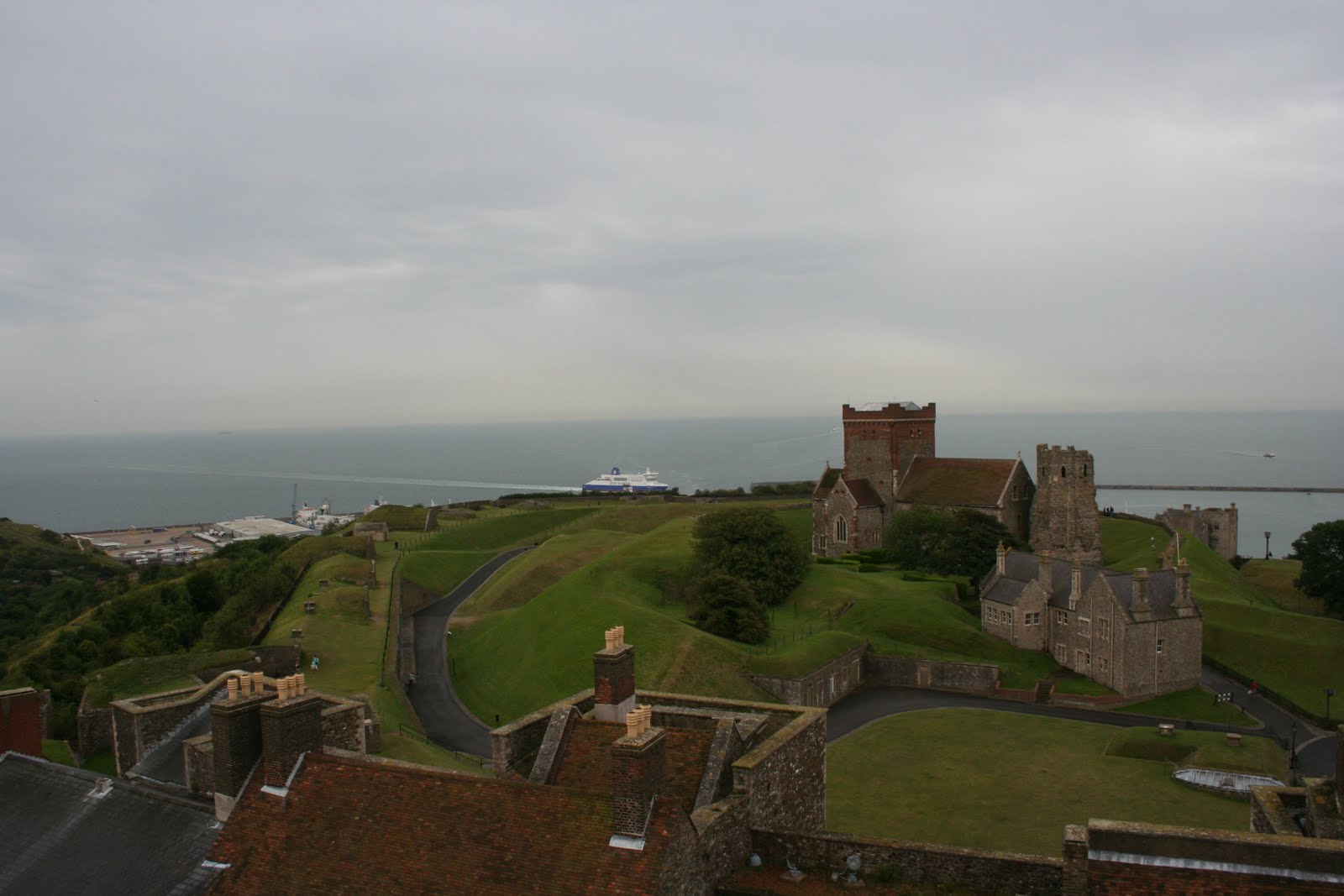
My time in London is coming to an end. Yesterday, I went to Dover. It was raining pretty much the whole time, which limited my picture taking, and probably my enthusiasm.
The keep part really does feel like a medieval castle in the fairy tale way. It's made up to look like it could be a 12th century movie set or something, yet it also feels emptyish. Unlike Windsor, it doesn't feel lively, and I missed that.
The best part was the Saxon church and the Roman lighthouse thing next to it. This picture's too bright, alas, but you can at least see brickwork and mosaic looking walls a bit. I don't know how much (if any) is original, but I'm pretty certain the wooden part isn't.
***
Today, I went to the Harry Potter platform thingy at King's Cross. There were signs all pointing to it, and a line, which meant I couldn't just get a clear shot.
Then I went to the Natural History Museum. It was a mistake. I used to love the local Natural History Museum when I was a kid, but the last time and this time, I just found all the taxidermed animals and birds utterly depressing. As I was there, looking at the stuffed birds, I remembered feeling the same way the last time I went to a natural history sort of museum, but I hadn't remembered it until then. I wish I hadn't gone; I kept thinking that I should have gone back to the Banqueting House or Pauls. The building is stunning in that Victorian over-embellished way.
As I left, though, I went to the butterfly house. For one thing, it was beautifully warm, which makes everything better. And for the other, the butterflies were beautiful, fluttering around all over the flowers and foliage. It was relaxing. Even the kids were quieter somehow.
Tomorrow, I head off to my next adventure. It's time. I'm pretty London'd out right now.
I think I've discovered to my disappointment that I'm not really a city person. Nor am I a rural person. I'm a suburban person, neither here nor there. The thing is, I don't like being a suburban person. But there it is.
Monday, August 22, 2011
A Couple of Things
I have one day left in London before I head off to the next adventure.
Any last minute suggestions? (I went to Dover today; I'll put some pictures up tomorrow, maybe. Too tired right now.)
What have I missed? If the weather's good, I may go walk around Hyde Park and such. If not, I'm thinking about the Natural History Museum. I love dinosaurs and such.
***
Stephen Fry is ubiquitous on TV here, it seems. I've seen him on quiz shows, an interview show, ads for a show on gadgets, and an episode of Jeeves. (As an aside, the quiz shows here are ... popular, different, smart, all at once.)
***
A while back, I talked about a colleague who'd had a serious stroke. I'm sad to say that my colleague has died. We're going to miss P so much in so many ways. P was one of the people whose institutional memory was helpful rather than not, who shared wisdom when asked, but didn't when not asked, and who contributed quietly as well as publicly.
I've been thinking a fair bit about P, since I found out that ze was just 65. Ze was just at retirement age, and that was the end. Ze hadn't (so far as I know) planned retiring soon, and now ze never will. I find that sad, but perhaps I shouldn't. Ze put a lot of self into the university and department.
Sunday, August 21, 2011
Stall N9 (10)
I went to Windsor Castle today. I texted the Queen so she'd know I was coming, but she didn't answer. I went anyway, and it was well worth the visit.
It's an impressive castle. It's almost fairy tale impressive. I went through the state rooms, which are impressive. I can't even imagine living a life where I went into those rooms as a participant (rather than as a tourist). (I'm much too uncomfortable with formality to think of such a life fondly.)
I went up to the Round Tower. As you walk up the entry stairs, you face straight into a 17th century canon that sticks through a hole in the wall. The idea was that if people were storming up, that canon would get off one shot as a deterent. It would deter me. The Round Tower, as you know if you've been there, isn't round any more because it was damaged during a seige and then by subsidence.
Windsor suffered two major seiges, both while occupied by John (once as prince, once as king). I was surprised to learn that it was controlled by parliamentary forces during the civil war.
I had a great day. When I was entering, the woman at the ticket counter figured out a way for me to be able to go on a Round Tower tour and a Kitchen Tour, even though I'd gotten there a bit late in the morning. Before the Tower tour, I went through the state rooms, and between the tours, I went through the moat garden, which is just beautiful. If I were a resident, I'd want to visit there every day (with good weather). It's unexpected, at least I didn't expect it, that there'd be this lovely gem of a garden right in the middle of this warish structure.
My Kitchen tour was scheduled for 4pm. When I went up, it turned out I was the only person who'd bought a ticket for that time, so I got a personal tour. It's fascinating. You get to go under St. George's Hall (which you get to see on the state rooms tour). St. George's Hall is near where the 1992 fire started, and which was seriously damaged in the fire. The guide showed me places where the stone walls were still drying out, even now. And he also told me about the area where we were, which had been mostly storage areas, semi-blocked up, before the fire, but which were restored to show the 14th and later walls and such, and made into this one beautiful room with vaulted ceiling, and corridors and such. In a way, the fire provided the impetus for some serious exploration of that area of the castle.
We also saw the main kitchen(s) used to prepare state meals when the Queen entertains heads of state and such. The main kitchen has this huge vaulted wooden ceiling, which was damaged by the fire. And the damage meant that archaeologists got to do the ring-dating on the wood, and discovered that the ceiling was built during the 14th century, and not later, as had been thought. It's utterly amazing to me that a ceiling built in the 14th century could still hold up after all this time. (There are still original timbers in use, where they could use them, and otherwise they put in new timbers.)
It was a great tour, with a wonderfully informative guide.
Since it was Sunday, the Chapel of St. George was closed except for services. So, as seems to be my habit, I stayed for evensong.
I went in, and we were seated in the Quire (choir) area, in the stalls of the Garter knights. How cool is that?
Before the service, I read some of the little metal plates at the back of my stall. I wrote down the few names I could make out.
Arthur Gray, Baron de Wilton, 1572
Thomas Howard, 1625
Robert, Conte de Lecester, 1559
If you look on this list of stall plates, you can tell that I was in Stall N9 (10).
Yes, so I was sitting in a stall associated with THAT Robert, Earl of Leicester. (I don't think the stall plates indicate that the stall was actually that knight's seat.)
I'm sort of clueless about garter symbolism. Most of the stalls had a big crest and such associated, with a helm thing (or crown) and such. But three (I think) that I counted on the far side had carvings of heads only. I don't know quite what that means. And several spots seemed "empty."
On my side, just down the way a bit, I recognized what I thought was the rising sun on a banner, which would be the banner of the Emperor of Japan (if I'm right about the banner and such).
And that was my day at Windsor. I didn't get to visit the various grave markers of Henry 8 or the others buried at the Garter Chapel, nor did I go to the mauseleum to visit Victoria and Albert.
Still, a pretty amazing day.
***
I've come to the apartment and am watching the television broadcast of the fall of Tripoli. Amazing. (Of course, we won't actually know how things work out yet. Still, amazing.)
Saturday, August 20, 2011
Self-Portrait (After Miro')
Guess where I went today! It was really fun and interesting.
After the special exhibition (hint in title), I had a snack. It was crowded, so I asked if I could share a table, and it was fine, so I did. I shared with a woman named Alison, who was delightful. We chatted a bit, and since one of her children just got into university (see, I left out the "the"!), she explained to me how the entry system works. It was great, and a fun chat.
There was an absolutely fantastic exhibit of works by Taryn Simon. Each piece included a series of portrait photos of single family members, grouped, with some blank spaces. And then to the right of that part was a list of the people, and then a couple paragraphs in small print explaining some aspect of the family grouping. To the right of that was a small collection of photos of related people or objects.
The idea is that each family group included ancestors and descendents of a person who's talked about in the central paragraphs (along with the rest of the family). So, for example, there's one series that records a family that has lost many members to violence in Serbia Herzogovena. A couple of the portrait photos in this case were a partial skeleton, and then two people were represented by a single tooth.
The photo stuff to the right of that included photos of a death squad killing some Muslim men.
Each family group took up a wall, basically, and it was fascinating putting them together by reading and looking at the pictures.
(If anyone wants to take a shot at my self portrait... go for it!)
Friday, August 19, 2011
I'm Clean!
Well, clean enough. I did spend the day in Bath, and I did try drinking some water, but I did not take a bath in Bath. The water tasted not great. I've tasted worse, but not happily.
I started out by going to the Jane Austen Centre. I want you to know that I hate Jane Austen, just to make that clear. I hate her for two reasons.
1. When I try to teach Austen, I sort of drool stupidly and just repeat, over and over, "isn't that amazing?" and "she's so good" and "isn't that funny?" As you might imagine, that doesn't go over terribly well with students.
2. She didn't write nearly enough. If she'd written just a couple more novels... wouldn't that be wonderful? (Yes, I've read the juvenalia, but seriously, if she'd written as many novels as Shakespeare did plays, what an orgasm of novel reading!)
The center was cheesy (they call her "Jane." Can you imagine a Marlowe center calling him "Chris"?) but also informative. I learned a lot about Austen's biography (I guess I never bothered with that part of the introduction of her novels). The center is just down the street from where she lived for a couple of months, so naturally, I walked up and took a picture of the door. I wasn't alone in that, either. There's some poor doctor whose door stars in a LOT of tourist pictures.
Then I walked to the Assembly Rooms, which feature in Northanger Abbey. (Have I mentioned how hilarious that novel is? Look, it's just...) Oddly enough, the ballroom is hosting an exhibit of award winning movie costumes. It made it sort of hard to get a real sense of the ballroom, but I got to see some fun costumes.
Here's a shot sort of around the costumes. The walls are a lovely light blue, and it's a beautiful space. But it wasn't as big as I would have expected from reading about the Assembly Rooms and all.
Here's the tea room, where all the people who've gone to the ball go to get snacks as 9pm. Supposedly, they served the snacks at that end, under the colonade area.
Look! It's the Roman Baths at Bath! Or, as they would have called the town, Aquae Sulis. (This blog is nothing if not educational!) This is the area called the Great Bath, and back when the Romans were in charge, they had a huge roof over the area, so (according to the guide thingy) the water wouldn't have been as green.
The baths weren't just a bath to get clean, but part of a whole temple complex. This gorgony looking figure was on part of the temple (I think), but aren't gorgons female? So maybe this is a Macbeth witch gorgon? I think I may be on to something here!
And this is the spring fed bath, which the Romans didn't bathe directly in, but the 17th and 18th c folks did. Supposedly, the water line
about midway up the columns was the 18th century level.
Here's a bath that's under the current road. The big modern columns hold up the road. Supposedly, they haven't done archaeology on the whole site, so there may be lots left to learn!
This was an absolutely fascinating place to visit, just amazing. But it felt like I'd visited three very different Baths!
And then when I got "home," I got off the train in Paddington Station to see this:
This is the Great Western Railway Paddington Band, which plays at Paddington Station every Friday from 7:30 to 9pm. How cool is that?
They handed out a flyer thing to explain about themselves, and in case you're interested, it says that "The Band is always looking for New Players. Even French Horn." And gives a number.
It also says that "There are no Rehersals as all Performances are Public Concerts." How's that for playing without a net?
Still, it was pretty cool to get off the plane and hear a band, and then walk forward and see one! (I thought for a bit that it was a flash mob thingy, but it's more a Victorian social leftover.
Thursday, August 18, 2011
Another Day, Another Amazing Day
First, let me say, I'm so tired of this cold. Bleargh. I don't get colds often, but I'm whiny as all get out when I do. WHINE!
When I went to see the plays at the Globe, I didn't go early enough to go through th exhibit and do the tour and all, so today my plan was to do that and then go to the Tate (very close). It seemed very do-able.
I took the tube (working on it!) to Southwark, and just as I was beginning to feel good and confident about finding my way around, I got good and lost. As those who've biked or driven with me will know, my sense of direction is so bad that if I say I think we should turn left, you can pretty much be sure we should be turning right.
I eventually found my way, and started reading the exhibition stuff while I waited for my tour. Then I went on the tour. It was GREAT!
Here you can see the heavens with the trap door open. Coolness!
We went up into the second gallery, so I got a different view of the theater and stage. This time the stage is set up for Much Ado, which was the matinee.
And look what's there above. I couldn't see this from where I was standing, but from the gallery, you can see the space above. The tour guide talked about making music and sound effects and such up there.
And here's a picture of the seating in the gallery.
So that was pretty good, and I was well-satisfied. I checked, but the performance was sold out, alas. Then I went to the exhibit, which is really good. It's informative and interesting, and has facsimiles of Henslowe's diary and such. It also talked about the Rose, and mentioned a tour in a way that made it sound possible. In the time I'd been in the exhibit, it had started raining pretty well.
Now, I'd read my guidebook, and it said there were occasionally tours, but they had to be done by special arrangement, and made it sound really difficult. But I decided to ask anyway. The tour guide who'd led my tour of the Globe was there, and said that she was scheduled to give the tour, but no one had asked. She seemed a little unwilling, and I would have been willing to let it go, but then she said she'd be glad to take me.
And so she did.
In case you weren't aware, in the 80s, a building that had been built on the site in the 50s was torn down, and because the law had been changed to give archaeologists a shot at any site likely to be interesting, and this one was very likely. So they did an archaeological dig and found the foundation structures for two stages and an outer and inner wall, which is pretty darned amazing. It taught theater history folks a lot about sizes and so on, things we couldn't necessarily tell from the few pictures and stuff we have.
Then, in an amazing compromise, the new building was built over the site, but with an area below that preserves the site. It's now got water on it, to keep it from drying out and degrading, so in order to see it, you have to turn on special lights. The light strings show where the old and newer stages were, and where the outer walls were.
Here, you're looking at the stage on your right. The smaller stage (the line on the right) is the later stage, which allowed more groundlings in the audience. The line to the left is the older stage, which was evidently taken out and replaced by the newer one.
And the outer line is the outer line of the audience area and outside that, the outer edge of the building.
Here's a slightly different view.
It was extraordinary to get to go there and see what's there. There's hope that someday, the Globe Trust will be able to develop the area and complete the archaeology, and make it into a better educational site. Meanwhile, I felt so lucky to be able to go in and see it and learn about it.
I never did make it to the Tate today.
***
In other news today, I really, really don't understand how university applications and admissions work here, not at all. Today was the day that students found out their A level grades, and so found out if they got in where they thought they might if their grades were good enough, or not, or if they basically have to scramble to try to get a spot in a program. It seems extra complicated because students enter having declared a course of study (a major, more or less), and it's not easy to change. There is much discussion on the news about difficulties, since a lot of students who might have taken a gap year chose to apply this year because next year tuition will be going up hugely. Or something like that.
Subscribe to:
Posts (Atom)