We're having discussions these days about how we can give our students "integrative learning"* experiences. One model, of course, has instructors from two fields working together on some level to show how two fields speak to each other, think about a common issue, etc. That can be an expensive proposition if we're thinking of two instructors team teaching or coordinating two small classes. And expensive isn't something that happens here, especially of late.
Another model has one instructor doing something "integrative" in a given course. That's cheap, because the school only has to pay one person.
And, of course, cheap is where we're aiming.
Yesterday, I was at a meeting where a faculty member suggested that since Leonardo had demonstrated expertise in all sorts of fields, we should be able to, too. She also suggested that she'd had a professor once who talked all about the relationship between Shakespeare and Delacroix, and how influential that professor had been on her own learning.
You may be thinking that I was extraordinarily polite in not interrupting to say that Shakespeare and Delacroix couldn't have had a relationship unless Shakespeare had come back from the dead, but mostly I wasn't able to understand what she said well (I have difficulty with her accent; I know this is my failing, so I keep my mouth shut).
I think learning to think in different ways, thinking creatively, and certainly understanding different fields is really important. I'm guessing I've taken more in depth courses in vastly different fields than most of my colleagues. But I also know how well I know my own field, and how little and outdated my knowledge of other fields is.
And I greatly respect other peoples' knowledge.
Now, English lit folks are notoriously unchaste when it comes to dabbling all over. We read psych, anthro, history, you name it. But we don't read in those fields the way experts in the fields do, nor do we read the same things, nor do we keep up in the field. We still teach Freud, for gosh sakes. Seriously, the last time anyone in Psych actually took Freud seriously was sometime around 1953, wasn't it? We still read Levi-Strauss as though he's the latest, coolest thing. And that's sort of okay, so long as we think about what we're doing in terms of teaching literature, perhaps. But if we think we have anything useful to say about thinking in the field of psychology or anthropology, we're probably wrong.
And imagining that we faculty folks here at a regional comprehensive university can somehow reproduce the multi-disciplinary learning of one of the top 10 or so minds in western Europe in the past thousand years? Well, I'm sure as heck not there.
I'm frustrated, too, because some of these folks talk about how exciting and liberating it is to teach all these wonderful new courses, and I can't think of much more exciting and liberating course to teach than Shakespeare, or Chaucer, or a seminar on early modern left earlobe studies. And then I secretly feel sorry for them that they don't get to teach Shakespeare and stuff, and don't seem to be endlessly amazed and fascinated by the stuff they do teach. Shhhhh. Don't tell or they'll all decide they're expert enough to teach Shakespeare and how Hamlet is all about the Oedipal.
* "Integrative learning" is the latest catchphrase here, along with "operational outcomes" or something. It's a way of trying to talk about interdisciplinary and multidisciplinary and just two or more fields of study somehow having something to do with each other without actually carefully thinking about how or what we're talking about.
Friday, April 20, 2012


Thursday, April 19, 2012
Teaching Comp Frustrations
My writing students are working on a big essay. It's a pretty good chunk of their grade and we've spent a good amount of time on it in class, brainstorming, bubble-mapping, talking about sources, and so on. They peer edited together yesterday, so today we worked with their peer editing responses to improve the papers. And then we worked on some other improvement stuff.
For example, I asked everyone to go through their essay and note when they'd used someone else's idea(s) or word(s) by marking in the margin. Then I asked them to check for each one that they'd introduced it appropriately and that it was in the works cited section (and to put a check by it there). Then they could see that everything in the works cited section actually had been cited in the paper easily, and they'd made sure they'd introduced sources well.
Good, right?
The thing is, the people who've written really strong drafts and who've cited sources have a lot to check, and it takes them a while to check stuff, revise source introductions and such. So they're busy.
The people who haven't done a strong draft look at their two or three pages and finish in a moment or two. Then they sit in the room looking bored. Because they don't have as much to check, they seem to think that they've got no more work to do. And mostly, they're likely to be wrong.
I can't seem to figure out how to warn them effectively with a general statement about people with fuller drafts taking longer, and those who finish quickly might have more to do overall. And making a more specific statement seems like I'm picking on them.
For example, I asked everyone to go through their essay and note when they'd used someone else's idea(s) or word(s) by marking in the margin. Then I asked them to check for each one that they'd introduced it appropriately and that it was in the works cited section (and to put a check by it there). Then they could see that everything in the works cited section actually had been cited in the paper easily, and they'd made sure they'd introduced sources well.
Good, right?
The thing is, the people who've written really strong drafts and who've cited sources have a lot to check, and it takes them a while to check stuff, revise source introductions and such. So they're busy.
The people who haven't done a strong draft look at their two or three pages and finish in a moment or two. Then they sit in the room looking bored. Because they don't have as much to check, they seem to think that they've got no more work to do. And mostly, they're likely to be wrong.
I can't seem to figure out how to warn them effectively with a general statement about people with fuller drafts taking longer, and those who finish quickly might have more to do overall. And making a more specific statement seems like I'm picking on them.
Wednesday, April 18, 2012
Kerfluffle
Wow, sometimes stuff comes out of someone over at the fort that sets us all in a kerfluffle, and that happened today.
I was mostly busy trying desperately to finish grading a stack, but I was just as happy not to worry too much about the stuff I can't do much about.
Interesting times around here. Wish us well.
I was mostly busy trying desperately to finish grading a stack, but I was just as happy not to worry too much about the stuff I can't do much about.
Interesting times around here. Wish us well.
Monday, April 16, 2012
Ugh
This cold sucks. What's stupid, of course, is that it's a little cold, probably not even all that bad as a cold, and certainly something like one tenth of a percent as bad as being really, seriously sick.
I haven't slept a whole night in over a week.
Remember the movie Alien, when the alien comes out of the guy's chest? Yeah, I feel like the alien is up my nose. And not in a good way.
My niece mentioned that whooping cough is going around her school (not at all near me), so I started googling symptoms of whooping cough. I don't think I have it, and I sure hope I don't, because 4-6 weeks of this (only worse) would be truly miserable.
I'd love to crawl back into bed, except I wouldn't actually sleep, and it wouldn't make me better (or I would have gotten better over the weekend when that's pretty much what I did with my life). I am trying to be really careful not to share my germs.
I haven't slept a whole night in over a week.
Remember the movie Alien, when the alien comes out of the guy's chest? Yeah, I feel like the alien is up my nose. And not in a good way.
My niece mentioned that whooping cough is going around her school (not at all near me), so I started googling symptoms of whooping cough. I don't think I have it, and I sure hope I don't, because 4-6 weeks of this (only worse) would be truly miserable.
I'd love to crawl back into bed, except I wouldn't actually sleep, and it wouldn't make me better (or I would have gotten better over the weekend when that's pretty much what I did with my life). I am trying to be really careful not to share my germs.
Friday, April 13, 2012
That Time of the Semester Thou Mayst in Me Behold
My office is a mess. I get cranky when my office is a mess, and need to take some time and clean it up.
Mostly it's a mess because there are stacks of books that I've used or referred to but not reshelved appropriately. And it's time. I've also gotten a few new books that need to find their proper place.
Then there are stacks of papers, revisions, research stuff, committee work. I have a bad stacking habit. The thing is, when something I stack will get done and moved on (for example, a stack of papers gets graded, recorded, and handed back), then the temporarly stack isn't a problem. It's the stacks that stick around for very long that are a problem.
This weekend's task list looks like this:
1 big stack for my seminar
1 smallish stack of revisions
1 smallish stack for my seminar
1 play to read for the first time every (I know! What was I thinking?)
Prep that same play for discussion
I've got an idea for a paper, but it's out of my usual comfort zone. Still, it's an idea. I went to the library yesterday and got a couple of books by the same author whose one text I want to look at. I'm going to read through them, just to make sure I'm familiar with what the author's written, and to check if there's something similar happening in these other works that should be included in my argument. Fortunately, these works don't involve learning a new language or anything. And the writer is pretty readable.
Oddly, this writer reminds me in some ways of a blogger whose work I enjoy (but who isn't on my sidebar, though maybe I should add the blogger?). Except I find the blogger more successful as a writer, though the blogger isn't a professional writer in the same way.
It looks like a good weekend ahead. It may rain, in which case I won't mow. And there's a bike race on (Amstel Gold), and I think I'll be able to watch a live feed of it if I get up early on Sunday.
Mostly it's a mess because there are stacks of books that I've used or referred to but not reshelved appropriately. And it's time. I've also gotten a few new books that need to find their proper place.
Then there are stacks of papers, revisions, research stuff, committee work. I have a bad stacking habit. The thing is, when something I stack will get done and moved on (for example, a stack of papers gets graded, recorded, and handed back), then the temporarly stack isn't a problem. It's the stacks that stick around for very long that are a problem.
This weekend's task list looks like this:
1 big stack for my seminar
1 smallish stack of revisions
1 smallish stack for my seminar
1 play to read for the first time every (I know! What was I thinking?)
Prep that same play for discussion
I've got an idea for a paper, but it's out of my usual comfort zone. Still, it's an idea. I went to the library yesterday and got a couple of books by the same author whose one text I want to look at. I'm going to read through them, just to make sure I'm familiar with what the author's written, and to check if there's something similar happening in these other works that should be included in my argument. Fortunately, these works don't involve learning a new language or anything. And the writer is pretty readable.
Oddly, this writer reminds me in some ways of a blogger whose work I enjoy (but who isn't on my sidebar, though maybe I should add the blogger?). Except I find the blogger more successful as a writer, though the blogger isn't a professional writer in the same way.
It looks like a good weekend ahead. It may rain, in which case I won't mow. And there's a bike race on (Amstel Gold), and I think I'll be able to watch a live feed of it if I get up early on Sunday.
Wednesday, April 11, 2012
If you Give a House a Repair
Do you know those kids' books, If You Give a Moose a Muffin and If You Give a Mouse a Cookie?
If not, what you need to know is that if you give a moose a muffin, then he'll want something else, and if you give him the something else, then he'll want something more, and if you give him the something more, then he'll want another thing, and if you give him other thing, then he'll want yet another thing, and so on. It's like the old for want of a nail the horse was lost thing, except it's backwards; that is, the thread isn't about lack, but about having/getting something, and that causing further desire.
My house is feeling like that lately:
I have a deck, but it has problems, so I asked the handyman to come look at it and think of some ideas, and so on. He did. And while he was doing that, he noticed (quite rightly), that the roof is in really bad shape.
So I called the roofing contractor, who came out (well, a couple of them) to give me an estimate, and said that yes, the roof really IS in bad shape (and showed me pictures from up there), and said that when you're having roofing done, it's an ideal time to have an energy audit, and then you can hire someone to add insulation.
So I called the energy audit guy, and he did the audit, which was pretty disappointing (but his toys made me oh so jealous! I love the infrared reader thingy!) because my house loses heat badly.
So when I get his report, I need to call an insulation contractor and have them do a proposal to do the work that's most cost effective for the roofing portion, and so on. (Some things are more cost effective for heating and cooling than others.)
But, the energy audit guy had to turn off the furnace to do the energy audit thing (because they suck air out of the house with a fan and then can tell where more cold air is entering from outside or moving around inside). And when he turned the furnace back on, it didn't come on.
So then I had to call the furnace company and ask them to send someone out. And he came, and then the furnace was more or less working, so he serviced it, and gently reminded me that I needed to change the filter, too, and also get the air conditioning serviced once it's warm enough outside.
So then I went to the store to get a filter, and remembered also that a number of people (including the energy audit guy and some friends) have told me that it's not too hard to put in a programmable thermostat, and if I do, it will be more efficient.
So I bought a programmable thermostat at the store.
And now I need to either woman up and put it in myself (which means turning off electricity somewhere, mostly, and doesn't look all that hard), or call and ask the handyman to come put it in for me.
And that's how getting ready to get an outside deck repaired can lead to a probable hospitalization for electrocuting myself. Or not. I really hope not. Remind me to get a really small screwdriver, though!
If not, what you need to know is that if you give a moose a muffin, then he'll want something else, and if you give him the something else, then he'll want something more, and if you give him the something more, then he'll want another thing, and if you give him other thing, then he'll want yet another thing, and so on. It's like the old for want of a nail the horse was lost thing, except it's backwards; that is, the thread isn't about lack, but about having/getting something, and that causing further desire.
My house is feeling like that lately:
I have a deck, but it has problems, so I asked the handyman to come look at it and think of some ideas, and so on. He did. And while he was doing that, he noticed (quite rightly), that the roof is in really bad shape.
So I called the roofing contractor, who came out (well, a couple of them) to give me an estimate, and said that yes, the roof really IS in bad shape (and showed me pictures from up there), and said that when you're having roofing done, it's an ideal time to have an energy audit, and then you can hire someone to add insulation.
So I called the energy audit guy, and he did the audit, which was pretty disappointing (but his toys made me oh so jealous! I love the infrared reader thingy!) because my house loses heat badly.
So when I get his report, I need to call an insulation contractor and have them do a proposal to do the work that's most cost effective for the roofing portion, and so on. (Some things are more cost effective for heating and cooling than others.)
But, the energy audit guy had to turn off the furnace to do the energy audit thing (because they suck air out of the house with a fan and then can tell where more cold air is entering from outside or moving around inside). And when he turned the furnace back on, it didn't come on.
So then I had to call the furnace company and ask them to send someone out. And he came, and then the furnace was more or less working, so he serviced it, and gently reminded me that I needed to change the filter, too, and also get the air conditioning serviced once it's warm enough outside.
So then I went to the store to get a filter, and remembered also that a number of people (including the energy audit guy and some friends) have told me that it's not too hard to put in a programmable thermostat, and if I do, it will be more efficient.
So I bought a programmable thermostat at the store.
And now I need to either woman up and put it in myself (which means turning off electricity somewhere, mostly, and doesn't look all that hard), or call and ask the handyman to come put it in for me.
And that's how getting ready to get an outside deck repaired can lead to a probable hospitalization for electrocuting myself. Or not. I really hope not. Remind me to get a really small screwdriver, though!
Tuesday, April 10, 2012
Two Random Things, Unrelated So Far As I Can Tell
I missed the Paris-Roubaix bike race (on TV, as well as in person) this Sunday because I was travelling. But I did get to read a bit later, and see some pictures, too. What I noticed is that Tom Boonen (who won the race) wasn't wearing gloves the whole time. A couple weeks ago, looking at pictures from the Tirreno-Adriatico race, I noticed that Chris Horner wasn't wearing gloves (at least in the time trial portion), either.
I wonder why not? (And especially, I wonder why not on cobblestones, where falls seem more likely, and where I'd imagine a tiny bit more padding would be welcome.)
(It sounded like a great day for Boonen, too! From television and such, he's a very likeable biker, so I was rooting for him in the absence of Fabian Cancellara.)
***
Sunday morning, I set the alarm on my ipod thingy for 5:45 so that I could get showered, packed, and dressed to get into a taxi by 6:10 to get to the airport for my flight at 7:45. Unfortunately, I hadn't changed the time zone setting on the ipod, so it was an hour behind the eastern time zone.
Uh oh, you're thinking.
Only not. I woke up and went to use the bathroom, and on the way back to bed, I looked at the room clock, and saw that it was 5:50. And then I thought, shouldn't my alarm have gone off? So I looked at the ipod, and it said it was 4:50. And I looked at the room thing, and then looked at my phone, which said 5:52. And finally, I realized the time zone thing and got my rear in gear.
How lucky was I to 1) need to use the bathroom, and 2) look at the room clock rather than my ipod? I'll count that as very lucky.
When I got to the airport, I asked and was let off at US Airways, because that's who had sold me the flight I was on. But it wouldn't let me check in. Finally, one of the service folks there pointed out that while US Airways had sold me the flight, it was actually a United flight, and I needed to go to the United area to check in. And that was a ten minute walk. Fortunately, I had plenty of time.
But again, how lucky was I that I wasn't already an hour behind? Very!
Some days, I feel like I'm in one of those Buster Keaton movies where the wall comes down but he ends up with the glassless window area coming safely around him.
I wonder why not? (And especially, I wonder why not on cobblestones, where falls seem more likely, and where I'd imagine a tiny bit more padding would be welcome.)
(It sounded like a great day for Boonen, too! From television and such, he's a very likeable biker, so I was rooting for him in the absence of Fabian Cancellara.)
***
Sunday morning, I set the alarm on my ipod thingy for 5:45 so that I could get showered, packed, and dressed to get into a taxi by 6:10 to get to the airport for my flight at 7:45. Unfortunately, I hadn't changed the time zone setting on the ipod, so it was an hour behind the eastern time zone.
Uh oh, you're thinking.
Only not. I woke up and went to use the bathroom, and on the way back to bed, I looked at the room clock, and saw that it was 5:50. And then I thought, shouldn't my alarm have gone off? So I looked at the ipod, and it said it was 4:50. And I looked at the room thing, and then looked at my phone, which said 5:52. And finally, I realized the time zone thing and got my rear in gear.
How lucky was I to 1) need to use the bathroom, and 2) look at the room clock rather than my ipod? I'll count that as very lucky.
When I got to the airport, I asked and was let off at US Airways, because that's who had sold me the flight I was on. But it wouldn't let me check in. Finally, one of the service folks there pointed out that while US Airways had sold me the flight, it was actually a United flight, and I needed to go to the United area to check in. And that was a ten minute walk. Fortunately, I had plenty of time.
But again, how lucky was I that I wasn't already an hour behind? Very!
Some days, I feel like I'm in one of those Buster Keaton movies where the wall comes down but he ends up with the glassless window area coming safely around him.
Sunday, April 08, 2012
Observations from SAA
I had a good time, heard a couple of really interesting papers, and got to see some friends (the best part, to be honest). My seminar was run well and had a good discussion.
I felt like I noticed a few things, and checked with someone else, who thought maybe to one, and yes to the other.
1) People from my generation were there in relatively low numbers compared to the people 10+ years ahead of us, or 10 years behind us. Maybe folks my age are mid-career and what with the holiday and such, didn't come? Or they've moved into administrative stuff? Or we're just in lower numbers?
2) When I first went to SAA, there was a fairly strong and visible group of African American scholars. I saw none of that group, and few African American scholars overall compared to those years. I'm not sure what's happened or happening.
3) Looking over the crowd, it seemed very male, and not only older men. There were several men who looked like they were posing as enfant terrible types, right down to the pony-tail.
4) There was an anime conference going on at the same hotel with the Shakespeare conference, and the two crowds were very different. It was really odd seeing someone in anime costume walk through the Shakespeare crowd. (The Shakespeare crowd, we like to think we're among the edgier folks in the English department, but we looked very staid compared to the anime crowd.) Thus, the enfant terrible men looked like real posers in comparison.
(Do women ever get the cache of being the enfant terrible, with the combination of admiration, exaltation, and admonishment from the good old boys, or does a woman just get the criticism?)
And a related observation: I caught a cold. I could feel it coming on last night, and it's been getting worse. Blah. It's amazing how something relatively as innocuous as a cold can make you feel lousy.
I rode back on the shuttle with a man who was way more revealing of his private life than I was quite comfortable with. And he had that too wide eyed look that some people have.
I felt like I noticed a few things, and checked with someone else, who thought maybe to one, and yes to the other.
1) People from my generation were there in relatively low numbers compared to the people 10+ years ahead of us, or 10 years behind us. Maybe folks my age are mid-career and what with the holiday and such, didn't come? Or they've moved into administrative stuff? Or we're just in lower numbers?
2) When I first went to SAA, there was a fairly strong and visible group of African American scholars. I saw none of that group, and few African American scholars overall compared to those years. I'm not sure what's happened or happening.
3) Looking over the crowd, it seemed very male, and not only older men. There were several men who looked like they were posing as enfant terrible types, right down to the pony-tail.
4) There was an anime conference going on at the same hotel with the Shakespeare conference, and the two crowds were very different. It was really odd seeing someone in anime costume walk through the Shakespeare crowd. (The Shakespeare crowd, we like to think we're among the edgier folks in the English department, but we looked very staid compared to the anime crowd.) Thus, the enfant terrible men looked like real posers in comparison.
(Do women ever get the cache of being the enfant terrible, with the combination of admiration, exaltation, and admonishment from the good old boys, or does a woman just get the criticism?)
And a related observation: I caught a cold. I could feel it coming on last night, and it's been getting worse. Blah. It's amazing how something relatively as innocuous as a cold can make you feel lousy.
I rode back on the shuttle with a man who was way more revealing of his private life than I was quite comfortable with. And he had that too wide eyed look that some people have.
Friday, April 06, 2012
Conferencing
I made it, some 11 hours after I got on the shuttle. My second plane was delayed, and it meant my afternoon conference plans didn't work out.
I did have a lovely dinner with a friend, which was great in every way except it made me wish we lived closer!
I did have a lovely dinner with a friend, which was great in every way except it made me wish we lived closer!
Thursday, April 05, 2012
Packing
I'm packing to go to SAA tomorrow. It's the first really short weekend packing I've done since I was in England going away most weekends, and it's weird.
For one thing, I have to be at the shuttle pick up at the rather brutal hour of 4am, so I have to leave home by 3:30. So I'm heading to bed shortly to try to sleep some.
I usually enjoy SAA, and I'm sure I will once I'm there, but I'm just tird now and not feeling the joy much, except when I think about getting together with a friend from grad school, one of those really good, really special people I don't get to see very often.
Let's compare:
England: Get a taxi or take the shuttle to the train, take the train for 2-3 hours, be somewhere great!
Here: Drive to the shuttle, take the shuttle for an hour and a half to an airport, get on a plane for a while to a stopover place, get on another plane for a longer while, be somewhere great! But not somewhere with a shambles, castle, Roman ruins, or really dead folks to visit.
Okay, time for bed, and then jetting off to a conference!
ps. I rode my bike today, and went up a hill that's about a mile and not too hard, and it was so good (not fast, mind, but good).
For one thing, I have to be at the shuttle pick up at the rather brutal hour of 4am, so I have to leave home by 3:30. So I'm heading to bed shortly to try to sleep some.
I usually enjoy SAA, and I'm sure I will once I'm there, but I'm just tird now and not feeling the joy much, except when I think about getting together with a friend from grad school, one of those really good, really special people I don't get to see very often.
Let's compare:
England: Get a taxi or take the shuttle to the train, take the train for 2-3 hours, be somewhere great!
Here: Drive to the shuttle, take the shuttle for an hour and a half to an airport, get on a plane for a while to a stopover place, get on another plane for a longer while, be somewhere great! But not somewhere with a shambles, castle, Roman ruins, or really dead folks to visit.
Okay, time for bed, and then jetting off to a conference!
ps. I rode my bike today, and went up a hill that's about a mile and not too hard, and it was so good (not fast, mind, but good).
Wednesday, April 04, 2012
Local Election, Part the Second
The election results were put up on the county site last night, and the local school board results were circulated among folks I know this morning. There was a lot of discussion among some folks I know about that election, and it went the way my crowd was hoping.
This wasn't just a school board and county supervisor election, though. It was also used for the primaries. But I went for the local stuff because I was among those who were worried by some of the school board candidates. In fact, some folks in my crowd made a big effort to "get out the vote" because they worried that a lot of Republicans would turn out to vote for that primary and then also vote in the school board election for the "tea party" type candidates, and Democrats wouldn't turn out because we didn't have a primary to vote in and thus the less "tea party" candidates for school board wouldn't get elected.
So imagine my surprise when I realized that I could also vote on the primary. Not only that, but I could vote in the primary for any of the candidates, Republican or Democratic, or even write in a candidate. (I didn't vote in the previous primary because I was out of the country and didn't make arrangements in time, and before that, I don't remember if I did or not.)
This morning, I was interested to see how things came out, and a bit surprised. For example, in the primary races, Barack Obama got more votes than any other candidate. But added together, the Republican candidates got about twice as many votes as he did. I'd guess that means a fair number of Democrats turned out and voted in the Democratic primary, even though Obama was running unopposed. On the other hand, some Republicans coud have voted for Obama, and I know at least one Democrat who voted for one of the Republican candidates just to mix things up (or something).
For the school board races, the two non "tea party" candidates got more votes each than Barack Obama did. (You could vote for two candidates in the race, so the information to be gleaned from that is limited, but since each of those candidates got more votes, that means that it wasn't just a matter of the same people voting for those two candidates as voted for Obama, if that makes sense.)
That suggests that some people voted in the school board election who didn't vote in the primary, or voted for a Republican candidate in the national primary but for a non "tea party" candidate locally.
(The candidates I've characterized as "tea party" seem fairly extreme to me, and I could easily imagine someone who's a moderate Republican choosing one of the other candidates.)
My car repair guy got re-elected (in another county district).
This wasn't just a school board and county supervisor election, though. It was also used for the primaries. But I went for the local stuff because I was among those who were worried by some of the school board candidates. In fact, some folks in my crowd made a big effort to "get out the vote" because they worried that a lot of Republicans would turn out to vote for that primary and then also vote in the school board election for the "tea party" type candidates, and Democrats wouldn't turn out because we didn't have a primary to vote in and thus the less "tea party" candidates for school board wouldn't get elected.
So imagine my surprise when I realized that I could also vote on the primary. Not only that, but I could vote in the primary for any of the candidates, Republican or Democratic, or even write in a candidate. (I didn't vote in the previous primary because I was out of the country and didn't make arrangements in time, and before that, I don't remember if I did or not.)
This morning, I was interested to see how things came out, and a bit surprised. For example, in the primary races, Barack Obama got more votes than any other candidate. But added together, the Republican candidates got about twice as many votes as he did. I'd guess that means a fair number of Democrats turned out and voted in the Democratic primary, even though Obama was running unopposed. On the other hand, some Republicans coud have voted for Obama, and I know at least one Democrat who voted for one of the Republican candidates just to mix things up (or something).
For the school board races, the two non "tea party" candidates got more votes each than Barack Obama did. (You could vote for two candidates in the race, so the information to be gleaned from that is limited, but since each of those candidates got more votes, that means that it wasn't just a matter of the same people voting for those two candidates as voted for Obama, if that makes sense.)
That suggests that some people voted in the school board election who didn't vote in the primary, or voted for a Republican candidate in the national primary but for a non "tea party" candidate locally.
(The candidates I've characterized as "tea party" seem fairly extreme to me, and I could easily imagine someone who's a moderate Republican choosing one of the other candidates.)
My car repair guy got re-elected (in another county district).
Monday, April 02, 2012
Local Elections
There's an election tomorrow; for me, there's a county supervisor seat and school board seats to decide about. And there are clear splits between candidates.
The school board part is fairly easy to find information about. But the county supervisor part isn't. I went to the county site, and tried to figure out who my representative is. Finally, I found a map of the area split into supervisor districts, and made it big enough to find my street (which is near an edge). Then it was a matter of figuring out who the supervisor for the district is. But then there's the redistricting question, and I can't quite figure it out. It looks like the person who's my current supervisor has been redistricted into another area. But the newspaper doesn't say anything about my district as it shows on the current map.
So, is the current map the map that the election uses, or does the election use a new map that I can't find?
It really shouldn't take this much work to figure out a basic local election.
When I look at the pictures of the local supervisors, I have to say, the pictures mostly aren't flattering. I recognized a couple of the people I know around town, which was sort of cool in that small community way. But I didn't recognize the person supposedly representing my district.
(Now ask me how much time I spent looking at the satelite view of my community spaces! A lot.)
The school board part is fairly easy to find information about. But the county supervisor part isn't. I went to the county site, and tried to figure out who my representative is. Finally, I found a map of the area split into supervisor districts, and made it big enough to find my street (which is near an edge). Then it was a matter of figuring out who the supervisor for the district is. But then there's the redistricting question, and I can't quite figure it out. It looks like the person who's my current supervisor has been redistricted into another area. But the newspaper doesn't say anything about my district as it shows on the current map.
So, is the current map the map that the election uses, or does the election use a new map that I can't find?
It really shouldn't take this much work to figure out a basic local election.
When I look at the pictures of the local supervisors, I have to say, the pictures mostly aren't flattering. I recognized a couple of the people I know around town, which was sort of cool in that small community way. But I didn't recognize the person supposedly representing my district.
(Now ask me how much time I spent looking at the satelite view of my community spaces! A lot.)
Friday, March 30, 2012
Do Overs
This teaching gig is difficult at times. One of the little day to day difficulties is what I call the "do-over." Students hand in an assignment, and you grade it, record the grade, and hand it back, and one (or more) of the students wants a "do-over" so that they can hand it in again, and you can grade it again, and record it again, replacing the original grade.
There's certainly a place for revision in teaching at all levels. There has to be a way to try something, not get it right, try again, and maybe again and again, each time trying to get it better.
That's a really important part of the learning process. I build revision time into many assignments, both before the assignment is graded by doing peer editing (and meeting with students who come to office hours or make an appointment) and sometimes after (when I encourage first year writing class students to revise).
I also build in a different sort of revision by asking students to do small, low stakes assignments in a series. They don't do any one assignment more than once, but they write, say, ten journals over the semester, for a total of 10% of the grade overall; thus they can mess up a bit and figure out what's expected, and then do better as they learn (or get in the habit) to develop ideas more fully and write more fully.
There are also times when a "do-over" isn't appropriate, though. I don't let students "do-over" midterms, for example, or a number of other assignments. (And students don't tend to ask for "do-overs" of midterms.")
I get frustrated, though, when students expect a "do-over" of something that doesn't seem appropriate. That happened today. And then, when I'm frustrated, I blog.
Do students today expect more "do-overs" than students in my generation? (I have no idea, obviously, because I only knew what I was expecting as far as "do-overs" in my generation, and I was too afraid of professors to ask content questions, much less for a "do-over.")
When do you think a "do-over" is most helpful/approriate for student learning?
When not?
To what extent do student requests for "do-overs" come up against not pedagogical resistance but re-grading issues?
There's certainly a place for revision in teaching at all levels. There has to be a way to try something, not get it right, try again, and maybe again and again, each time trying to get it better.
That's a really important part of the learning process. I build revision time into many assignments, both before the assignment is graded by doing peer editing (and meeting with students who come to office hours or make an appointment) and sometimes after (when I encourage first year writing class students to revise).
I also build in a different sort of revision by asking students to do small, low stakes assignments in a series. They don't do any one assignment more than once, but they write, say, ten journals over the semester, for a total of 10% of the grade overall; thus they can mess up a bit and figure out what's expected, and then do better as they learn (or get in the habit) to develop ideas more fully and write more fully.
There are also times when a "do-over" isn't appropriate, though. I don't let students "do-over" midterms, for example, or a number of other assignments. (And students don't tend to ask for "do-overs" of midterms.")
I get frustrated, though, when students expect a "do-over" of something that doesn't seem appropriate. That happened today. And then, when I'm frustrated, I blog.
Do students today expect more "do-overs" than students in my generation? (I have no idea, obviously, because I only knew what I was expecting as far as "do-overs" in my generation, and I was too afraid of professors to ask content questions, much less for a "do-over.")
When do you think a "do-over" is most helpful/approriate for student learning?
When not?
To what extent do student requests for "do-overs" come up against not pedagogical resistance but re-grading issues?
Thursday, March 29, 2012
On the Margin
A student asked me yesterday (while I was handing back papers and such in the few minutes before class) how many grandchildren I have.
That struck me as out of the blue, and vaguely inappropriate. Mostly, weird.
Partly, it's that I don't think of myself as grandparent age, but my grandparents were already grandparents at my age, and it's not at all out of the ordinary to be a grandparent at my age. Still, I don't think of myself that way. Nor do I tend to think of my colleagues that way. So weird.
Partly it's that questions about one's reproductive status seem at least marginally inappropriate in a professional setting. On the other hand, folks who have children do use those children for examples and such, or for chit chat, and I don't think that's inappropriate.
This student is often marginally inappropriate. Stu has relatively little verbal self-control and often seems to talk before zie really thinks.
Stu also tends to want me to chat when I'm handing back papers, though I've told hir that I actually can't both chat and hand back papers. (I can't look at names, walk over to the person, give hir a paper, and then look at the next name and do the same while chatting. I'm sure some people can, but I can't.)
***
Speaking of verbal self-control: students in one of my classes are doing presentations, and several students just (either with or without raising their hands to start) interrupt to ask a question, often only marginally related. It bothers me when this happens, but I usually answer the question and move on, because the time spent talking about how unhelpful it is to be interrupted would make the interruption way worse (and be seen as mean by the students).
But today I talked a bit about it between presentations. And then someone interrupted the next time anyway.
It's like some students just get an idea and instantly, right this very instant, someone else needs to hear about it and respond! NOW!
It's not all students, of course, or even the majority, but the ones who do it really stand out.
Get offa my lawn! (/old fogey voice off)
That struck me as out of the blue, and vaguely inappropriate. Mostly, weird.
Partly, it's that I don't think of myself as grandparent age, but my grandparents were already grandparents at my age, and it's not at all out of the ordinary to be a grandparent at my age. Still, I don't think of myself that way. Nor do I tend to think of my colleagues that way. So weird.
Partly it's that questions about one's reproductive status seem at least marginally inappropriate in a professional setting. On the other hand, folks who have children do use those children for examples and such, or for chit chat, and I don't think that's inappropriate.
This student is often marginally inappropriate. Stu has relatively little verbal self-control and often seems to talk before zie really thinks.
Stu also tends to want me to chat when I'm handing back papers, though I've told hir that I actually can't both chat and hand back papers. (I can't look at names, walk over to the person, give hir a paper, and then look at the next name and do the same while chatting. I'm sure some people can, but I can't.)
***
Speaking of verbal self-control: students in one of my classes are doing presentations, and several students just (either with or without raising their hands to start) interrupt to ask a question, often only marginally related. It bothers me when this happens, but I usually answer the question and move on, because the time spent talking about how unhelpful it is to be interrupted would make the interruption way worse (and be seen as mean by the students).
But today I talked a bit about it between presentations. And then someone interrupted the next time anyway.
It's like some students just get an idea and instantly, right this very instant, someone else needs to hear about it and respond! NOW!
It's not all students, of course, or even the majority, but the ones who do it really stand out.
Get offa my lawn! (/old fogey voice off)
Tuesday, March 27, 2012
What's a Liberal to Do?
I've been thinking a lot about the bubble quiz responses I saw here and on the NPR site. I've been thinking about responding, and hesitating, and thinking, and hesitating. I'm learning. I've learned a lot in the past say 5 years from some initiatives on campus and from my colleagues. I've had two colleagues who've been especially instrumental in my learning, and I'm most grateful to them. But I have a lot to learn, and I expect in five years to look back and see real change from now, as I look back now and see real change from then. And I look forward to that. But it does make responding uncomfortable because I for sure don't have all the answers, and some of the answers I do have just aren't good enough.
On the other hand, I think it's important to respond here on my blog where I put up the link. One of the main reasons I think it's important to respond is that I imagine most of you are a lot like me in some ways: you're probably liberal (some more, some less), probably college educated or with a graduate degree, most are female (I think). And I'm pretty sure most of you are white, US born, with a job (though for those adjuncting or in grad school, it's not the job you're aiming for). And most of you want to promote social justice, to end racism, to make the world a better place.
Even though I'm sure what I have to say won't be good enough in some ways, and even though I expect to get schooled, I'm going to respond. Schooling is good for me, after all. Being challenged is good for me, as I think it's good for my students, even though it's uncomfortable.
Here goes:
When I look at the responses both here and at the NPR site, I see some common threads. 1) There's a thread of "yes, but I" followed by some specific point about why one or another question doesn't apply to the responder. 2) There's a thread of "this is a bogus test." 3) There's a thread of "so doing stuff that 'those people' do is good?" ("Those people" are "white trash" in some comments over at NPR)
I'm sure the test isn't perfect, but in some ways my concerns aren't with the test, but with the responses because they tend to come from a space of defensiveness, a space of "competitive victimization" sometimes, and from an attitude of "white guilt" and/or class guilt.
First, there's nothing wrong or right about any of the behaviors or status stuff on the test. There's nothing about living in a small town, working on a factory floor, watching popular movies, etc that is right or wrong. The test is trying to look at stuff most people in the US experience, and asking takers to identify their own relationship to those experiences.
But it sure feels like those are right and wrong answers, doesn't it? I sure wanted to get points for having had a job that sometimes involved walking on a factory floor, though it didn't involve doing the factory labor there (and even though my family members owned the factory and I was employed there as a part-time receptionist largely because I am a family member).
The test is saying, most working class US people have these experiences; if you don't share many of these experiences, then you're probably not much aware of the experiences of most working class US people. The next point is what the test didn't say outright: If you're not much aware of the experiences of most working class US people, then you may think you're aware, and think you share these experiences, and will behave in such a way that adversely affects those who do share these experiences. That is, you may think you understand working class experiences, but you may vote or act in ways that harm working class people.
That next step is where I think those of us who scored low (did you notice how many people reported their scores or not? And a pattern? I did.) felt defensive, and often expressed our white or class guilt. That's also where some of us played competitive victimization, that "yes, you had it bad, but I also had it bad" move we see so often.
That defensiveness, that guilt, and especially that competitive victimization, none of that does anything to work for social justice.
So we white liberal folks can look at our scores and make excuses, or we can look at our scores and think about what our bubble tells us. And if we do that, we can step up and work for social justice. I think we mostly want social justice, but we don't want to feel guilty about our privileges. We want the world to see that we, too, are Trayvon Martin (to use only the latest tag), by which we mean, we're also victims.
I have to say, I'm not Trayvon Martin. I'm sorry he was killed, and I hope the grand jury will look at all the evidence and act for justice, but I'm not Trayvon Martin because no middle-aged, upper-middle class white woman is going to be subject to the sort of structural violence that a young Black man is subject to. I will not be wearing a hoodie and pretending that my wearing a hoodie does anything to work towards social justice.
Here's what I will do, and here's what I hope you are doing:
1) Get educated. Notice I didn't say "educate yourself"? I don't think white folks can really educate themselves about racism, nor do I think middle and upper-middle class folks can educate ourselves about classism. I need to listen to what other people say, and keep my mouth more closed than open in these discussions. (Insert ironic look at self for typing this long screed.)
I need to listen when someone talks about how difficult it is to "make it" on an adjunct salary. I need to listen when people of color tell me about experiencing racism. I need to listen. And if I open my mouth, I should not deny the reality of their experiences or make excuses for how things are.
After listening, I can read and further my education. I found Beverly Daniel Tatum's Why Are All the Black Kids Sitting Together in the Cafeteria helpful.
2) Recognize Privilege. When I look around, and I see that I'm on third base metaphorically, I need to recognize that I didn't hit a triple. I started out on third base. It's uncomfortable, though, because I did work hard to "get where I am" and I want people to recognize and respect my hard work. But I have to recognize that all the hard work I did would have counted for very little if I hadn't had opportunities afforded by my parents, the racism in society, social structures, and so on. And those opportunities aren't available to most people. Yes, a few people have more privilege than I do. BFD. My privilege gave me opportunties not available to the vast majority of people, and in comparison, my hard work means not so much.
In recognizing my privilege, I can try not to assume that everyone has the same privilege. And I can try to not be a jerk about that. I can try to work justly with students who weren't raised to expect to go to college or to know how to behave in college, for example.
3) Think Structurally. Injustice is structural in our society, and we can best change it by working to change structures. And that's damned hard. Yes, it's great to feed people by donating or volunteering at a local food bank. But it's more lasting to work on changing social structures.
In big things, I don't know where to begin. I don't. I don't know how we're going to make sure that every child in the world has food every day, and shelter. I don't know how we're going to make sure that every human being's rights are respected, and that they're treated with dignity and respect.
But I do know that at my school, I can do some stuff.
I can work on making my syllabi and classes anti-racist and anti-classist. I can talk about social justice in my classes, analyze racism, show how our social structures come through in the literature I love and teach. I can love Shakespeare while recognizing the cultural power that very name has, and not be defensive about loving Shakespeare. And I have to know that deconstructing that power doesn't actually diminish it, not really.
I can use my voice as a faculty member to ask questions about how our structures can help all students succeed, and not only middle class white students. I can ask how our structures make it easier for middle class white students to get in and come to my school, and how we can change those structures to welcome more diverse students and promote their success.
I can listen to my colleagues, learn from them, and support them, especially the ones who work more directly for social justice. I can follow the leadership of people who have more experience and different experiences than I do.
But no, I don't need to suddenly watch TV more, go to more movies, eat at the local franchise of chain restaurant. I do need to recognize that I'm making choices to do and not do some things, and that my choices may put me in a bubble.
I do know that I have a lot to learn, and hope that you're going to teach me in the discussion I hope ensues.
On the other hand, I think it's important to respond here on my blog where I put up the link. One of the main reasons I think it's important to respond is that I imagine most of you are a lot like me in some ways: you're probably liberal (some more, some less), probably college educated or with a graduate degree, most are female (I think). And I'm pretty sure most of you are white, US born, with a job (though for those adjuncting or in grad school, it's not the job you're aiming for). And most of you want to promote social justice, to end racism, to make the world a better place.
Even though I'm sure what I have to say won't be good enough in some ways, and even though I expect to get schooled, I'm going to respond. Schooling is good for me, after all. Being challenged is good for me, as I think it's good for my students, even though it's uncomfortable.
Here goes:
When I look at the responses both here and at the NPR site, I see some common threads. 1) There's a thread of "yes, but I" followed by some specific point about why one or another question doesn't apply to the responder. 2) There's a thread of "this is a bogus test." 3) There's a thread of "so doing stuff that 'those people' do is good?" ("Those people" are "white trash" in some comments over at NPR)
I'm sure the test isn't perfect, but in some ways my concerns aren't with the test, but with the responses because they tend to come from a space of defensiveness, a space of "competitive victimization" sometimes, and from an attitude of "white guilt" and/or class guilt.
First, there's nothing wrong or right about any of the behaviors or status stuff on the test. There's nothing about living in a small town, working on a factory floor, watching popular movies, etc that is right or wrong. The test is trying to look at stuff most people in the US experience, and asking takers to identify their own relationship to those experiences.
But it sure feels like those are right and wrong answers, doesn't it? I sure wanted to get points for having had a job that sometimes involved walking on a factory floor, though it didn't involve doing the factory labor there (and even though my family members owned the factory and I was employed there as a part-time receptionist largely because I am a family member).
The test is saying, most working class US people have these experiences; if you don't share many of these experiences, then you're probably not much aware of the experiences of most working class US people. The next point is what the test didn't say outright: If you're not much aware of the experiences of most working class US people, then you may think you're aware, and think you share these experiences, and will behave in such a way that adversely affects those who do share these experiences. That is, you may think you understand working class experiences, but you may vote or act in ways that harm working class people.
That next step is where I think those of us who scored low (did you notice how many people reported their scores or not? And a pattern? I did.) felt defensive, and often expressed our white or class guilt. That's also where some of us played competitive victimization, that "yes, you had it bad, but I also had it bad" move we see so often.
That defensiveness, that guilt, and especially that competitive victimization, none of that does anything to work for social justice.
So we white liberal folks can look at our scores and make excuses, or we can look at our scores and think about what our bubble tells us. And if we do that, we can step up and work for social justice. I think we mostly want social justice, but we don't want to feel guilty about our privileges. We want the world to see that we, too, are Trayvon Martin (to use only the latest tag), by which we mean, we're also victims.
I have to say, I'm not Trayvon Martin. I'm sorry he was killed, and I hope the grand jury will look at all the evidence and act for justice, but I'm not Trayvon Martin because no middle-aged, upper-middle class white woman is going to be subject to the sort of structural violence that a young Black man is subject to. I will not be wearing a hoodie and pretending that my wearing a hoodie does anything to work towards social justice.
Here's what I will do, and here's what I hope you are doing:
1) Get educated. Notice I didn't say "educate yourself"? I don't think white folks can really educate themselves about racism, nor do I think middle and upper-middle class folks can educate ourselves about classism. I need to listen to what other people say, and keep my mouth more closed than open in these discussions. (Insert ironic look at self for typing this long screed.)
I need to listen when someone talks about how difficult it is to "make it" on an adjunct salary. I need to listen when people of color tell me about experiencing racism. I need to listen. And if I open my mouth, I should not deny the reality of their experiences or make excuses for how things are.
After listening, I can read and further my education. I found Beverly Daniel Tatum's Why Are All the Black Kids Sitting Together in the Cafeteria helpful.
2) Recognize Privilege. When I look around, and I see that I'm on third base metaphorically, I need to recognize that I didn't hit a triple. I started out on third base. It's uncomfortable, though, because I did work hard to "get where I am" and I want people to recognize and respect my hard work. But I have to recognize that all the hard work I did would have counted for very little if I hadn't had opportunities afforded by my parents, the racism in society, social structures, and so on. And those opportunities aren't available to most people. Yes, a few people have more privilege than I do. BFD. My privilege gave me opportunties not available to the vast majority of people, and in comparison, my hard work means not so much.
In recognizing my privilege, I can try not to assume that everyone has the same privilege. And I can try to not be a jerk about that. I can try to work justly with students who weren't raised to expect to go to college or to know how to behave in college, for example.
3) Think Structurally. Injustice is structural in our society, and we can best change it by working to change structures. And that's damned hard. Yes, it's great to feed people by donating or volunteering at a local food bank. But it's more lasting to work on changing social structures.
In big things, I don't know where to begin. I don't. I don't know how we're going to make sure that every child in the world has food every day, and shelter. I don't know how we're going to make sure that every human being's rights are respected, and that they're treated with dignity and respect.
But I do know that at my school, I can do some stuff.
I can work on making my syllabi and classes anti-racist and anti-classist. I can talk about social justice in my classes, analyze racism, show how our social structures come through in the literature I love and teach. I can love Shakespeare while recognizing the cultural power that very name has, and not be defensive about loving Shakespeare. And I have to know that deconstructing that power doesn't actually diminish it, not really.
I can use my voice as a faculty member to ask questions about how our structures can help all students succeed, and not only middle class white students. I can ask how our structures make it easier for middle class white students to get in and come to my school, and how we can change those structures to welcome more diverse students and promote their success.
I can listen to my colleagues, learn from them, and support them, especially the ones who work more directly for social justice. I can follow the leadership of people who have more experience and different experiences than I do.
But no, I don't need to suddenly watch TV more, go to more movies, eat at the local franchise of chain restaurant. I do need to recognize that I'm making choices to do and not do some things, and that my choices may put me in a bubble.
I do know that I have a lot to learn, and hope that you're going to teach me in the discussion I hope ensues.
Sunday, March 25, 2012
Bubble?
Have you seen this "do you live in a bubble?" quiz and article from NPR?
I scored a low number, which means that I do, in fact, live in a bubble of privilege.
It reminded me of a step forward/back exercise I've been subject to in groups talking about racism and privilege and such. You step forward if you're a minority, back if you took private lessons in something as a kid, and so on.
The weird thing about these "tests" is that because of the set up, you feel like you really want to be one stepping forward (or scoring a high number), even though most US folks spend much of their energy in fact trying to step back (or have their kids step back) or trying to live with privilege. (And one of the problems, especially with the structural racism in the US, is that most people of color won't get to a good level of what counts as privilege no matter how hard they work.) Trayvon Martin didn't live with the "privilege" of not being shot because he was wearing a hoodie and went to buy some candy. But that seriously shouldn't be privilege, should it?
(I've got nothing to add to the discussion of Trayvon Martin's death, except to be horrified.)
Anyway, according to the quiz, I'm in quite a bubble. And, yes, I think I am. The bubble being explored (or revealed) in the quiz is more a social/economic status bubble rather than a race bubble, and it exposes my social class privilege pretty clearly.
If you read the comments, there are a lot of commenters sounding very defensive about their results, and I understand that defensiveness. I had the same initial response, and then I thought about it and yes, realized that I'm pretty darned privileged and my behavior shows it. (The questions reflect mostly behavioral choices--did you go fishing, watch certain TV shows regularly, and so on--though some reflect choice less--did you live in a small town, and so on.)
It seems to me that what's important is to NOT make excuses for one's choices just because they correlate with social/economic status, but to think about how one's choices and experiences aren't those that most people in the US make or have, and then to step back and think hard about one's judgments about those choices.
Here's an example from the quiz. It asks if, in the last month, you've voluntarily hung out with people who smoke. I haven't. And really, I'm happy I haven't. It's way more healthy not to smoke, right? And I want to be healthy, and want my friends to be healthy, and so on.
But a lot of people do smoke, and it means something that I don't hang out with them. Here's what the quiz says about this question:
Should I suddenly start hanging out with people who are smoking? I'm not going to. But I should certainly be aware that my ability to make that choice is something that a lot of US people don't have, and that's important.
To what extent are our choices freely made or not? To what extent are our "choices" determined (or strongly influenced) by our friends and family or social/economic status?
I scored a low number, which means that I do, in fact, live in a bubble of privilege.
It reminded me of a step forward/back exercise I've been subject to in groups talking about racism and privilege and such. You step forward if you're a minority, back if you took private lessons in something as a kid, and so on.
The weird thing about these "tests" is that because of the set up, you feel like you really want to be one stepping forward (or scoring a high number), even though most US folks spend much of their energy in fact trying to step back (or have their kids step back) or trying to live with privilege. (And one of the problems, especially with the structural racism in the US, is that most people of color won't get to a good level of what counts as privilege no matter how hard they work.) Trayvon Martin didn't live with the "privilege" of not being shot because he was wearing a hoodie and went to buy some candy. But that seriously shouldn't be privilege, should it?
(I've got nothing to add to the discussion of Trayvon Martin's death, except to be horrified.)
Anyway, according to the quiz, I'm in quite a bubble. And, yes, I think I am. The bubble being explored (or revealed) in the quiz is more a social/economic status bubble rather than a race bubble, and it exposes my social class privilege pretty clearly.
If you read the comments, there are a lot of commenters sounding very defensive about their results, and I understand that defensiveness. I had the same initial response, and then I thought about it and yes, realized that I'm pretty darned privileged and my behavior shows it. (The questions reflect mostly behavioral choices--did you go fishing, watch certain TV shows regularly, and so on--though some reflect choice less--did you live in a small town, and so on.)
It seems to me that what's important is to NOT make excuses for one's choices just because they correlate with social/economic status, but to think about how one's choices and experiences aren't those that most people in the US make or have, and then to step back and think hard about one's judgments about those choices.
Here's an example from the quiz. It asks if, in the last month, you've voluntarily hung out with people who smoke. I haven't. And really, I'm happy I haven't. It's way more healthy not to smoke, right? And I want to be healthy, and want my friends to be healthy, and so on.
But a lot of people do smoke, and it means something that I don't hang out with them. Here's what the quiz says about this question:
Rates of smoking have a strong socioeconomic gradient, but the wording of the question is designed to get at something else. Open smoking in the world of the new upper class has become so rare that it is nearly invisible. Cigars and pipes appear occasionally, but it is possible to go for weeks in the new-upper-class milieu without smelling a whiff of cigarette smoke anywhere except on a public street. Elsewhere in America, there are still lots of homes, bars, and work sites where smoking goes on openly, and nonsmokers in those settings accept it as a fact of life. The question asks to what extent you have any voluntary participation in that part of America.That's interesting, isn't it? I might wish that no one would smoke (for the health reasons, and also because we have a lot of land under agricultural production for tobacco that could be growing other stuff), but the survey is more looking at my ability to choose not to hang out with folks who are smoking. And that's a bubble ability.
Should I suddenly start hanging out with people who are smoking? I'm not going to. But I should certainly be aware that my ability to make that choice is something that a lot of US people don't have, and that's important.
To what extent are our choices freely made or not? To what extent are our "choices" determined (or strongly influenced) by our friends and family or social/economic status?
Twins!
Okay, I know they're not really twins, because they're the seeding bodies, and not the seeds or plants from the seeds, but seriously, aren't these cute?
 Previously, I've had three (I think) cones from my other young pine tree, but these look like the first for this tree! (I have two other, quite small pines, too, but they're still not mature enough to make cones.) These are in a good spot to see from my deck, so I'm eager to watch them grow!
I have a top super secret special thing that I call the "Pinecone Project." It's sort of embarrassing, or at least has the potential to be. When the cones from the other tree dropped, I opened them up the rest of the way and got out some seeds, and then read up a bit on the internet about pine seed germination and learned about cold stratification. The basic idea of cold stratification is that you put the seed in a cold, wet area (wet cloth in the refrigerator, for example) and fool it into thinking that it's been the spring thaw, so that it gets ready to germinate. So I did that, and had, for a while, a container with seeds in my fridge.
That got me thinking that I should gather some other seeds (since there were so few left in the cones by the time they dropped), and do the same, so I went to a local parkish area (there's a pool area, golf course, walking area, and parking lot all together) and collected some pine cones. Because the cones are differently shaped, I was able to collect both white and red pine seeds, and did. (The nurseries here tend to only carry white pine plants, though I'm not sure why, but I'd like some diversity in my pines.)
 I did the cold stratification thing to those seeds, too, and then planted them, and here's the result. I'm pretty sure the one seedling is just a random seedling from weeds or whatever, but the others? They look alike, but they don't look anything like pines, do they? Of course, that makes sense, since pine needles grow out of a fascicle, and it would make sense that a tiny seedling wouldn't just produce miniature fascicles and pine needles. But I'm eagerly waiting to see if these actually ARE my pines or not.
 Why the project? There's this lovely green space between my house and the ones on the far side of the little valley thing, and supposedly, that's too steep to be developed with other houses. (Yes, I'm pretty sure that will eventually be changed and they'll decide it's not too steep, but I'm guessing it will be too steep for a while yet.) And if somehow, some tiny pine trees started growing in that area, then in 50 years, there would be a bit more privacy, right?
That and doing it is fun, too.
 There's also this. We get a fair bit of road noise, and more trees (in my fantasy world) helps absorb and diffuse that. (Though in 50 years, I have a feeling we'll have less road noise because fewer gas cars and quieter, more aerodynamic cars. And somehow quieter tires? I don't plan to be around in this house, but maybe someone will!)
My plan, if things work, is to put these seedlings in a cage near the house for a couple of years (the rabbits eat anything not caged, if it tastes good), and then in a few years, move the seedlings out to near the sumac plants you see in the one picture.
In other news: The lone surviving Tamarack has greened up already, and the daffodils have bloomed beautifully. There are also the little blue Glory of the Snow flowers, blooming with delicate loveliness! And the grape hyacinths are showing, looking like little, tiny grape clusters. (I should take some more pictures this morning!)
This past week, spring has come in quite dramatically, and it's so wonderful. (But also scary, because we didn't get much snow this winter, and our farmers need plenty of water for crops and such.)

I have a top super secret special thing that I call the "Pinecone Project." It's sort of embarrassing, or at least has the potential to be. When the cones from the other tree dropped, I opened them up the rest of the way and got out some seeds, and then read up a bit on the internet about pine seed germination and learned about cold stratification. The basic idea of cold stratification is that you put the seed in a cold, wet area (wet cloth in the refrigerator, for example) and fool it into thinking that it's been the spring thaw, so that it gets ready to germinate. So I did that, and had, for a while, a container with seeds in my fridge.
That got me thinking that I should gather some other seeds (since there were so few left in the cones by the time they dropped), and do the same, so I went to a local parkish area (there's a pool area, golf course, walking area, and parking lot all together) and collected some pine cones. Because the cones are differently shaped, I was able to collect both white and red pine seeds, and did. (The nurseries here tend to only carry white pine plants, though I'm not sure why, but I'd like some diversity in my pines.)


That and doing it is fun, too.

My plan, if things work, is to put these seedlings in a cage near the house for a couple of years (the rabbits eat anything not caged, if it tastes good), and then in a few years, move the seedlings out to near the sumac plants you see in the one picture.
In other news: The lone surviving Tamarack has greened up already, and the daffodils have bloomed beautifully. There are also the little blue Glory of the Snow flowers, blooming with delicate loveliness! And the grape hyacinths are showing, looking like little, tiny grape clusters. (I should take some more pictures this morning!)
This past week, spring has come in quite dramatically, and it's so wonderful. (But also scary, because we didn't get much snow this winter, and our farmers need plenty of water for crops and such.)
Saturday, March 24, 2012
How's That Working Out for You?
You know when someone says s/he does X, and another person thinks that the results of X have been bad, and they ask how it's working out as a way to try to get the first person to re-evaluate doing X? Yes? This post is like that. I need to re-evaluate my grading for the break.
Here's what I listed on my to do list at th ebeginning of break:
Stack of Shakespeare papers
Stack of Writing papers
Stack of Writing peer editing
Stack of Shakespeare journals
Stack of Marlowe stuffs
SAA Response (today!)
Read other SAA papers
Draft a paper for something else
Clean up the house a bit
Plant marigolds (inside little pots)
Reread H5
Reread Marlowe play (how bad is it that I can't remember which one?)
And here's how it's working out so far:
Stack of Shakespeare papers - 9 left to do (33 total)
Stack of Writing papers - 8 left to do (24 total)
Stack of Writing peer editing - about half done
Stack of Shakespeare journals - done, grades recorded
Stack of Marlowe stuffs
SAA Response (today!) - done!
Read other SAA papers - not even started :(
Draft a paper for something else
Clean up the house a bit - done
Plant marigolds (inside little pots) - not even started (which is probably actually smart, given how early it still is in the spring season and how cold it can still get
Reread H5 - I found my text again
Reread Marlowe play (how bad is it that I can't remember which one?) - I figured out the text (and don't have to re-read until Wednesday)
And: I've gone birding to a marsh a ways away with a friend, ridden close to 100 miles, cared for some friends' pets, had a couple meals out with friends, made a verbal agreement for the roof work (they're sending out the contract), read a really good book (The Rider by Tim Krabbe), watched a couple of movies on dvd (A Single Man and Synechdoche, New York), put a book on cd into my itunes so I can listen at night.
And the day is still youngish (before noon)! So IF I can finish one of the stacks of papers today, and start in on H5, I'll call it very good!
But the stacks still look big :(
Here's what I listed on my to do list at th ebeginning of break:
Stack of Shakespeare papers
Stack of Writing papers
Stack of Writing peer editing
Stack of Shakespeare journals
Stack of Marlowe stuffs
SAA Response (today!)
Read other SAA papers
Draft a paper for something else
Clean up the house a bit
Plant marigolds (inside little pots)
Reread H5
Reread Marlowe play (how bad is it that I can't remember which one?)
And here's how it's working out so far:
Stack of Shakespeare papers - 9 left to do (33 total)
Stack of Writing papers - 8 left to do (24 total)
Stack of Writing peer editing - about half done
Stack of Shakespeare journals - done, grades recorded
Stack of Marlowe stuffs
SAA Response (today!) - done!
Read other SAA papers - not even started :(
Draft a paper for something else
Clean up the house a bit - done
Plant marigolds (inside little pots) - not even started (which is probably actually smart, given how early it still is in the spring season and how cold it can still get
Reread H5 - I found my text again
Reread Marlowe play (how bad is it that I can't remember which one?) - I figured out the text (and don't have to re-read until Wednesday)
And: I've gone birding to a marsh a ways away with a friend, ridden close to 100 miles, cared for some friends' pets, had a couple meals out with friends, made a verbal agreement for the roof work (they're sending out the contract), read a really good book (The Rider by Tim Krabbe), watched a couple of movies on dvd (A Single Man and Synechdoche, New York), put a book on cd into my itunes so I can listen at night.
And the day is still youngish (before noon)! So IF I can finish one of the stacks of papers today, and start in on H5, I'll call it very good!
But the stacks still look big :(
Wednesday, March 21, 2012
That Princeton Survey Thing
I just filled out the survey; I'd done the original pass way back when.
They really set it up so that it's focused on folks at R1s, and need to rething the "how many courses" you teach question to also ask about credit hours or student contact hours.
It's hard to be cheerful about professional prospects in this state. I need to not think about that or I'll start getting really upset and will want to go home and make oatmeal cookies so that I can eat the dough.
But, I'm over halfway done with one big grading stack, so at least there's that.
They really set it up so that it's focused on folks at R1s, and need to rething the "how many courses" you teach question to also ask about credit hours or student contact hours.
It's hard to be cheerful about professional prospects in this state. I need to not think about that or I'll start getting really upset and will want to go home and make oatmeal cookies so that I can eat the dough.
But, I'm over halfway done with one big grading stack, so at least there's that.
Tuesday, March 20, 2012
The Thing About Grading
You start, and grade for a good while, and then you look, and somehow your stack feels just as large, and maybe larger, than it did.
If you've got classes in the high 20s and 30s, you can't (or maybe I should say "I can't"?) just power through and finish, as I can with a few papers or small journal type assignments.
The other thing: there's really nothing on TV that works for grading. At least for me. (I need something fairly familiar, not too interesting, just to make some background noise.)
More grading must happen today.
If you've got classes in the high 20s and 30s, you can't (or maybe I should say "I can't"?) just power through and finish, as I can with a few papers or small journal type assignments.
The other thing: there's really nothing on TV that works for grading. At least for me. (I need something fairly familiar, not too interesting, just to make some background noise.)
More grading must happen today.
Monday, March 19, 2012
Stress Break?
Today is the first official day of spring break here at NWU. Last night I had a dream, not quite a nightmare, that it was the first day back and I hadn't graded any of the papers I need to grade. Bleargh!
So here's the work rundown for the week:
Stack of Shakespeare papers
Stack of Writing papers
Stack of Writing peer editing
Stack of Shakespeare journals
Stack of Marlowe stuffs
SAA Response (today!)
Read other SAA papers
Draft a paper for something else
Clean up the house a bit
Plant marigolds (inside little pots)
Reread H5
Reread Marlowe play (how bad is it that I can't remember which one?)
It sounds like a lot, and feels like a lot, but it's easier to focus when you don't have classes to prep and teach throughout the day and week, right?
Yesterday, a friend and I went to a big marsh several hours away, but we didn't see nearly as many birds as I would have hoped. The company was wonderful and we had a really good time (at least I did), so it was a great trip.
So here's the work rundown for the week:
Stack of Shakespeare papers
Stack of Writing papers
Stack of Writing peer editing
Stack of Shakespeare journals
Stack of Marlowe stuffs
SAA Response (today!)
Read other SAA papers
Draft a paper for something else
Clean up the house a bit
Plant marigolds (inside little pots)
Reread H5
Reread Marlowe play (how bad is it that I can't remember which one?)
It sounds like a lot, and feels like a lot, but it's easier to focus when you don't have classes to prep and teach throughout the day and week, right?
Yesterday, a friend and I went to a big marsh several hours away, but we didn't see nearly as many birds as I would have hoped. The company was wonderful and we had a really good time (at least I did), so it was a great trip.
Saturday, March 17, 2012
Crocus Report

One of the things I really enjoy about the blog is that I can look back and see what's what with things. For example, I did a search for "crocus" on the blog and was surprised to see that while we're all talking about what an amazingly early spring we're having, I had posted pictures of my crocuses at about this time several years. So it feels early, but the crocuses aren't saying it's that much earlier, maybe a few days, maybe not. I suppose that's why we write things down?

Spring break officially began for me yesterday afternoon! Let the relaxing begin! (And the grading, and reading!)
Friday, March 16, 2012
My Students!
I had 20+ students come to class, and they were great.
I got all teary-eyed reading Hal's farewell to Hotspur. But I noticed one of my students wiping her eye, too :)
***
As for what I do with a class of 30+ for Shakespeare?
This is a sophomore level class, though my junior level classes also cap at 35.
Mostly discussion: break out groups look at passages, then come back for full class discussion. Mini-lecture moments, but mostly looking at the text and pulling from there to talk about themes and issues. Sometimes we draw stuff, enact moments, read aloud, etc.
For grading:
10 short journals (on a specific passage in a text)
4 Research Question assignments (prep for later assignment)
Explication Paper
Research paper based on question (find a published essay that responds to the research question, write a summary of it and how it answers your question, basically)
Midterm
Final Exam
I'd guess I get about 15 full pages of prose from the average student, with some doing up to 30, and some a bit less (not counting the midterm and final). They have some choice on journals (they have to turn in 10 of about 15 possible journals), and on research questions.
At this point in the semester, I've graded 7 of the short journals, and 4 out of the 5 research question assignment possibilities. They've done the explication, and taken the midterm. So the next big thing is the research assigment, and then the final.
Our students tend to be willing to work hard if you ask them to, and are very capable readers and thinkers. They're good people to work with.
I got all teary-eyed reading Hal's farewell to Hotspur. But I noticed one of my students wiping her eye, too :)
***
As for what I do with a class of 30+ for Shakespeare?
This is a sophomore level class, though my junior level classes also cap at 35.
Mostly discussion: break out groups look at passages, then come back for full class discussion. Mini-lecture moments, but mostly looking at the text and pulling from there to talk about themes and issues. Sometimes we draw stuff, enact moments, read aloud, etc.
For grading:
10 short journals (on a specific passage in a text)
4 Research Question assignments (prep for later assignment)
Explication Paper
Research paper based on question (find a published essay that responds to the research question, write a summary of it and how it answers your question, basically)
Midterm
Final Exam
I'd guess I get about 15 full pages of prose from the average student, with some doing up to 30, and some a bit less (not counting the midterm and final). They have some choice on journals (they have to turn in 10 of about 15 possible journals), and on research questions.
At this point in the semester, I've graded 7 of the short journals, and 4 out of the 5 research question assignment possibilities. They've done the explication, and taken the midterm. So the next big thing is the research assigment, and then the final.
Our students tend to be willing to work hard if you ask them to, and are very capable readers and thinkers. They're good people to work with.
Taking Bets
How many of the 33 students currently enrolled in my Shakespeare class will be in class this afternoon?
more than 20
between 10 and 20
fewer than 10
All the students who signed up for conferences with me this morning (five) came, so that's hopeful (but that wasn't for the Shakespeare class).
I haven't been off the floor (where my department lives) and into the teaching wing yet today, but I heard from a colleague that a lot of classes are dark. And presumably they're not dark because they're playing a movie.
Today's the day we talk about Falstaff, honor, death, and then we kill Hotspur. It's a good day! And then break, and that, too, should be good!
*edited to change the greater than and less than signs, which html things mean something different, and thus didn't display as I wanted.
And yes, I said "fewer." Anyone else have that pet peeve about count nouns?
more than 20
between 10 and 20
fewer than 10
All the students who signed up for conferences with me this morning (five) came, so that's hopeful (but that wasn't for the Shakespeare class).
I haven't been off the floor (where my department lives) and into the teaching wing yet today, but I heard from a colleague that a lot of classes are dark. And presumably they're not dark because they're playing a movie.
Today's the day we talk about Falstaff, honor, death, and then we kill Hotspur. It's a good day! And then break, and that, too, should be good!
*edited to change the greater than and less than signs, which html things mean something different, and thus didn't display as I wanted.
And yes, I said "fewer." Anyone else have that pet peeve about count nouns?
Wednesday, March 14, 2012
Another Reason to be Glad I Teach English
I read a research protocol today that involved counting and measuring mouse feces.
I've never had to do that as a lit prof. What's more, I've never had to write up a protocol asking permission to do that.
Life's looking pretty good right now!
I've never had to do that as a lit prof. What's more, I've never had to write up a protocol asking permission to do that.
Life's looking pretty good right now!
Three More Days
There's nothing quite like getting to work early in the morning and entering a long column of midterm exam grades in the gradebook. For just that moment you can look and see that yes, you did a good deal of work to get those graded.
But then there are all the blank columns still waiting. And the stacks of papers in my bag and on the desk, all waiting.
I have one big stack to grade still (I'm aiming for Friday, but not really hopeful). Then there's a small stack for one class, a small stack for another class, and a small stack for another class. (The small stacks tend to be journals, so they aren't too onerous, but they still take some time.)
And then, and then, there's spring break!
I have a foot appointment (which I may cancel) and a roofing estimate appointment, but other than that, my time looks flexible. I'm also okay to give blood again in there, but I think I'll put it off for a week so that I can ride my bike and feel good every day. (Giving blood makes me feel less than lively if I ride the next day. I don't feel less lively if I do normal stuff, but riding or other sporty stuff, I do.)
My foot: Last time, the physical therapist suggested trying some support shoes (structured, or something), so I got a pair (running shoes) and have been wearing those. And my foot hasn't been hurting.
BUT, I also haven't been walking for 5+ hours at a time.
If the foot is fine, then it's fine. To test it, I need to walk for five hours (or less if it starts hurting earlier).
If the foot's fine, then I don't really need the appointment.
If the foot isn't fine, then the physical therapist is at a lost and will suggest that I go back to the clinic physician and ask for a referal to a podiatrist. Or, I can just accept that when I walk 5+ hours, my foot will get sore and leave it at that.
And that's what I'm leaning towards: leave it at that. I can't really imagine a podiatrist is going to do anything helpful that doesn't involve a risk of something worse (like surgery), and I don't think the pain is that bad or happens that often to go through surgery about it.
But then there are all the blank columns still waiting. And the stacks of papers in my bag and on the desk, all waiting.
I have one big stack to grade still (I'm aiming for Friday, but not really hopeful). Then there's a small stack for one class, a small stack for another class, and a small stack for another class. (The small stacks tend to be journals, so they aren't too onerous, but they still take some time.)
And then, and then, there's spring break!
I have a foot appointment (which I may cancel) and a roofing estimate appointment, but other than that, my time looks flexible. I'm also okay to give blood again in there, but I think I'll put it off for a week so that I can ride my bike and feel good every day. (Giving blood makes me feel less than lively if I ride the next day. I don't feel less lively if I do normal stuff, but riding or other sporty stuff, I do.)
My foot: Last time, the physical therapist suggested trying some support shoes (structured, or something), so I got a pair (running shoes) and have been wearing those. And my foot hasn't been hurting.
BUT, I also haven't been walking for 5+ hours at a time.
If the foot is fine, then it's fine. To test it, I need to walk for five hours (or less if it starts hurting earlier).
If the foot's fine, then I don't really need the appointment.
If the foot isn't fine, then the physical therapist is at a lost and will suggest that I go back to the clinic physician and ask for a referal to a podiatrist. Or, I can just accept that when I walk 5+ hours, my foot will get sore and leave it at that.
And that's what I'm leaning towards: leave it at that. I can't really imagine a podiatrist is going to do anything helpful that doesn't involve a risk of something worse (like surgery), and I don't think the pain is that bad or happens that often to go through surgery about it.
Tuesday, March 13, 2012
Click!
I met with a student about an assignment recently. Stu wanted to run an idea about organizing a paper with me; zie'd started off thinking X, but was now thinking Y (a MUCH more sophisticated understanding), and wanted to know if it was okay to reflect that in the paper, and if it was, how could zie do that.
YAY!
I told Stu that I was impressed by the development, and we went over one or two organizational possibilities. Stu was in that moment of having realized how much zie is learning in classes (not only mine) and wanted to talk about hir learning, and it was delightful.
Often, students learn a lot, but it takes time to realize that they've learned, and they're long gone from our classes by the time they realize it (if ever). But every once in a while, you get a student who's ready at just that moment to learn and realize hir learning, and it's so fun to hear about hir excitement.
YAY!
I told Stu that I was impressed by the development, and we went over one or two organizational possibilities. Stu was in that moment of having realized how much zie is learning in classes (not only mine) and wanted to talk about hir learning, and it was delightful.
Often, students learn a lot, but it takes time to realize that they've learned, and they're long gone from our classes by the time they realize it (if ever). But every once in a while, you get a student who's ready at just that moment to learn and realize hir learning, and it's so fun to hear about hir excitement.
Monday, March 12, 2012
Trifles
Little niggling things are on my mind today.
Last Friday, the handyman went to the house to check on a lighting fixture that wasn't working and on the stairs to my deck, which have never been quite right. And while he was there, he glanced up at the roof and then told me that I need to get the house reroofed. (He doesn't do roofs.)
He gave me a couple of suggestions for people whose work he respecs, and I called them. One called back this morning to make an appointment to give me an estimate, and the other I'm waiting to hear (they thought they should be able to look and measure stuff for the estimate without my being there).
Bleargh. I was thinking that I might replace the ugly carpet in my living room with hardwood this spring, but I think roofing's more important. (And I'm really glad he pointed out the roof issues, because I don't look up there enough, and I would far rather replace it early than deal with leak damage.)
***
In our department coffee room, we have: a toaster, a coffee maker, a microwave, and a water-heater (for tea or whatever) all plugged into the same area (because there are very few plugs around in this building compared to what you'd put in a building nowadays). You can use any two things, and it's okay, but if you use a third thing, you'll blow the circuit and then you have to call maintenance and get them to come up and do something in their secret locked room.
So today, I had some stuff to microwave for lunch and wanted hot tea as well, so I put my stuff in the microwave while someone else was using the toaster. Then I waited, and once my microwaving was done, started the water heating. The toaster finished and then another person started the microwave for her lunch.
And then another person came in and without looking at what was already going, started up the toaster.
Poof. No water heating, no lunch heating, nada. So I never got my hot tea, and now my caffeine levels are dangerously low in the late afternoon (which is at least partly my fault because I was up way too late finishing some grading).
***
An advisee came in on Friday and asked me questions about a class over in another area of campus (one we have a fair bit of contact with). On the computer registration system, the lecture and discussion for one class are scheduled so that they overlap. I don't know what's up.
So this morning, I emailed their chair to ask what I should suggest to my advisee. And she helpfully emailed back.
I don't know whether it's a department problem or a computer problem or somewhere in between, but it's not good when they're telling me to tell my student not to register yet. It's really hard to get into classes, and if she got lucky with a good time assignment this semester, she needs to take advantage of it because she probably won't have the same luck twice.
***
I have one of those students. You know, the student who makes you really happy you chose to become a professor. If I could clone him, all our lives would be immensely better in so many ways.
Last Friday, the handyman went to the house to check on a lighting fixture that wasn't working and on the stairs to my deck, which have never been quite right. And while he was there, he glanced up at the roof and then told me that I need to get the house reroofed. (He doesn't do roofs.)
He gave me a couple of suggestions for people whose work he respecs, and I called them. One called back this morning to make an appointment to give me an estimate, and the other I'm waiting to hear (they thought they should be able to look and measure stuff for the estimate without my being there).
Bleargh. I was thinking that I might replace the ugly carpet in my living room with hardwood this spring, but I think roofing's more important. (And I'm really glad he pointed out the roof issues, because I don't look up there enough, and I would far rather replace it early than deal with leak damage.)
***
In our department coffee room, we have: a toaster, a coffee maker, a microwave, and a water-heater (for tea or whatever) all plugged into the same area (because there are very few plugs around in this building compared to what you'd put in a building nowadays). You can use any two things, and it's okay, but if you use a third thing, you'll blow the circuit and then you have to call maintenance and get them to come up and do something in their secret locked room.
So today, I had some stuff to microwave for lunch and wanted hot tea as well, so I put my stuff in the microwave while someone else was using the toaster. Then I waited, and once my microwaving was done, started the water heating. The toaster finished and then another person started the microwave for her lunch.
And then another person came in and without looking at what was already going, started up the toaster.
Poof. No water heating, no lunch heating, nada. So I never got my hot tea, and now my caffeine levels are dangerously low in the late afternoon (which is at least partly my fault because I was up way too late finishing some grading).
***
An advisee came in on Friday and asked me questions about a class over in another area of campus (one we have a fair bit of contact with). On the computer registration system, the lecture and discussion for one class are scheduled so that they overlap. I don't know what's up.
So this morning, I emailed their chair to ask what I should suggest to my advisee. And she helpfully emailed back.
I don't know whether it's a department problem or a computer problem or somewhere in between, but it's not good when they're telling me to tell my student not to register yet. It's really hard to get into classes, and if she got lucky with a good time assignment this semester, she needs to take advantage of it because she probably won't have the same luck twice.
***
I have one of those students. You know, the student who makes you really happy you chose to become a professor. If I could clone him, all our lives would be immensely better in so many ways.
Saturday, March 10, 2012
Total Joy
It's gloriously warm out today! I went out for the first bike ride of the year, and it was happiness. Every time I saw another biker I would wave and call "Yay biking!" and they would be grinning, too, and you could tell we were all happy to be out playing on our bikes.
I've opened up some of the windows in the house to air things out, and I'm thinking of going and sitting out on the deck in the sunshine. It's just that good to have the combination of sunshine and warmth.
Last week, I planted some pine seeds I'd collected (some from the two pine cones under my own tree, some from white and red pines in a local parkish area (it's the parking lot for the community swimming pool). So they're sitting outside now, too, in the sunshine.
The sunshine and warmth just fills me with joy.
I've opened up some of the windows in the house to air things out, and I'm thinking of going and sitting out on the deck in the sunshine. It's just that good to have the combination of sunshine and warmth.
Last week, I planted some pine seeds I'd collected (some from the two pine cones under my own tree, some from white and red pines in a local parkish area (it's the parking lot for the community swimming pool). So they're sitting outside now, too, in the sunshine.
The sunshine and warmth just fills me with joy.
Friday, March 09, 2012
Communicating
I was at a meeting this morning, a meeting of folks from around the university, students, faculty, administrators, lots of different people. And we were there in part to hear about efforts to introduce a specific diversity program thing on campus. All of that is to say that there were people there who were very versed in the issue, but mostly there were people there who were committed to social justice but who weren't really in the know about this specific issue. One person (let's call this person X) is basically in charge of the next move, and had to leave early for another commitment, so the facilitator changed around the schedule slightly to ask X to talk about the next move.
But then someone else wondered if the whole group should get a quick background. And that made sense.
So another speaker started in on the background. Let's call this speaker Y.
This speaker comes from a culture known for being less direct about arguments, say, than US culture is. And so the speaker started in, and 20 minutes later, when the person facilitating the meeting (let's call this person Z) tried to interrupt the narrative to refocus on the issue at hand, Y got frustrated because zie hadn't had the chance to tell the full story. Y said zie wanted to make one point, and when Z acquiesced, went on for another five minutes not only about one point, but circling around serveral. To me, Y's communication feels like we're circling around, getting a long narrative about stuff that isn't the real point, and not really getting to the real point. (I've experienced Y's communication on many occasions.)
So here's the issue: We're all committed to social justice, and many of us have put in some time to learn about cultural issues of communication. So I know, for example, that the culture person Y comes from tends to be less direct than my own culture (white, US, middle/upper middle class). And I know that in order to work effectively towards social justice, I need to learn about, recognize, and value other styles of communication.
And that means that I (and other people at the meeting, at least some of whom are far more well-educated in understanding different cultures) need to respect non-dominant sorts of communication.
On the other hand, I'm not sure that Y's communication practices are cultural so much as unaware rhetorically. I don't know if Y's communication practices would be more acceptable in hir home culture than they are here.
And, by being rhetorically unaware, Y seems to undercut hir own stated goals, to alienate listeners, and thus to cause problems for the very cause we're working for.
Of course, these are issues some of our students run into a lot: to what extent should they be responsible for code-switching to meet the expectations of people who aren't going to care about cultural differences? And to what extent should dominant US culture learn to respect and deal with other communication practices? And even if we can assert that people from the dominant US culture SHOULD respect and deal with other communication practices, it's not going to happen quickly or easily, and our students are going to be out there working and being members of the community the whole time.
So there I was, wanting Y to get to the point so that X could give us the more important information, and wanting to be a good cultural communicator.
And looking around the room, I could see other people looking similarly frustrated and impatient. And I don't think frustrating these people helped Y's causes at all.
But then someone else wondered if the whole group should get a quick background. And that made sense.
So another speaker started in on the background. Let's call this speaker Y.
This speaker comes from a culture known for being less direct about arguments, say, than US culture is. And so the speaker started in, and 20 minutes later, when the person facilitating the meeting (let's call this person Z) tried to interrupt the narrative to refocus on the issue at hand, Y got frustrated because zie hadn't had the chance to tell the full story. Y said zie wanted to make one point, and when Z acquiesced, went on for another five minutes not only about one point, but circling around serveral. To me, Y's communication feels like we're circling around, getting a long narrative about stuff that isn't the real point, and not really getting to the real point. (I've experienced Y's communication on many occasions.)
So here's the issue: We're all committed to social justice, and many of us have put in some time to learn about cultural issues of communication. So I know, for example, that the culture person Y comes from tends to be less direct than my own culture (white, US, middle/upper middle class). And I know that in order to work effectively towards social justice, I need to learn about, recognize, and value other styles of communication.
And that means that I (and other people at the meeting, at least some of whom are far more well-educated in understanding different cultures) need to respect non-dominant sorts of communication.
On the other hand, I'm not sure that Y's communication practices are cultural so much as unaware rhetorically. I don't know if Y's communication practices would be more acceptable in hir home culture than they are here.
And, by being rhetorically unaware, Y seems to undercut hir own stated goals, to alienate listeners, and thus to cause problems for the very cause we're working for.
Of course, these are issues some of our students run into a lot: to what extent should they be responsible for code-switching to meet the expectations of people who aren't going to care about cultural differences? And to what extent should dominant US culture learn to respect and deal with other communication practices? And even if we can assert that people from the dominant US culture SHOULD respect and deal with other communication practices, it's not going to happen quickly or easily, and our students are going to be out there working and being members of the community the whole time.
So there I was, wanting Y to get to the point so that X could give us the more important information, and wanting to be a good cultural communicator.
And looking around the room, I could see other people looking similarly frustrated and impatient. And I don't think frustrating these people helped Y's causes at all.
Wednesday, March 07, 2012

Sunday, March 04, 2012
Bits of Sunday
I sometimes call myself "The U-turn Queen." Let's just acknowledge that I have a poor sense of direction. I used to fret about it, but now I just make myself the u-turn and it's fine.
Yesterday, I went out cross-country skiing for only the second time this season. I went alone, out to this gorgeous, wonderful park. This park has a maze of trails, but they're marked with numbers and a map at intersections. The numbers get higher the further you are from the warming hut and parking lot.
And I skied. I'm a lousy skier, but as long as I'm out enjoying myself, it doesn't much matter how clumsy I look. And for moments at a time, I float along and it's glorious! Just wonderful!
I was skiing along, and at first it was totally awkward and blah, and I thought about turning around and heading back right away. And then it started feeling good. I was going slowly, focusing on trying to slide and relax, and it felt good. So I went a bit further. And then I thought I should head back rather than get too tired, so I looked at where I was, and planned my move to the next intersection, and then I needed to go left. But that took me to a hill, and I snowplowed down it with great care (because I felt awkward and it's sort of icy).
But at the next intersection, the sign was shot out. I know :( Think about someone peppering a sign with shot, and think about that sign being in a public park. Ugh. So I went the way I thought would take me back without making me climb that hill. And there were hills, and I snowplowed down, and herring-boned up.
And the next sign I got to was #65, and showed that I was at about the half way point of a long side-loop. Oops! I could have made a u-turn, but I didn't because I figured the way forward couldn't be as difficult as the way back. It was about that difficult, but I finally did make it back. (I DID whuss out and take off my skis to climb up two hills and down one.) Every so often someone else would ski by in the opposite direction (mostly, friendly folks, who said hi), so it wasn't like I was exactly breaking new ground in the wilderness.
All in all, I skied for an hour and 40 minutes, and my heart monitor said I used 900 calories. No wonder I was hungry! And now today, I'm just a bit sore. (I've read that heart monitors tend to overestimate caloric use, but still, that's a lot of calories.)
But, Paris-Nice will be on TV shortly (the prologue)! I, myself, am planning to ride along for a bit. Yay, it's the beginning of the TV biking season!
I should grade a bunch today, too, and I will. And I've already written the midterm for tomorrow, so at least that's done!
Yesterday, I went out cross-country skiing for only the second time this season. I went alone, out to this gorgeous, wonderful park. This park has a maze of trails, but they're marked with numbers and a map at intersections. The numbers get higher the further you are from the warming hut and parking lot.
And I skied. I'm a lousy skier, but as long as I'm out enjoying myself, it doesn't much matter how clumsy I look. And for moments at a time, I float along and it's glorious! Just wonderful!
I was skiing along, and at first it was totally awkward and blah, and I thought about turning around and heading back right away. And then it started feeling good. I was going slowly, focusing on trying to slide and relax, and it felt good. So I went a bit further. And then I thought I should head back rather than get too tired, so I looked at where I was, and planned my move to the next intersection, and then I needed to go left. But that took me to a hill, and I snowplowed down it with great care (because I felt awkward and it's sort of icy).
But at the next intersection, the sign was shot out. I know :( Think about someone peppering a sign with shot, and think about that sign being in a public park. Ugh. So I went the way I thought would take me back without making me climb that hill. And there were hills, and I snowplowed down, and herring-boned up.
And the next sign I got to was #65, and showed that I was at about the half way point of a long side-loop. Oops! I could have made a u-turn, but I didn't because I figured the way forward couldn't be as difficult as the way back. It was about that difficult, but I finally did make it back. (I DID whuss out and take off my skis to climb up two hills and down one.) Every so often someone else would ski by in the opposite direction (mostly, friendly folks, who said hi), so it wasn't like I was exactly breaking new ground in the wilderness.
All in all, I skied for an hour and 40 minutes, and my heart monitor said I used 900 calories. No wonder I was hungry! And now today, I'm just a bit sore. (I've read that heart monitors tend to overestimate caloric use, but still, that's a lot of calories.)
But, Paris-Nice will be on TV shortly (the prologue)! I, myself, am planning to ride along for a bit. Yay, it's the beginning of the TV biking season!
I should grade a bunch today, too, and I will. And I've already written the midterm for tomorrow, so at least that's done!
Thursday, March 01, 2012
Witchy Woman
I'm going to do my senior seminar next semester on early modern witch plays (and some historical context stuff).
Macbeth is on the list, of course. Because yay Macbeth.
What other plays (and in which editions) have you enjoyed or thought would work well in a classroom?
So far, The Witch of Edmonton is HIGH on my list, and maybe The Tempest, too. But there are lots (so maybe not LOTS, but some), and I'm aiming for, say, 10 plays that I can get in reasonably good, affordable editions.
I have a week to turn in my book orders (it's so early!). I know that's a whole congressional mandate thing, but it's obvious that no one in congress ever thought about teaching anything that wasn't constantly on the rotation or taught from a textbook type book.
Macbeth is on the list, of course. Because yay Macbeth.
What other plays (and in which editions) have you enjoyed or thought would work well in a classroom?
So far, The Witch of Edmonton is HIGH on my list, and maybe The Tempest, too. But there are lots (so maybe not LOTS, but some), and I'm aiming for, say, 10 plays that I can get in reasonably good, affordable editions.
I have a week to turn in my book orders (it's so early!). I know that's a whole congressional mandate thing, but it's obvious that no one in congress ever thought about teaching anything that wasn't constantly on the rotation or taught from a textbook type book.
Sleep In
Yesterday, we had snow, and that meant I got a few emails from students who couldn't make it to class. It happens, and it's way more important that students are safe than that they get to close. And when road conditions are bad, they're bad.
But today, more students missed my morning class. And I got emails from them after class, a few of them, saying basically that they'd slept in and missed class.
It's weird how that can happen with a fair number of students in a class (three for this class). Did they go out partying last night? Was there a midnight dorm fire alarm drill thing? Or was it just coincidence?
But today, more students missed my morning class. And I got emails from them after class, a few of them, saying basically that they'd slept in and missed class.
It's weird how that can happen with a fair number of students in a class (three for this class). Did they go out partying last night? Was there a midnight dorm fire alarm drill thing? Or was it just coincidence?
Wednesday, February 29, 2012
Bird Feeder

This isn't the best picture because the light was getting low when I finished digging out the driveway (thanks to my wonderful neighbor for his help!) and went inside and looked out the back window to see this. The darkish blotches are feathers, I think body/warming feathers, and they're not actually that small.
There weren't any mammal footprints around, but you can see there's a small disturbance on the right. (The shadowy area on the left is where I tossed out some seed this morning so the juncoes and other birds who feed more on the ground could get some despite the snow.)
It looks like it's a bird feeder in more than one way, eh?
You Have to Wonder
There's a student in one of my classes who's been to class I think three times all semester (we're now in week six or seven). Zie hasn't turned in much work, and what zie has turned in has been very poor.
Today, we got snow, a good bit of it, but not enough to close our campus. And today, for the first time, zie sent me an email saying that zie regretted that zie would be missing class today, and could I email information about what we are doing in class.
So I did. But it just makes me wonder why all of a sudden zie thinks I won't have noticed all the missing work.
And then I followed up with an email suggesting zie drop the class because it's pretty much mathematically impossible for hir to pass the class at this point.
Today, we got snow, a good bit of it, but not enough to close our campus. And today, for the first time, zie sent me an email saying that zie regretted that zie would be missing class today, and could I email information about what we are doing in class.
So I did. But it just makes me wonder why all of a sudden zie thinks I won't have noticed all the missing work.
And then I followed up with an email suggesting zie drop the class because it's pretty much mathematically impossible for hir to pass the class at this point.
Tuesday, February 28, 2012
Ottoman

So, this refers to a text, but isn't quite right. I guess that makes it all the more difficult, eh? Bonus for anyone who knows not only the play but what's wrong with this picture (exclusive of the art, because, well, just because).
Monday, February 27, 2012
Argh
I sort of lost my temper in class today. It's not like I yelled, but I told a student to quit talking a second time, because she kept chattering, and not about what we were discussing, and while another student was trying to speak on topic.
I get so tired of that sort of rude behavior.
But I'm going to pay for it on my evaluations, I bet.
I get so tired of that sort of rude behavior.
But I'm going to pay for it on my evaluations, I bet.
Goals, Outcomes, and Excellence Without Money*
There's a variety of curricular stuff going on here at NWU, much of it aimed at trying to improve our dismal 4 year graduation rates and much of it aimed at trying to reduce our costs because the state is again reducing it's support for public education and also not allowing us to raise tuition. Both of these factors are important, and have been for a number of years, and a lot of people here have been working on trying to figure out how to educate students more quickly and more cheaply.
So, there's been a lot of brainstorming for several years in all sorts of places, and folks have come up with some pretty good solutions. And now one of the big shots has put a stop to the process and put it in the hands of the new assessment guru to bring things into line with goals and outcomes (seriously, I've never heard those words distinguished in a meaningful way, but all the assessment people insist that they're separate and distinct).
Here's what I'd like to see actually on the goals/outcomes lines, right at the top:
Reduce costs.
Reduce average time to degree.
Increase four year graduation rates.
I want them up there because those are the things driving the curriculum right now and I think we should be honest about that.
*I first encountered the "Excellence without Money" thing at Roxie's World. Credit where credit is due, so long as it doesn't require any actual money!
ps. Even though this sounds backwards, the brainstorming has always started from a "what do we want students to learn" point, even if the new assessment guru wasn't in the room.
So, there's been a lot of brainstorming for several years in all sorts of places, and folks have come up with some pretty good solutions. And now one of the big shots has put a stop to the process and put it in the hands of the new assessment guru to bring things into line with goals and outcomes (seriously, I've never heard those words distinguished in a meaningful way, but all the assessment people insist that they're separate and distinct).
Here's what I'd like to see actually on the goals/outcomes lines, right at the top:
Reduce costs.
Reduce average time to degree.
Increase four year graduation rates.
I want them up there because those are the things driving the curriculum right now and I think we should be honest about that.
*I first encountered the "Excellence without Money" thing at Roxie's World. Credit where credit is due, so long as it doesn't require any actual money!
ps. Even though this sounds backwards, the brainstorming has always started from a "what do we want students to learn" point, even if the new assessment guru wasn't in the room.
Sunday, February 26, 2012

Friday, February 24, 2012
You Might Think...
You might think that being late with my SAA paper this past week would make me a bit more patient about students being late with stuff, but you would be wrong.
I don't know what it is, maybe I'm tired after a rough week, but I'm not feeling patient. I try not to let it show, of course.
I really need this weekend!
I don't know what it is, maybe I'm tired after a rough week, but I'm not feeling patient. I try not to let it show, of course.
I really need this weekend!
Thursday, February 23, 2012
I am that...
You know, that one, the student who needs an extension, the person who procrastinates, the prof who doesn't get something done on time.
I finally did get it done, and though I missed the real deadline, I turned it in before the extension deadline, with a strong thank you to the organizers. (The it is my SAA seminar paper, and it's done, and just under the word limit, if you don't count footnotes.*)
It feels SO good to have that part done. That's good. It's bad that it feels so good that I don't want to turn my attention to the many other things I need to get done now (especially, need I say, some grading).
Committee time soon. Bleargh.
* And thanks to Flavia, I didn't add a note whining about how hard it was to cut it down. :)
I finally did get it done, and though I missed the real deadline, I turned it in before the extension deadline, with a strong thank you to the organizers. (The it is my SAA seminar paper, and it's done, and just under the word limit, if you don't count footnotes.*)
It feels SO good to have that part done. That's good. It's bad that it feels so good that I don't want to turn my attention to the many other things I need to get done now (especially, need I say, some grading).
Committee time soon. Bleargh.
* And thanks to Flavia, I didn't add a note whining about how hard it was to cut it down. :)
Monday, February 20, 2012

Sunday, February 19, 2012
Spring
I'm so ready for spring that it hurts. And it's probably a good two months away at best, and three at worst.
Dear Proserpina,
Come on up early!
Yours, Bardiac
***Edited to add: I'm not alone! The crocuses and daffodils are peeking above the soil in my yard! (I realize they'll soon be covered with snow. Still!)
Dear Proserpina,
Come on up early!
Yours, Bardiac
***Edited to add: I'm not alone! The crocuses and daffodils are peeking above the soil in my yard! (I realize they'll soon be covered with snow. Still!)
Friday, February 17, 2012
Petty Irritations
I'm grading along in a pile of journals, and I grade Steve Student's journal for the day. And then right behind it, in the middle of the pile, is Steve Student's journal from the previous week. (These are journal assignments where the students have to turn in 10, but they have 15 opportunities over the course of the semester.)
I've already turned back the previous week's journals (before this week's were turned in).
Does Steve Student really think I won't notice? Does he think I'll think I lost his journal assignment before?
I'm guessing this strategy has worked for Steve before, because every year, some student (or more than one) does this sort of thing, putting an assignment due previously into a current stack. And they wouldn't be doing it in college if they didn't think it would work.
Of course, if I were horribly behind on grading and had all the stuff in the same pile, it might work. But I'm not and I don't.
The thing is, I have to give some response, right? That is, I guess, I feel like I have to be ready to prove to a complaining student that I didn't accept the journal because it's late, and I can demonstrate it's lateness, and I need to be able to do that with no context because when the student complains, I won't have the rest of the pile surrounding the paper and such.
I usually put something along the lines of "this journal is late (and was in the middle of a pile of journals all dated this week), and I don't accept late journals."
I'm not just being petty in not accepting these late. One of the points of the assignment is that it helps students prepare for that day's discussion. It's a starting point, and not something the student should write after having listened to other peoples' ideas. (There are other assignments for responding to discussion and such.)
I've already turned back the previous week's journals (before this week's were turned in).
Does Steve Student really think I won't notice? Does he think I'll think I lost his journal assignment before?
I'm guessing this strategy has worked for Steve before, because every year, some student (or more than one) does this sort of thing, putting an assignment due previously into a current stack. And they wouldn't be doing it in college if they didn't think it would work.
Of course, if I were horribly behind on grading and had all the stuff in the same pile, it might work. But I'm not and I don't.
The thing is, I have to give some response, right? That is, I guess, I feel like I have to be ready to prove to a complaining student that I didn't accept the journal because it's late, and I can demonstrate it's lateness, and I need to be able to do that with no context because when the student complains, I won't have the rest of the pile surrounding the paper and such.
I usually put something along the lines of "this journal is late (and was in the middle of a pile of journals all dated this week), and I don't accept late journals."
I'm not just being petty in not accepting these late. One of the points of the assignment is that it helps students prepare for that day's discussion. It's a starting point, and not something the student should write after having listened to other peoples' ideas. (There are other assignments for responding to discussion and such.)
Thursday, February 16, 2012
Focus
Our enrollment cap for our first year writing course is 28. Sometimes the powers that be add another for 29, but you get the idea. It's a big class, way bigger than any of our professional organizations sees as a "best practice."
The numbers are a problem in big, obvious ways. But they're also a problem in little ways. My problem today is with focus.
I collected some journals and quizzes from the class today. The journals are frequent short writing assignments (most don't write a full page) to which I respond mostly with short, positive comments in the margins and a quick 1-10 grade. (At least the short, positive comments are my goal.) All sorts of writing research suggests that short writing assignments that someone responds to are a good practice in all sorts of classes, and especially in writing classes. I'm convinced by the research, so I use them in my classes.
I can do 12 of these in short order, well-focused and not too frustrated. And if I saw that I had only a few more to grade, I'd power through the last four or five easily enough. But when I look and see that I have more to grade than I've graded, I find it difficult to keep my focus. And that means that I stop grading and write a whiny blog post or something instead of powering through.
Okay, now I have to get back to that last part of the stack. And then the quizzes.
Bonus: Almost all the students are now actually citing their source in the journal! YAY! (Yes, I care. Citing sources should be habit for assignments in college.)
The numbers are a problem in big, obvious ways. But they're also a problem in little ways. My problem today is with focus.
I collected some journals and quizzes from the class today. The journals are frequent short writing assignments (most don't write a full page) to which I respond mostly with short, positive comments in the margins and a quick 1-10 grade. (At least the short, positive comments are my goal.) All sorts of writing research suggests that short writing assignments that someone responds to are a good practice in all sorts of classes, and especially in writing classes. I'm convinced by the research, so I use them in my classes.
I can do 12 of these in short order, well-focused and not too frustrated. And if I saw that I had only a few more to grade, I'd power through the last four or five easily enough. But when I look and see that I have more to grade than I've graded, I find it difficult to keep my focus. And that means that I stop grading and write a whiny blog post or something instead of powering through.
Okay, now I have to get back to that last part of the stack. And then the quizzes.
Bonus: Almost all the students are now actually citing their source in the journal! YAY! (Yes, I care. Citing sources should be habit for assignments in college.)
Wednesday, February 15, 2012
Privileged Problem
I just turned back a set of papers that were fairly typical first year writing class papers. Overall, they were dismal in the way that such papers tend to be, but since students have an opportunity to revise them for a different grade, it's not horrific.
But I hate turning back papers. I find it stressful.
The students flip to the grade, and then they tend to look down, and I know they feel bad, and I don't want them to feel bad. I want them to write really good papers.
I know they've tried hard, but there's a point where trying hard doesn't always lead to stunning success. I can try as hard as I want, practice with massive diligence, and still, I won't succeed in the NBA. Or on the Tour. (And then, of course, there are degrees of "trying hard." I may ride really hard for an hour, but that doesn't compare to spending six or more hours on a bike just about every day of the week. Similarly, what counts as hard work for one student may not for another.) And I'm not grading effort.
But I hate turning back papers. I find it stressful.
The students flip to the grade, and then they tend to look down, and I know they feel bad, and I don't want them to feel bad. I want them to write really good papers.
I know they've tried hard, but there's a point where trying hard doesn't always lead to stunning success. I can try as hard as I want, practice with massive diligence, and still, I won't succeed in the NBA. Or on the Tour. (And then, of course, there are degrees of "trying hard." I may ride really hard for an hour, but that doesn't compare to spending six or more hours on a bike just about every day of the week. Similarly, what counts as hard work for one student may not for another.) And I'm not grading effort.
Organizing
We're talking curricular stuff in lit again, and I'm trying to think about how we can organize our lit major.
At this point, we're organized in terms of time/geography, mostly, with a nod to some other areas. So, for example, we require students to take an early Brit, late Brit, early Am, late Am, Am ethnic, World, and Women's lit. We allow students to double count a women's lit course. (So, for example, a course on American Indian Women writers could count for women's lit and Am ethnic lit. Or it could count for an earlier OR later Am lit and women's lit. But it can't count for both Am and Am ethnic lit for one student.) (These are in addition to some core courses in theory, linguistics, and text studies.)
There are difficulties, and some folks think we need to change.
I'm looking for other ways to think about organizing an English lit major. The core has to be something that the department as a whole agrees with, but we can rethink our lit part. And I need your help. Can you point me to interesting ways to organize an English lit major, please?
ps. We have other English majors, and they organize their stuff as they think best. We work with a common core for our students, and students can take courses in other areas somewhat.
Here are a couple I've looked at:
Harvard
UCLA
Duke
(I've just glanced around, and these are some that seem not to be basically time/geography based.)
At this point, we're organized in terms of time/geography, mostly, with a nod to some other areas. So, for example, we require students to take an early Brit, late Brit, early Am, late Am, Am ethnic, World, and Women's lit. We allow students to double count a women's lit course. (So, for example, a course on American Indian Women writers could count for women's lit and Am ethnic lit. Or it could count for an earlier OR later Am lit and women's lit. But it can't count for both Am and Am ethnic lit for one student.) (These are in addition to some core courses in theory, linguistics, and text studies.)
There are difficulties, and some folks think we need to change.
I'm looking for other ways to think about organizing an English lit major. The core has to be something that the department as a whole agrees with, but we can rethink our lit part. And I need your help. Can you point me to interesting ways to organize an English lit major, please?
ps. We have other English majors, and they organize their stuff as they think best. We work with a common core for our students, and students can take courses in other areas somewhat.
Here are a couple I've looked at:
Harvard
UCLA
Duke
(I've just glanced around, and these are some that seem not to be basically time/geography based.)
Tuesday, February 14, 2012
A Quick Note from the Grading Pile
My writing students have been working on an essay about the liberal arts in response to some readings we've worked through together.
More than one students' insight has to do with how the school should make them aware of the liberal arts aspect of their education and how our school is totally failing at this.
Um.
More than one students' insight has to do with how the school should make them aware of the liberal arts aspect of their education and how our school is totally failing at this.
Um.
Saturday, February 11, 2012
Ethics and Manners Questions
We aren't in an area where we have a bunch of highly qualified people willing to adjunct. But we'd like to have well-qualified adjuncts who do a good job (and the majority of our adjuncts fit here). And we're sure they're out there, but we're not sure they'd want to move here for an unstable adjuncting job or even that they have any way of knowing that we have adjunct positions available.
Let's imagine we have 1 TT job. We interview six folks, any one of whom would be wonderful, but we're only allowed to hire ONE person, so we do the best job we can to hire the person who seems best. And maybe we have two adjuncting positions, too. They don't pay as much, and there's minimal job security (though most adjuncts in my department do get benefits and full time jobs most semesters; we don't fire good adjuncts on a whim, either).
What are the ethics of sending the other five folks (or a couple of them) a letter (after the polite phone call to let them know the bad news) saying that we've got some adjunct positions, and we'd love to have them apply.
I know it would feel beyond crappy to get one of those letters, like, you don't want to hire me to TT, but you want me to work cheaply as an adjunct?
But would even that feeling be better than not knowing about a possible job opportunity?
If there were such a situation, what sorts of other factors would make moving here better for adjuncts? For example, all our adjuncts have offices, though they share offices. Most of our adjuncts have benefits (because they've got full-time or near full-time equivalent work). I'm not saying we do a great job treating our adjuncts well, but what factors are most important that we can manage? I can't manage my colleague's sometimes rude behavior, or the fact that the state pays adjuncts worse than it pays faculty, and that it doesn't pay faculty especially well. Mostly our adjuncts will teach writing and intro level department courses, too, and that's not something we can easily change.
Offices
Benefits
Travel funds, but very limited (for all of us)
Professional development opportunities
What other factors are most important? Is it worth sending out such a letter?
Let's imagine we have 1 TT job. We interview six folks, any one of whom would be wonderful, but we're only allowed to hire ONE person, so we do the best job we can to hire the person who seems best. And maybe we have two adjuncting positions, too. They don't pay as much, and there's minimal job security (though most adjuncts in my department do get benefits and full time jobs most semesters; we don't fire good adjuncts on a whim, either).
What are the ethics of sending the other five folks (or a couple of them) a letter (after the polite phone call to let them know the bad news) saying that we've got some adjunct positions, and we'd love to have them apply.
I know it would feel beyond crappy to get one of those letters, like, you don't want to hire me to TT, but you want me to work cheaply as an adjunct?
But would even that feeling be better than not knowing about a possible job opportunity?
If there were such a situation, what sorts of other factors would make moving here better for adjuncts? For example, all our adjuncts have offices, though they share offices. Most of our adjuncts have benefits (because they've got full-time or near full-time equivalent work). I'm not saying we do a great job treating our adjuncts well, but what factors are most important that we can manage? I can't manage my colleague's sometimes rude behavior, or the fact that the state pays adjuncts worse than it pays faculty, and that it doesn't pay faculty especially well. Mostly our adjuncts will teach writing and intro level department courses, too, and that's not something we can easily change.
Offices
Benefits
Travel funds, but very limited (for all of us)
Professional development opportunities
What other factors are most important? Is it worth sending out such a letter?
Friday, February 10, 2012
That, in Aleppo Once
I'm going to confess something really embarrasing. Try not to think too poorly of me for it.
I first read Othello at about the age of 27, and I didn't have any idea where Aleppo, or Rhodes, or Cypress really were. I had the vaguest of vague ideas that they were somewhere in the middle east, but they may have been Lothlorien for all I could place them on a map or say anything about them that didn't involve Othello.
Only after I taught a seminar on the Other in early modern drama and started to read historical stuff about the Ottoman empire and such did I sort of realize what a fascinating and complex area the middle east and Mediterranean are. But they're still nothing like as real or vivid in my imagination as England (not even the whole of the UK, because I know little about Ireland, and only a bit more about Scotland and Wales), South America (specifically Ecuador), and Japan.
But still, when I heard this morning on the radio about the explosions in Aleppo, my mind went first to Othello. It shouldn't, but it did.
I first read Othello at about the age of 27, and I didn't have any idea where Aleppo, or Rhodes, or Cypress really were. I had the vaguest of vague ideas that they were somewhere in the middle east, but they may have been Lothlorien for all I could place them on a map or say anything about them that didn't involve Othello.
Only after I taught a seminar on the Other in early modern drama and started to read historical stuff about the Ottoman empire and such did I sort of realize what a fascinating and complex area the middle east and Mediterranean are. But they're still nothing like as real or vivid in my imagination as England (not even the whole of the UK, because I know little about Ireland, and only a bit more about Scotland and Wales), South America (specifically Ecuador), and Japan.
But still, when I heard this morning on the radio about the explosions in Aleppo, my mind went first to Othello. It shouldn't, but it did.
Thursday, February 09, 2012
Rewards
I've been conferencing with a number of my writing students this past week. On Tuesday afternoon, I talked with a student about a draft of a paper due Wednesday. The paper was all over the place, trying to do two or three arguments, and not really doing any.
But we talked, and the student really wanted to make one argument, so we drew out a rough outline and I suggested the student put away the draft and begin completely again. And she was politely resistant, but I assured her that would be best. And we talked about an extension until Friday to turn in the essay, and that was that.
Today she came to my office hours to talk about her new draft, and it was such a smart, well-written draft. I had one substantial suggestion about how she talked about an example doing two things, though it only did one thing. And right away, she saw that using a second example to show the second thing separately would work, and she had a good example. So we made a note (because making a note means it's easier to remember when you get down to the writing part).
It was great. She'd totally left the other draft behind, and talked about how hard it was to do that, but how it had been the right thing. And while she was worried that this draft wouldn't actually be good, she was also hopeful that it was, because she felt good about it (but was, in that very understandable way, not confident).
So now she's learned something important about drafting and redrafting. And with good reason, she's enthusiastic about the result she just got.
She made my day. It was a good day, but now it's way better than good.
It's great when students take some suggestion, do the hard work, and really put together a fine draft.
But we talked, and the student really wanted to make one argument, so we drew out a rough outline and I suggested the student put away the draft and begin completely again. And she was politely resistant, but I assured her that would be best. And we talked about an extension until Friday to turn in the essay, and that was that.
Today she came to my office hours to talk about her new draft, and it was such a smart, well-written draft. I had one substantial suggestion about how she talked about an example doing two things, though it only did one thing. And right away, she saw that using a second example to show the second thing separately would work, and she had a good example. So we made a note (because making a note means it's easier to remember when you get down to the writing part).
It was great. She'd totally left the other draft behind, and talked about how hard it was to do that, but how it had been the right thing. And while she was worried that this draft wouldn't actually be good, she was also hopeful that it was, because she felt good about it (but was, in that very understandable way, not confident).
So now she's learned something important about drafting and redrafting. And with good reason, she's enthusiastic about the result she just got.
She made my day. It was a good day, but now it's way better than good.
It's great when students take some suggestion, do the hard work, and really put together a fine draft.
Wednesday, February 08, 2012
Deflating the Day
I dislike grade quibbles. No, I should say, I really dislike grade quibbles. By quibbles, I mean the sort of grade questions that aren't about substance, but are about one or two points on an assignment that's a small part of things.
I especially hate when a student tells me that another student got a better grade for writing the same thing. I have a feeling that they haven't written exactly the same thing (or one of them might have plagiarized). But the student doesn't see it, and I don't have both pieces of paper in front of me.
I also hate the question about why a student "lost" a point, or why I took a point away. From my point of view, the paper earns points or a grade, starting with an F for a blank piece of paper, and hopefully moving up from there. But from the point of view of the student who asks about losing a point, s/he started with a perfect paper and I, yes, I, took away points. Or they got lost somewhere. And both of those are about me being bad.
And I really hate the students who see their point quibbles as a sort of lawyering.
The thing is, the quibbles I'm talking about are a difference of maybe 2 points out of a hundred possible on an assignment or group of small assignments that are 10% of the total grade. So we're talking about .2 on the final grade.
Now, of course, it's vital that I as the teacher treat all students fairly, but it's also true that I as a human being get a bad taste in my mouth from this sort of quibbling.
I would much rather have a student talk to me about how to do better on assignments, especially if they come talk to me before the assignment is due (which I encourage). I like to talk to students, and I'll do my best to help them write a good assignment.
But the quibbling. I think it's that quibbling about that one or two point difference feels to me like the student thinks I'm totally random in grading and not to be trusted at all. Yes, I realize that sometimes students feel that way, but it's exhausting and demoralizing, especially when it comes along with hearing the governor and politicians go on about how horrible we faculty folks are and how overpaid.
I especially hate when a student tells me that another student got a better grade for writing the same thing. I have a feeling that they haven't written exactly the same thing (or one of them might have plagiarized). But the student doesn't see it, and I don't have both pieces of paper in front of me.
I also hate the question about why a student "lost" a point, or why I took a point away. From my point of view, the paper earns points or a grade, starting with an F for a blank piece of paper, and hopefully moving up from there. But from the point of view of the student who asks about losing a point, s/he started with a perfect paper and I, yes, I, took away points. Or they got lost somewhere. And both of those are about me being bad.
And I really hate the students who see their point quibbles as a sort of lawyering.
The thing is, the quibbles I'm talking about are a difference of maybe 2 points out of a hundred possible on an assignment or group of small assignments that are 10% of the total grade. So we're talking about .2 on the final grade.
Now, of course, it's vital that I as the teacher treat all students fairly, but it's also true that I as a human being get a bad taste in my mouth from this sort of quibbling.
I would much rather have a student talk to me about how to do better on assignments, especially if they come talk to me before the assignment is due (which I encourage). I like to talk to students, and I'll do my best to help them write a good assignment.
But the quibbling. I think it's that quibbling about that one or two point difference feels to me like the student thinks I'm totally random in grading and not to be trusted at all. Yes, I realize that sometimes students feel that way, but it's exhausting and demoralizing, especially when it comes along with hearing the governor and politicians go on about how horrible we faculty folks are and how overpaid.
A Not Quite Random Encounter
I went shoe shopping yesterday. I wasn't thrilled about it, but my physical therapist suggested I get running shoes that limit pronation and such because he's stumped. He doesn't know what's happening, but this might help.
He keeps asking me if the doctor has ordered any bone scan sort of stuff, and from the questions, I get the sense that he thinks she should have. But she's the one with the MD. And the two alternatives she gave me were to try physical therapy or try a podiatrist, and she recommended the physical therapy.
Anyway, I thought I'd give the more structured shoes a try, and hope for the best. And if they don't help, then I have to decide if it's worth pursuing further, since it's not a disabling pain or anything.
At the store, I talked to the running salesperson about what he suggested, and she started showing me the super structured shoes and the medium structured shoes. (Quite a difference from my five fingers, which I love, and have tried to emulate in other shoes. Oops.) The super structured ones were a bit uncomfortable. And the three pairs of medium ones were all pretty darned comfortable. And priced pretty closely.
So I was doing the thing where you put a different sort of shoe on each foot and try them and walk around and compare.
Meanwhile, another woman was sitting nearby, trying on walking shoes. And while our salespeople had gone off to find other samples or something, we chatted. She started it by saying something about my running and her walking. And I responded by saying as long as we were both playing outside, we won because getting out makes all the difference, and I said something about biking. She said she'd never much liked biking even as a kid. And I asked her if she'd tried a recumbent bike, because they're way cool.
She said that she was 87 and not going to take up biking now. To be clear, she said this in a totally friendly, amused, happy way.
And I was FLOORED. I'd figured her for maybe somewhere between 60 and 65. She walked with a spark, and she held herself with animation, and I just NEVER would have guessed her for 20+ years older. And I told her so.
And then we went back to talking about how great it is to get outside and exercise.
I think she's living proof that there's something good in it.
He keeps asking me if the doctor has ordered any bone scan sort of stuff, and from the questions, I get the sense that he thinks she should have. But she's the one with the MD. And the two alternatives she gave me were to try physical therapy or try a podiatrist, and she recommended the physical therapy.
Anyway, I thought I'd give the more structured shoes a try, and hope for the best. And if they don't help, then I have to decide if it's worth pursuing further, since it's not a disabling pain or anything.
At the store, I talked to the running salesperson about what he suggested, and she started showing me the super structured shoes and the medium structured shoes. (Quite a difference from my five fingers, which I love, and have tried to emulate in other shoes. Oops.) The super structured ones were a bit uncomfortable. And the three pairs of medium ones were all pretty darned comfortable. And priced pretty closely.
So I was doing the thing where you put a different sort of shoe on each foot and try them and walk around and compare.
Meanwhile, another woman was sitting nearby, trying on walking shoes. And while our salespeople had gone off to find other samples or something, we chatted. She started it by saying something about my running and her walking. And I responded by saying as long as we were both playing outside, we won because getting out makes all the difference, and I said something about biking. She said she'd never much liked biking even as a kid. And I asked her if she'd tried a recumbent bike, because they're way cool.
She said that she was 87 and not going to take up biking now. To be clear, she said this in a totally friendly, amused, happy way.
And I was FLOORED. I'd figured her for maybe somewhere between 60 and 65. She walked with a spark, and she held herself with animation, and I just NEVER would have guessed her for 20+ years older. And I told her so.
And then we went back to talking about how great it is to get outside and exercise.
I think she's living proof that there's something good in it.
Monday, February 06, 2012
Meeting Madness
Quick question first: is anyone else having an issue with blogger where you'll hit publish, and it will say it's published, and then you hit view blog and what you thought was published wasn't? So you do it again, and it's still not? And then a couple of tries later, it is?
I'm on this committee I hate. I hate it because it's basically a rubber stamp committee. We're supposed to review stuff, but any time we dare to really question something, the deanling in charge gets defensive and cranky.
Recently, for example, we were reviewing a change for the NWU catalog.
There was the change, and then a short note at the bottom explaining the logic behind the change, and that logic had to do with making the information clearer.
Okay.
Faculty #1: I think it's confusing, it sounds like X, but it's supposed to be Y.
Faculty #2: No, I think it's actually supposed to be X.
Faculty #3: Really? Because I thought Y.
Faculty #1: The note says it's Y. But in the catalog, that note won't be there, so they should change it to clarify.
Deanling: It's not confusing to the people who need the information.
Faculty #1: I think the fact that three faculty members express confusion demonstrates that it's confusing, and I don't think students will be better readers of this information.
Deanling: It's not confusing.
What I wanted to say, but did not: Either listen when we say something needs clarification, or we can just give you the rubber stamp and go back to our offices where we can actually do meaningful work.
Endnote: the deanling did finally agree to suggest to the writer that it wasn't quite clear, and to pass along the committee's recommendation for making it clearer. Basically, I have a feeling this means that the deanling will say that the faculty were fussing about this but that zie doesn't think it's worth changing.
I'm on this committee I hate. I hate it because it's basically a rubber stamp committee. We're supposed to review stuff, but any time we dare to really question something, the deanling in charge gets defensive and cranky.
Recently, for example, we were reviewing a change for the NWU catalog.
There was the change, and then a short note at the bottom explaining the logic behind the change, and that logic had to do with making the information clearer.
Okay.
Faculty #1: I think it's confusing, it sounds like X, but it's supposed to be Y.
Faculty #2: No, I think it's actually supposed to be X.
Faculty #3: Really? Because I thought Y.
Faculty #1: The note says it's Y. But in the catalog, that note won't be there, so they should change it to clarify.
Deanling: It's not confusing to the people who need the information.
Faculty #1: I think the fact that three faculty members express confusion demonstrates that it's confusing, and I don't think students will be better readers of this information.
Deanling: It's not confusing.
What I wanted to say, but did not: Either listen when we say something needs clarification, or we can just give you the rubber stamp and go back to our offices where we can actually do meaningful work.
Endnote: the deanling did finally agree to suggest to the writer that it wasn't quite clear, and to pass along the committee's recommendation for making it clearer. Basically, I have a feeling this means that the deanling will say that the faculty were fussing about this but that zie doesn't think it's worth changing.
Saturday, February 04, 2012
Hoarfrost


It's hard to catch how magical hoarfrost looks in a picture. Or at least I haven't really figured it out. It's partly, I think, the way that human eyes see the big picture, and the light, and also smaller parts, while I can't seem to capture all that with a photo. Nonetheless, here's a taste of the magic in my yard when it got light this morning!
Friday, February 03, 2012
XKCD For The Win!
XKCD is often brilliant and funny, but today's is really good.
You should go there and read bunches! (And be sure to scroll over the image to read a comment; the comments add a lot!)
But in the meantime:
You should go there and read bunches! (And be sure to scroll over the image to read a comment; the comments add a lot!)
But in the meantime:
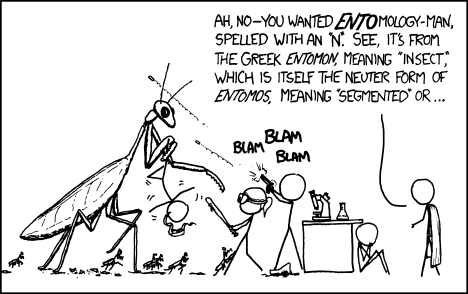
Thursday, February 02, 2012
Grading Thoughts
No matter how good writing is (say, essays, or journals), there's a point where reading them is just work. I'm at that point with one of the assignments I'm grading. The first few were good to read. The next few tolerable. And now I'm to the part where they're just work to grade.
In writing a journal assignment, one of the writing students said zie was in the class because zie had to be. Seriously, I know how that feels. I'm in the class because my paycheck depends on it. Every day, I'm in the class because my paycheck depends on it. And I try to make it a really good class and a good learning experience because I think that's my ethical responsibility and also because doing poorly would make me less happy. But it's not like I come to work and teach comp just for the sheer pleasure.
I went to bed at about 8:30 last night, and I feel so much better today. Sleep is a wonderful thing!
In writing a journal assignment, one of the writing students said zie was in the class because zie had to be. Seriously, I know how that feels. I'm in the class because my paycheck depends on it. Every day, I'm in the class because my paycheck depends on it. And I try to make it a really good class and a good learning experience because I think that's my ethical responsibility and also because doing poorly would make me less happy. But it's not like I come to work and teach comp just for the sheer pleasure.
I went to bed at about 8:30 last night, and I feel so much better today. Sleep is a wonderful thing!
Subscribe to:
Posts (Atom)