Having received some encouragement to talk about the hiring side of the job market, I decided to split what I have to say into a couple posts. So if someone has questions, or wants to add ideas, please feel free to jump on in.
To be clear: I teach at a mid-size regional comprehensive university; we call ourselves a liberal arts university, though we also have several pre-professional programs. My department has English majors with several emphases, as well as a very small MA program. What I have to say reflects my experience here and at my previous jobs. I don't, alas, have universal truths to impart. (Except that you should read more Shakespeare!)
The thing I'd like to say to people applying for jobs is that in my department, we're looking for a colleague. We're not looking for the smartest grad student around, or the one with the best academic pedigree. We're looking for a colleague. We expect to mentor our junior colleagues; I've seen some admirable mentoring here. So when I say we're looking for a colleague, I don't mean we're looking for someone who's fully formed as a scholar, teacher, etc. I mean we're looking for someone who is making, or has made, the mental move from student to colleague. That move was especially difficult for me, and I would have denied there was even a move, until I realized I had made it.
Our basic philosophy: colleagiality: We look forward to tenuring every person we hire, and it's pretty rare that we fail. When we fail at that, we talk about what went wrong in our personnel committee meetings, and if/when we have another opportunity, we try to do better. We're not entirely altruistic in this, however, because 1) working with someone who hates it here and wants to leave isn't fun, and going through the necessary steps to not-rehire or to deny tenure to someone is downright difficult, depressing, frustrating, etc. 2) job searches are stressful and time-consuming for us, and 3) if we lose someone (we don't rehire, or they decide to leave), we aren't assured that we'll retain the tenure line, and if we lose a tenure line, that's one less person to share the work of our department.
So when we hire, we're thinking about working with this person in all sorts of ways. We're thinking about mentoring them in teaching and scholarship, working with them in committees, brainstorming in department meetings, sitting in the lunchroom, helping students together, being supportive of life changes, difficulties, and sharing joys. We're thinking about where we want our department to go in the next 20 years, and how our new colleague is going to help us go there, or think of somewhere even better.
I'm not saying we're perfect, not at all. And there's a danger in a department that cares about colleagiality that we could look for people who are "just like us." I don't know quite why, but when I walk around the offices, I don't see that having happened much. I see people who disagree about a lot of things who manage to treat each other with basic respect. I see people with very different life experiences who respect and value each others' experiences pretty well. I can't say that for every department I've been in, but this one does pretty well. We could do better in some areas, of course.
If your letter sounds like you would hate it here (it's cold in winter, small community, regional comprehensive, teaching writing), then we're probably not going to find your application appealing.
Teaching: We teach a fairly heavy load, almost always including a first year writing class. We're up front about that in our advertisements when we do searches. When we look for a colleague, we look for someone who will be able to walk into classrooms during the first week of classes ready to teach. We have lots of people who are willing to share their syllabus for whatever class, willing to show new faculty what's where and such. And we'll mentor new faculty with mutual class visits, discussions, and so forth. But when push comes to shove, we can't teach your classes for you.
How does this matter to applicants?
ABD? If you aren't done with your dissertation by the time you arrive in mid-August (when our contracts start so that we can have endless administrative meetings), then teaching three classes, some probably new preps, and adjusting to a new school/community, etc, is going to make finishing painfully hard. And if you don't finish, our administration won't rehire you for a second year. If you're ABD, make sure you actually WILL be done, and that your letter writers talk about that specifically in their letters of recommendation.
Talking Teaching You need to be able to talk about your teaching convincingly. You should sound like you're a thoughtful teacher who can plan a syllabus, manage a classroom, grade fairly, and give good feedback to students. Since we label ourselves a liberal arts school, you might want to think about what that means to you, and think about ways to articulate your thoughts on the benefits of a liberal arts education. You should be able to talk well about teaching writing courses and courses in your field. Typically, when one of our colleagues proposes a new course, people in my department will happily talk about how "I'd like to take that course!" or "I wish I could take that!" When you're talking about courses you'd like to teach, aim at getting us to wish we could take them.
I'd say that we tend to look favorably on someone with some adjuncting experience or a previous tt job. I suspect R1s look less favorably, but somoene else would have to confirm this.
Scholarly and Creative Activity We're not an R1, but we do require scholarly or creative activity for tenure/promotion. We're serious about this, even though we have a fairly heavy teaching load. (I regularly teach 11 credit hours a semester; my old grad school friend at an R1 teaches 6. My classes are bigger, and I never have TAs to grade or hold discussions. My load includes a writing intensive course with loads of essay grading.)
How does this matter to applicants?
ABD? If you're ABD when you get here, then we're worried that you won't be able to finish. We ALL know how difficult it is to do anything with our load. And if you haven't finished, then you aren't getting a jump on the project(s) that will help you earn tenure; it's like you're starting at a huge disadvantage. You can overcome that; we've hired folks ABD who've done wonderfully, but it's tough!
Talking Scholarship and Creative Activity You should be able to talk about things you'd like to do further work on. You should be able to talk about teaching students how to do research. We want you to be able to sound interesting enough that we won't hate seeing you in the lunch room for the next 25 years, interesting enough that you'll be able to teach students complex stuff well. If you can't explain your work to interested phuds, then you sure as heck won't be able to explain it to our students. Think of yourself as a colleague talking to other colleagues, not as a student trying to impress someone with how much they can say about X or Y.
But what you work on? We're pretty open minded.
However, if you've applied for a job in, say, underwater basketweaving, and all you can talk about in your letter is your dissertation on underwater ceramics and how much you'd like to teach only ceramics classes, then your letter of application is going into the "not really qualified" pile FAST.
Remember, in most English fields, we'll get abundant applications from people who really do love underwater basketweaving, enough that they wrote a dissertation in the field and daydream about teaching special topics classes in underwater basketweaving. If you're a ceramicist, you're not really competing with them for our job. (Now, if the job says underwater artisan generalist, then by all means, go for it!)
Service We don't at all expect that an applicant will have any service experience, but when one does, we notice. We know that our colleagues will be working alongside us in committees, and we want a sense that they'll focus on the work and contribute to solving problems. If you can give us that sense, and everything else in your application letter is where it needs to be, then that will help. It's not a make or break thing so far as I've seen.
One Last Thing We're likely to get a boatload of applications from very fine candidates. Seriously, if you saw us sit around a search committee table trying to narrow down the top applicants to an interview pool, you'd realize how difficult the job is. Some people write just great letters, have fascinating dissertation topics, say wonderful things about teaching, and just sound superb. If there are ten of them, or if there are 50 of them, the truth is, we can only hire ONE.
So, I want folks to keep this in mind. If we send you a fast rejection letter, it's because you don't sound like you fit the position. If we send you a slow one, it's because you sounded like you fit, but others sounded like they fit better. A rejection letter doesn't mean we didn't like you or didn't think you're smart; it means we aren't hiring you.
We regret that we can't hire more than one person. We see so many top notch people apply, and we know the economic suckage that is the reality of academics, and we wish we could change things. We can't. We aren't using large numbers of TAs to cheaply staff our lower division courses and then producing them as PhDs in a glutted market.
But every one of us has received FAR more rejection letters than job offers, and we know how draining and horrible those letters are. People in my department HATE to write rejection letters. Our previous chair wrote especially gracious letters, agonizing over each one. But they were still rejection letters. And no matter how gracious, they suck.
Next up, timing, or, why the heck can't you guys make a decision already!
Sunday, September 30, 2007


Saturday, September 29, 2007
Would it help?
I went for a ride this morning, thinking that the cloudiness would clear up into a sunny autumn day. I took a new (for me on a bike) route, with some (for me) challenging hills. Challenging hills are good for clearing the mind, and making sure that things like legs, lungs, and heart are doing their thing.
As I was riding, I was thinking about ways of helping someone deal with a problem. Sometimes, people talk about a problem, and they really just want the other person in the conversation to confirm the difficulty, sympathize, and perhaps join in condemning the idiocy around us. Other times, people talk about a problem and they really want information or help solving it.
When I was about 8 miles out of town, it started to rain, proving my weather optimism wrong. Fortunately, it was a light drizzle, so not horrid for riding, though it did make me a bit tense. I turned around and headed back.
I've recently read some blogs by folks who are on the job market, or thinking about being on the job market, and I think back to my own misery on the market. Being on the market is about 10 orders of magnitude more miserable than being wet and 8 miles from town with hills to climb. And I wondered about writing a post to try to demystify the other side of the job market? I mean, there are some aspects of the market that just make no sense unless you've sat on the other side, and then they make at least some sense.
On the other hand, no blog post is going to actually do anything to solve the real economics of academic job searching, and maybe what's most helpful is to be supportive of those on the market without trying to explain stuff? Sometimes, after all, the explaining sounds like making excuses.
I'm home now, dry, wearing long johns (yes, already) and sweats, and sitting in front of a space heater with a warm laptop on my lap, about to go out and lube my bike (I cleaned it after I got back, and it's been air-drying for an hour or so). And I'm almost warm again, finally.
Would it help to try to demystify the job search process from the other side? Do people even have questions, or do folks feel well-informed?
Friday, September 28, 2007
Blind Spots
I was having a conversation with a colleague from a different department recently. She asked me if I'm a feminist.
I was taken aback. I hate thinking that it's even a question. But I guess it is. I'm not sure, maybe I don't qualify as a feminist according to her definitions? (After all, I do work on lit by really dead white guys, and that sure doesn't sound feminist to lots of people.)
So we talked on about some work this colleague does, and how people in a different academic area, folks not working from feminist theory, don't see things the same way.
I worry when feminists seem too certain that we've got all the answers. I mean, it's easy to point out certain blind spots in other peoples' approaches. But feminism in its various versions has had plenty of blind spots, and we haven't always been willing to rethink them, even when pointed out with grace, patience, and forceful logic. Think about the ways 70s white, middle class feminists refused to recognize the experiences of women of color and women of different socio-economic positions. How often straight women have resisted including GLBT folks.
It's easy for me to point out a couple of blind spots from 20-30 years ago.
What concerns me is the blind spots I can't see. But I'm pretty sure they're there.
Thanks, Wisdom of the Internet!
First, thanks for the conversation about my decision. I found it remarkably helpful. And, I did say no, and yes, it went okay.
Frankly, you folks made me think about things a bit, and I realized that I'm willing for Task X to go undone if no one else is willing to do it. That was a good realization for me because there are only so many things I can do. And Task Y is looking very enticing, and likely to make me happy in the doing.
Basically, anyone with a PhD in English should be able to do Task X, and I actually had the nerve to tell Leslie so. Leslie gave me a shocked look. Indeed, Leslie has told me s/he feels unable to do Task X. But seriously, if someone with a phud in English isn't qualified to do Task X, we shouldn't have hired that person. The thing is, you have to step back and think hard about it, and then do a load of work that doesn't really pay off except in doing Task X.
Sometimes, I think I should get out of this business altogether. I could move to a warmer clime, right? And if new college grads with BAs in English can get a job, then I should be able to? I really don't think there's any more green grass on the other side of the fence, though, just different sorts of grasses.
Wednesday, September 26, 2007
Decision
Last year, I agreed to do Task X (imagine, say, editing a newsletter for alums) for the department until I go to Asia in the spring; I agreed on condition that I wouldn't do Task X when I got back. I did Task X a couple of years ago, and the results were well received.
It is a truth universally acknowledged in my department that I'm less wonderful than most at doing X (imagine editing). This truth is fairly painful at times, but there it is.
So, today I got asked if I would do Task X again next year, to give the (Leslie) person responsible for overseeing Task X another year to find another Xer. And Leslie is one who makes no bones about letting me know that I'm inadequate. But, apparently, the (painful to me) irony of asking me to do Task X when Leslie him/herself is obviously much more capable is lost on Leslie him/herself.
Apparently, only one other person in the department is willing to do Task X, and when s/he does it, despite his/her obvious skills at X, Task X doesn't turn out well.
I want to suggest that Leslie put out a general request for someone to take over Task X, but I realize that the one other person would jump at the opportunity, and the results would be as ugly as before. Despite my weakness at Xing, the results seem largely positive when I do Task X.
Pluses and minuses:
Task X is, in itself, not onerous or unpleasant, but it's not my favorite either.
But, Task X means I don't have time for Task Y, and Task Y is far more important to me. But, Leslie doesn't care about Task Y; it's someone else's responsibility.
And, I resent Leslie for asking me to do Task X yet again when s/he knows I feel that Task Y is more important and central to my work.
I resent Leslie asking me when s/he's made it clear she thinks I'm less than competent (but still more capable of actually getting Task X done).
At the same time, I know that Leslie respects my abilities to get Task X done successfully despite his/her sense of my incompetence at X.
I don't think Leslie would go out of his/her way to do me favors or disfavors with his/her connections either way. On the other hand, I may be wrong about that.
Task X is important in the large picture, and needs to be done by someone. So either someone new steps up, the unsuccessful person does it (to the detriment of all), or I do it again.
I don't know what to do.
Because of my lousiness at X, I really don't feel like there's anyone in my department with whom I can talk this over and get good/wise advice.
Best Practicing
When I was taking some basic pedagogy classes, back in the days of purple professorial fingers and dot matrix printers, I learned that writing an essay assignment along with students was a great idea because it would make you really think about the do-ability of the assignment, it would give you opportunities to model the assignment (at varying stages), and so forth.
I have, on occasion, written essay assignments along with students, though, I confess, not often. More often, especially for exams, I'll sketch out a couple possible essay responses, just to make sure that what I've set up in a prompt is do-able in the time allotted. (If I can't sketch out the basics of a response in 10-15 minutes, then students are likely to have a hard time writing an exam, especially since my warped mind WROTE the prompt, and they aren't mindreaders.)
I'm thinking of doing an essay along with my first year writing students. It would be the first time in a long while, but I'm sort of feeling that it might be helpful and interesting. And it's a new assignment, so I think it's a useful check on my perceptions.
I'm thinking of contributing my thesis to the load we critique on thesis day, and to setting up a draft on draft day. What do you think?
For those of you in the comp/rhet business, who know so much more theory about composition teaching than I do:
Do you write along with your students? Does anyone even talk about that these days?
Do you model writing for your students?
Do you have suggestions (if I do this), for doing it as effectively as possible?
Tuesday, September 25, 2007
Visiting Writer
The author of our common text came to campus recently and did some presentations and such. He did a great job talking about writing and about the book we've been reading, and was incredibly generous to our students in signing copies and answering questions.
But I kept having this feeling that I was watching Bobcat Goldthwait doing Garrison Keillor; you know that sort of wincing thing that Goldthwait does, as though he's expecting to be hit upside the head at any moment? Except now think of him doing Keillor type stories about the upper midwest, but with fewer Lutherans and more snow mobiles.
People from the Northwoods have a particular accent. For example, you can instantly tell I'm not from the Northwoods because I say "Northwoods." People from here say "Thwoods." Our speaker went from a lower midwestern accent at times (think American Broadcast News accent), to an exaggerated Northwoodsian accent, depending on what he was talking about. Interesting code switching in fast mode.
I'm still torn about using this book as our common text. I don't think it works well for me as a model for teaching college writing, nor as something I really want students to spend a lot of time doing close analysis with. I love teaching Shakespeare and talking about gender constructions and such, but Shakespeare's been dead a long time, so he's not being a sexist now.
This book, though, has four female characters with names, pretty much; there are other female characters, "the slattern," "[male name's] wife," "girl," and so forth. Two of the named women die (framing the opening and closing of the book, and important because they're survived by father and husband, it seems, since the text focuses on the men anyway), one of them gets put down for "wearing men's clothes." Men, though, actually have names and are represented as important in their own right. Shocking, I know.
But the most irritating moment? One of my colleagues did the introduction, and in the process talked about how students shouldn't be forced to read books that aren't about themselves. They should only read books about themselves.
Dude, I wanted to shout, this book is incredibly white, straight male centered. Do you really think that this one's about every one of our students? And do you really think that putting down one of the more important authors in English lit (not Shakespeare, either!) in order to laud the local guy has a lot of validity?
I didn't shout, though. Nor did I ask the visiting writer about the sexism in his text.
See, tenure didn't completely destroy all my social skills after all!
And yes, I got my copy signed. I'm torn. (Hey, if I could get my Shakespeare text signed, I totally would!)
Monday, September 24, 2007
No Tolerance and Stuff Questions
So, there's a question I keep wondering about as I read about the Jena 6.
I'm not someone who's an expert on high schools or anything, but these days, don't they tend to have rules and laws about how you can't bring weapons to school campuses and stuff?
Nooses are murder weapons, right? There's really no other reason for a rope to be set up like a noose except to make it useful to murder someone (or kill some animal, I suppose).
So how come the three students who brought murder weapons to the school campus and displayed them in the open got only three days suspension?
And if the murder weapons were brought to school and displayed in order to intimidate and coerce, in other words, in order to terrorize, civilians, how come they don't come under terrorism laws? Seriously, go read various legal code definitions of terrorism and tell me that those nooses weren't terrorism. Yeah, maybe not on a huge scale, but the laws don't say anything about scale, just intimidation, coercion, and violence.
Here are several definitions in US law of terrorism, collected here (my boldfacing):
The United States has defined terrorism under the Federal Criminal Code. Chapter 113B of Part I of Title 18 of the United States Code defines terrorism and lists the crimes associated with terrorism. In Section 2331 of Chapter 113b, terrorism is defined as:
"..activities that involve violent... <or life-threatening acts>... that are a violation of the criminal laws of the United States or of any State and... appear to be intended (i) to intimidate or coerce a civilian population; (ii) to influence the policy of a government by intimidation or coercion; or (iii) to affect the conduct of a government by mass destruction, assassination, or kidnapping; and ......(C) occur primarily within the territorial jurisdiction of the United States......(C) occur primarily outside the territorial jurisdiction of the United States..."
U.S. Code of Federal Regulations:
"...the unlawful use of force and violence against persons or property to intimidate or coerce a government, the civilian population, or any segment thereof, in furtherance of political or social objectives" (28 C.F.R. Section 0.85).
The FBI defines terrorism as
the unlawful use of force or violence against persons or property to intimidate or coerce a government, the civilian population, or any segment thereof, in furtherance of political or social objectives.
USA PATRIOT Act:
"activities that (A) involve acts dangerous to human life that are a violation of the criminal laws of the U.S. or of any state, that (B) appear to be intended (i) to intimidate or coerce a civilian population, (ii) to influence the policy of a government by intimidation or coercion, or (iii) to affect the conduct of a government by mass destruction, assassination, or kidnapping, and (C) occur primarily within the territorial jurisdiction of the U.S."
~~~~~~~~~~
If you read about confessions in early modern England, sometimes you'll read that someone was "shown the instruments of torture" and then started talking. The idea is that you don't actually have to break someone on a rack or whatever to induce a confession. In modern terms, you don't actually have to shoot someone to get them to give you a wallet. The implication is that you have the ability and will to inflict pain and damage, and you can sometimes coerce someone to act differently than they would if you weren't demonstrating that ability and will.
I can't imagine what was in the minds of the students who brought the nooses to their school and hung them up. Did they really imagine that this sort of coercion would work today? Did they imagine that there was any way violence wouldn't escalate as a result of their act(s)?
In contrast, I find it easy to imagine what was in the minds of the students who reacted to the nooses and verbal taunts. I may be wrong, but I know I would have been thinking that I wouldn't put up with that sort of coercion, that I wouldn't be intimidated. I'm not excusing the use of violence, but I can see myself going there if pushed hard enough.
I'm not someone who's an expert on high schools or anything, but these days, don't they tend to have rules and laws about how you can't bring weapons to school campuses and stuff?
Nooses are murder weapons, right? There's really no other reason for a rope to be set up like a noose except to make it useful to murder someone (or kill some animal, I suppose).
So how come the three students who brought murder weapons to the school campus and displayed them in the open got only three days suspension?
And if the murder weapons were brought to school and displayed in order to intimidate and coerce, in other words, in order to terrorize, civilians, how come they don't come under terrorism laws? Seriously, go read various legal code definitions of terrorism and tell me that those nooses weren't terrorism. Yeah, maybe not on a huge scale, but the laws don't say anything about scale, just intimidation, coercion, and violence.
Here are several definitions in US law of terrorism, collected here (my boldfacing):
The United States has defined terrorism under the Federal Criminal Code. Chapter 113B of Part I of Title 18 of the United States Code defines terrorism and lists the crimes associated with terrorism. In Section 2331 of Chapter 113b, terrorism is defined as:
"..activities that involve violent... <or life-threatening acts>... that are a violation of the criminal laws of the United States or of any State and... appear to be intended (i) to intimidate or coerce a civilian population; (ii) to influence the policy of a government by intimidation or coercion; or (iii) to affect the conduct of a government by mass destruction, assassination, or kidnapping; and ...
U.S. Code of Federal Regulations:
"...the unlawful use of force and violence against persons or property to intimidate or coerce a government, the civilian population, or any segment thereof, in furtherance of political or social objectives" (28 C.F.R. Section 0.85).
The FBI defines terrorism as
the unlawful use of force or violence against persons or property to intimidate or coerce a government, the civilian population, or any segment thereof, in furtherance of political or social objectives.
USA PATRIOT Act:
"activities that (A) involve acts dangerous to human life that are a violation of the criminal laws of the U.S. or of any state, that (B) appear to be intended (i) to intimidate or coerce a civilian population, (ii) to influence the policy of a government by intimidation or coercion, or (iii) to affect the conduct of a government by mass destruction, assassination, or kidnapping, and (C) occur primarily within the territorial jurisdiction of the U.S."
~~~~~~~~~~
If you read about confessions in early modern England, sometimes you'll read that someone was "shown the instruments of torture" and then started talking. The idea is that you don't actually have to break someone on a rack or whatever to induce a confession. In modern terms, you don't actually have to shoot someone to get them to give you a wallet. The implication is that you have the ability and will to inflict pain and damage, and you can sometimes coerce someone to act differently than they would if you weren't demonstrating that ability and will.
I can't imagine what was in the minds of the students who brought the nooses to their school and hung them up. Did they really imagine that this sort of coercion would work today? Did they imagine that there was any way violence wouldn't escalate as a result of their act(s)?
In contrast, I find it easy to imagine what was in the minds of the students who reacted to the nooses and verbal taunts. I may be wrong, but I know I would have been thinking that I wouldn't put up with that sort of coercion, that I wouldn't be intimidated. I'm not excusing the use of violence, but I can see myself going there if pushed hard enough.
Convincing?
I seem to spend a lot of time at the beginning of semesters trying to convince my first year students of some basic college concepts. Doing the reading. Taking notes. Looking up words. I hate giving quizes for all the usual reasons, but mostly because I hate grading quizzes.
The reading for today included a discussion of five reading strategies, including things such as taking notes, looking up words, changing reading speeds, and such. Another reading for the day came from the non-fiction "common book" many of us are teaching in our first year writing class.
Today's (open notes, closed book) quiz looked like this:
1) List the five strategies... (blah blah author and page info).
2) What does [a word they were unlikely to know from the common book reading] mean?
3) Which strategy from number 1 would be most likely to help you with number 2?
I glanced at the quizzes, and they all left #2 blank. But they all had an answer for #3! Think it will take?
~~~~~~~~
It was sort of amusing because I always start out with time for students to ask questions about the reading, and one of the questions had been about the meaning of another word in the common book, and although none of them knew it, no one had bothered to look it up.
I write my quizzes before class in my notes; if someone asks a question that appears in the quiz, I answer it fully, and then people do well on the quiz. I hope the strategy rewards good question-asking. And since I tend to build my quizzes to take us to at least one thing I want to discuss, if they've asked the question, then they've gotten us where I wanted us to go in the first place, so yay them! (The "vocabulary" word was prime for leading us into a good discussion, for example.)
Sunday, September 23, 2007
Grade One, Blog One
I got my first real set of first year writing class essays on Friday, so I pulled out the pile and started in on the top one.
I marked it way more than I should have. I need a couple stamps: "Support your assertion." "Why do you think so?" "Is this your idea, or someone else's?" "How does this paragraph relate to your thesis?"
Then I also need one that says "Cite your source!"
It's really hard to pick up the second paper when you've just put a one-legged A on the first.
I bet if someone came up with a set of writing response stamps, they'd make a fortu... Hmmm, what other stamps should I make?
Thursday, September 20, 2007
Two Notes I Should Write
Dear Student,
Thank you for bringing your paper draft to my office hours today. You made my day a lot better. I hope I was able to help you with your work.
Best, B
Dear Advisee,
Thank you for stopping by to chat today. I've been a little worried since your email, but I'm reassured now. Oh, and thanks for asking the smart prof down the hall the question we had and bringing back the answer! We both learned something!
Best, B
Wednesday, September 19, 2007
More Thoughts on Assessment
I can't sleep. It may have something to do with regular insomnia. Or it may have to do with the banging coming from over the neighbor's way (sounds like a door banging in the wind, maybe?). Or whatever.
One of the things that struck me today listening to the assessment head talk was that there's a crucial piece missing.
The assessment guy's been collecting data for X number of years, and has found that our students don't write as well as we think they should.
The assessment guy has also realized that the method of assessment is rather flawed, so he went around and asked people on campus if they thought that despite the flaws, our students don't write as well as we think they should. And, yes, pretty much everyone on campus says that our students don't write as well as we think they should.
Now, assessment guy wants to say two things: 1) We need a better method of assessment because the last one isn't well designed. 2) The data from the last one is actually valid enough that I should keep my job despite the fact that I designed the flawed methodology. But we can't actually use the data because I need to collect more for another X number of years.
I'd like to fire the assessment guy (which means he'd go back to teaching, not go on unemployment), but as we in higher ed know, administrators can never be fired for incompetency or actually expected to accomplish what's promised.
Let's accept, for the moment, that the interpretation of the data, though imperfect, is broadly right: our students don't write as well as they should.
The next question is why?
Is the faculty incompetent?
Is the faculty basically competent, but doing something wrong which could be changed for the better?
Are there other factors which aren't helping students write well?
Because the way assessment works, we measure students' work at the end, their "outcomes," and then decide if we're doing an acceptable job or not. And since it's the school's responsibility to to the job, and as far as writing's concerned, it's the faculty's responsibility to foster good writing, then something needs to happen with the faculty.
There are difficulties with this approach, of course, since education isn't just something that faculty do to students. But the school can't control what students do, so measuring what students do doesn't make sense for assessment. (This is like blaming plastic widget makers for imperfections in the plastic widgets they turn out without recognizing that the plastic going in--over which the widget makers have no control--is of poor quality or messed up with extraneous stuff.)
Assessment doesn't tell us about how what we do could be different, or how what we do is different (or not) from what our peer institutions do. Assessment just measures outcomes.
Ah, but we should all do best practices! Except, on an institutional level, we know we aren't, at least when it comes to class size.
As far as what faculty do in their classrooms? We're all doing process work, the sort of work that composition specialists tell us helps students learn to write better. We all teach using brainstorming techniques, drafting, draft revisions, etc.
How do we do better? I don't know. One thing I do know is that when I have students do brainstorming or drafting in my upper level classes, they tell me they usually just write one draft and turn it in. So something's not "taking" between their first year writing course and whatever other writing they do in college.
Tuesday, September 18, 2007
An Assessment Tale
I'm frustrated by assessment. Here's the thing, ten years ago as a new faculty member, I heard the first I'd ever heard about assessment. Never heard the word in grad school, but my first department meeting, I heard:
From the assessment head:
Portfolios! We're going to assess student learning using portfolios, and then we'll be able to allocate resources based on what we learn about student learning! We've ready this great book by an assessment guru, and s/he says portfolios are ideal! Every school out there is using portfolios! If there's a problem in an area, we'll figure out why and that will help us know how to allocate resources!
Me (as bright eyed and bushy tailed as someone can be after a disertation and the MLA meat market):
Okay! Portfolios! So, I need to set up some assignments in my class so they overtly address the portfolio rubrics. And then I need to set aside time in my class to help students put stuff in their portfolios, and that means I have to set aside time in my class to introduce students to the whole portfolio idea and try to convince them it's meaningful to them! I'm on it! I'm a new faculty member and I'm going to try do my best!
New job a few years later, assessment head:
We use portfolios! I read a book by this guru and portfolios will solve all our problems! And look, we have a cool new electronic way to do portfolios! And we'll use the portfolio assessment to help us allocate resources! This is the best thing since Fry Bread!
Me (a little less bright eyed after another go at the MLA meat market):
Okay! Portfolios! I've heard of these. I'll set up assignments to address the portfolio rubric directly, and set up class time to introduce students to the concept of a portfolio and help them put things in the electronic form. Because you all must know what you're talking about, and there are resources involved, right?
Ten years later:
Assessment head:
Portfolios suck! We've got ten years of data, but faculty members didn't buy in. I just read a new book and there's a whole new way to do assessment! It will only mean a little more new work for you in your classes. And some more committee work. But we'll tie resources to the results within a few more years.
Me (perhaps a bit cynical?):
We know from the data that we're unsatisfied with student writing. We know from the data that our class sizes for writing classes are nearly double what they should be for ideal student learning. How about putting some resources in now?
What makes you think you know what you're doing this time? Why should we trust this guru when the last one was full of excrement?
Unfortunately, I was saying just that as I vented in a friend's office doorway when the assessment head came and went into the next office.
There are NO RESOURCES to put behind changing things to make student writing better. We've been through this, heard it. Quit lying. Get yourself some ethics and be honest. Actually do some serious research before you pass off your latest guru's work as meaningful or valuable.
The first time, I bought in, worked hard to help students learn about the portfolio stuff, to have assignments that were appropriate for the rubrics, and to encourage students to participate. And what's the result? I wasted my time and energy. And now you want me to waste more time and energy on a new idea that hasn't been tried out and for which you have no evidence, really?
And you want me to buy some prime farmland where?
Monday, September 17, 2007
The Gathering
Every year about this time, my department has a fairly formal gathering. I just signed up to go despite some hesitance.
The thing is, this gathering is a very couples gathering. It's like a middle-aged prom without dancing (usually). (To be honest, it feels a lot like a holdover from the days of all male profs taking their wives out so that the men can be admired en masse.) Couples sit in pairs. Tables are organized as 4 or 6. If you're a single person, taking a single seat at a table is awkward. It's like you're supposed to pretend that you're actually coupled up with one of the other single people in the department, but obviously, you don't want to be coupled up with those folks or you would be for real.
Usually I'm pretty comfortable socializing with couples. One of my social dining groups includes a couple; most of my friends are parts of couples. I bike ride with a couple fairly regularly. (Yes, I'm sure this sounds like I'm doing that stereotypical thing about how some of my best friends are this or that. Sorry.)
But this gathering is always uncomfortable for me in being so couples dedicated.
I'm not sure that there's any way to have this sort of formal gathering without it being incredibly couples oriented. I'm not sure what could be done about it to make things comfortable for the few of us who aren't coupled up and for the majority who are.
Every year I've gone to this gathering, I've regretted going. And every year I've skipped going, I've regretted skipping.
My Inner Paper Pusher
I spent about 2 hours today prepping the agenda and such for a committee meeting. I got a student worker to make copies of the materials we need, and they're color coded. Stuff we'll only need at that one meeting, blue. Stuff we'll need through the semester, pink, yellow, and goldenrod. Agenda and minutes to approve? green.
The thing is, I've noticed in the past that color coded stuff for meetings often helps people (me, for one) keep track of various pieces of work, and that speeds up the meeting process. Color coding is especially helpful when we need to talk about the same issue at more than one meeting (as with longer projects).
Everything's in order, set up with the agenda.
Some meetings make me crazy. Disorganization, people not paying attention, endless repetition, not actually working on something that we can affect. And alas, there's a bit of that sort of endless repetition work on the agenda for tomorrow, but it has to be done.
But I actually do like meetings where we're focused and can actually accomplish something real. We do have important issues to discuss and work through, too. And we can actually make a difference! I like that.
As a faculty member, I really shouldn't admit that, right?
It's knowing that sort of thing about myself that makes me realize I could probably do okay working outside of academics.
Saturday, September 15, 2007
Squash?
This evening, I cooked squash for the very first time. They look enticing at the local farmers' market, and one of my friends had told me they're easy to cook and very yummy, so I took the plunge. Local food and all that.
I started with a butternut squash, washed it, cut it in half (without self-injury, shockingly enough!), cleaned out the seed stuff, and put it in a 400 degree (F) oven in a baking pan with some water, cut side down. Half an hour later, I turned the sides over and put the whole thing back in the oven. Half an hour later, I took it out of the oven and checked it for overall softness. The innards were soft.
My friend had told me to put butter and brown sugar on it, so that's what I did.
I have to admit, I have doubts about the health benefits of eating something primarily so it can be a substrate for butter and brown sugar. Why not jump directly to a brown sugar sandwich?
I had to call another friend to ask about storing and reheating, and he suggested that I put the inner stuff (not the rind) through a strainer, and then tomorrow try it with cream and some thyme or something, or more butter and brown sugar.
It was during the strainer phase that I realized that the squash reminded me of things better forgotten from my Peace Corps days, and suddenly it seemed less appetizing, even as a substrate for butter and brown sugar.
Suggestions? (Remember, these need to be easy suggestions! I'm a cook that had to get directions for baking a squash!)
Tourist
I played tourist a bit today. I drove over to another community known as a bit of a tourist destination, for around here, anyways. You can use your imagination to think about why a tiny community in the upper midwest might be a bit of a local tourist destination.
I'd heard the area was beautiful, so I made a copy from the local map from my state gazette/atlas book, and blew it up so I could read it without reading glasses. And waited for the day. Today was the day, still warm enough to make me happy to be outside.
I drove over, and once there, stopped in a local gas station with my map and asked about some road suggestions. The woman behind the counter was kind enough to help me, and also let me use their restroom. Within a few minutes, I was parked in a local municipal lot just off the local highway, and started off on a country road. With the map, it looked like I could make a sort of loop one way, then cross the local highway and make a loop the other way before returning to my car. So that was my plan.
As I road off to one side of the local highway, the countryside gradually became less farmlandish, and more woodsy. I was passed by big trucks towing trailers with ATVs, those little four wheel things people ride around on trails. I smiled and waved, and the ATV folks smiled and waved back. And gave me lots of room on the road (thank you!). I passed a local county forest and ATV park (really!), and a local wilderness area with public hunting (it's not hunting season yet, but seeing the sign did make me think about getting a blaze orange biking jacket). Just on the other side of the wilderness area, I expected to turn back on a road, but when I got there, I realized it was a dirt road, and being a skinny tire biker, I avoid dirt roads. So I just rode further up the country road I was on for a while, turning back after I'd ridden about 11 miles, and well off the section of map I'd brought.
I found a way to make a smaller loop back, one that took me into farm country.
When I was a kid, I was horse crazy. And still, I find horses beautiful, but I've come to the conclusion that riding seriously, or owning a horse, is more committment than I choose to make. Still, when I ride by, I smile at horses and admire them. And when I ride by, most of them look up, in that prey animal way. You can sort of see their brains clicking: look, something that might be a predator? But a danged slow predator. And no legs. And it looks like there's a human attached. Not to worry.
One horse sauntered up to the fence to get a really good look at me as I inched by, working my way slowly up a slight slope. It sauntered faster than I was riding up the hill.
Then I rode along the highway just long enough to get to the next paved county road, and off I went. Hills! There was one hill that I really thought I'd have to walk, but I made it up. And my reward at the top was riding up along a ridge with a beautiful view of the valley off to the side. Wow, just wow.
I think this was one of the best, if not the best, rides I've ever taken. In the past, I've often looked longingly at bikers biking across swaths of the country as I've driven by, but today, I was that biker. I waved and smiled at the ATV folks and at farmers, and they all waved and smiled back. My lungs and legs burned up hills, but managed to get up them. And I felt the freedom of a kid as the worries of the week fell behind.
There are days when I'm especially grateful to be healthy and such. Today, I rode by a farmhouse with what looked like a wheelchair ramp leading up to its front door, and I felt especially grateful. I rode along, grateful to have a bike that helps me feel good, to have lungs and legs that work well together, and to have the freedom and time to just play.
36 miles of feeling that good is hard to beat.
Thursday, September 13, 2007
Totally Tuckered
Today was one of those days when I realize I'm actually more than okay. My classes went really well. I got a good phone call. I helped a colleague proofread a project. And I handled a student issue well.
Sometimes, when I'm getting ready to enter a classroom, I wonder what the heck I think I'm doing, and why anyone would think I can teach. Today, I taught. I helped people learn, helped people put things together mentally. Some days I have my doubts, and it's hard to walk into a classroom. Today was almost magical for me. (And, I hope, for my students.) Today was why teaching is such a rewarding profession.
Every so often, you hear from someone unexpected about something you did. Sometimes, the feedback is a sort of thank you. Today, I got a phone call like that. The dominant metaphor used, though, was "standing in front of the train." So I'm not sure I want to reify that one. Remember the picture of the person who stood in front of a tank in Tiananmen Square? I admire that person's pure fortitude. But I don't think I could ever be that person, even metaphorically. I wish I could.
I had really great office hours. Two students, very different things to talk about, both good conversations. I love talking to students in office hours.
I'm tuckered. My voice is ragged; either from talking or I'm catching a cold (sort of rare for me, fortunately). But I did a lot of talking today (a lot of class time, and then outside of class, too).
One of the things with teaching a night class is that I try to keep good energy going, and then at the end, it takes me some time to wind down. I'm winding now, though.
Undermining
One of our university administrators generously gives talks in classes to our students about their education. It's a really good talk, and a wonderful opportunity for our first year students to meet a high level administrator up close, and to learn that that administrator cares about their education and isn't just a paper pusher.
So UA is doing a really good thing.
UA came to my class to give the talk, and as I introduced UA, I specifically told the students to take good notes. They dutifully began to take notes.
And about five minutes in, UA sort of got bothered by the notetaking and asked them to stop, telling them that we'd make the powerpoint available to them.
Inside, I just screamed. You see, notetaking is an important skill, and my class is one place where I try to teach notetaking skills in a real way. I let them use their notes in quizzes, for example, to encourage them. I give them a copy of my notes for some things, and talk about the strategies I use to take notes.
Near the end of the talk, UA said that one of the skills employers value is good notetaking skills for meetings, so that after a meeting, an employee can explain what happened in the meeting, act on decisions made during the meeting, and so forth.
Inside, I wanted to smack UA upside the head.
Yes, it can be painful to talk to students while they're learning notetaking skills. Yes, it slows down their willingness to respond to questions and such. Yes, it can be distracting while you're talking.
But this is where they learn! Don't undermine your own message!
Wednesday, September 12, 2007
Arcana
As if the last post weren't obscure enough. Here goes.
I've found a word use that predates the OED quotations for usage by 13 years. There was a possibility that it was 23 years, but no, it's only 13 years. I just spent almost an hour tracking that piece of information down through black letter texts on EEBO. Fun times in B's office, I tell you.
I've never found one before, and I'm oddly excited in that quirky, arcana-loving way some of us have. It's not exactly the holy grail, or even a sliver of the true cross, but it's still a first for me.
Background: If that made no sense to you, here's what will help:
The OED, or Oxford English Dictionary, is a historical dictionary of English. When you look up a word, you find a basic history of usage, along with etymology (historical sources and root meanings), pronunciation, and meanings. We tend to think of words as having meanings, but really, the meanings of words are what users of the language "agree" to understand by a certain sound pattern or graphic image pattern representing a sound pattern. So you can use the OED to trace out through usage (represented by quotations) how the usage of specific words has changed over time. (Look up "let," or "silly," or "clown," to see some common words whose meanings have changed in big ways.)
Way back in the 1850s, the Philological Society (in London) started a project to track down words and such, and eventually the project grew into an attempt to create a historical dictionary of the English language. At various times, the editors sent out appeals for people to keep track of words and send them in, especially words being used in older texts and such. They tended to favor canonical and literary texts, including Shakespeare and Chaucer, but it's not like even their army of readers tracked down every text in English. And then, in 1933, they printed up what they'd found, the Oxford English Dictionary. And immediately started hearing about things they missed. So they added supplements. And in 1989, they printed the second edition.
They keep updating, now on their electronic versions, because people keep reading stuff, old and new.
I found my word because I read it in a reading for a class I'm teaching, and realizing that I wasn't absolutely certain what the word means, and knowing that someone might ask, I looked it up. And there, in pixels on the screen, were a set of quotation examples with their printing dates. And there, in a modern edition of an old book (originally printed 13 years before the first quotation example cited), was the word. Then, of course, I had to look up old editions to verify the word.
It's not a hugely important word. It's not "exsufflicate" (Shakespeare, Othello 3.3.184 [ed Sanders] TLN 1798), a word which appears only in one spot in Shakespeare (and in the words of people like me who talk about words in Shakespeare), and so has no easily understood agreed upon meaning. (We understand what it might mean by using root words and similar words in other languages.) Were I to find a quotation of "exsufflicate" that predates Othello by 13 years, I would be VERY excited.
But still, I'm sort of goofily excited.
Monday, September 10, 2007
Gorboduc, the MMORPG Version
Or, Am I Procrastinating, or Does This Count as Class Prep?
STC #18684 (15th ed)
Cast:
Gorboduc, Guild Leader of Britain
Videna, his wife
Ferrex, his elder son
Porrex, his younger son
Eubulus, a good counselor to Gorboduc (Guild Officer)
Arostus, a not so good counselor to Gorboduc (Guild Officer)
Philander, another counselor to Gorboduc (Guild Officer)
Dordan, Ferrex's pal
Tyndar, Porrex's pal
Nuntius, a messenger
Marcella, a companion to Videna
Fergus, Duke of Albany, Guild leader of the Scots
Act 1: Dumb show. Warrior guy comes out with a bundle of sticks. Pretends to try to break them as a bundle, and shockingly, can't. Takes the bundle apart and breaks the sticks one by one over his helm.
Act 1, scene 1: Enter Videna and Ferrex
Videna: You are my favoritest son ever! I changed the DKP to make sure you get all the loot at the next raid!
Ferrex: Mommy, I love you!
[Ghost of Freud to Come: hmmmm, that gives me an idea.]
Act 1, scene 2: Enter Gorboduc and his counselors, Eubulus, Arostus, and Philander
Gorboduc: I'm tired of being guild leader. I'm gonna divide the guild bank and everything else between Ferrex and Porrux, and retire to the guildhall!
Arostus: Good idea, boss! You rock!
Eubulus: WTF, bad idea! Tell them you'll split until after you sell your account!Philander: WTF, you f***w**, don't split the guild!
Act 2: Dumber Show: An old dude offers the King a glass of wine. King declines. A brave and lusty young gentleman offers the King a golden goblet [Ghost of Zeus past: hmmm, that gives me an idea!] filled with poison [Ghost of Zeus past: maybe not such a good idea.] King drinks and falls over dead.
Act 2, scene 1: Enter Ferrex and Dordan (his pal)
Ferrex: WTF, Dadzors cut my DKP in half and gave half to Porr3x-sux!
Dordan: Your mom still loves you! She's bringing pizza! But Porrex is gonna KS you and take your lootz! You should KS him, first! We'll get some guildies to help!
Act 2, scene 2: Enter Porrex, Tyndar (his pal), and Philander
Porrex: Dad loves me best, but why did he let Ferret-face keep any DKP?
Tyndar: Watch out! Ferrex is gonna try to PK you! He's got a group! And your mom's a biatch! She hates you!
Philander: WTF, Ferrex isn't going to PK you! He's grinding levels. Ask in guild.
Act 3: Dumbest show so far: Porrex kills Ferrex, no surprise there, right?
Act 3, scene 1: Enter Gorboduc, Eubulus, and Arostos
Gorboduc: Where's Philander?
Arostos: He's afk again!
Eubulus: Hey, I just got an IM from Dordan! He says "F iz gon try to PK P! Tell Gorb!"
Arostos: Oh, nozors! Make them join a chat channel together!"
Enter Philander
Philander: Sorry, my mom made me take out the garbage. :( Porrux thinks Ferrex is going to PK him, so he's going to gank Ferrex first.
Gorboduc: Oh, S***! F******s! No dueling before a raid!!
Enter Nuntius
Nuntius: WTF! Porrex trained Ferrex! And now he's corpse camping him!
[Ferrex tells guild: Rez plz! I'm gonna petition Porrex!]
Act 4: Another really dumb show: Furies, music, bad stuffs! Videna PKs Porrex. [Ghost of Titus future: hmmm, pastries anyone?]
Act 4, scene 1: Enter Videna
[Videna tells guild: Fer' needs a stick, plz! He's in Burned Woods.]
Videna: WTF, I popped out Porrex and he killed my favorite kid! I bet the hospital changed him out and gave me some criminal nursed by a tiger!
Act 4, scene 2: Enter Gorboduc and Arostus
Gorboduc: This sux. There's no cleric on to rez Fer'!
Enter Porrex and Eubulus
Eubulus: I found Porrex.
Gorboduc: WTF, you ganked your brother! I'd deguild you if you weren't my son!
Porrex: But Ferrex tried to PK me!
Gorboduc: Go to your room! No computer privileges for a week!
Exit Porrex
Eubulus: This sux. My mom says I have to eat dinner now. :(
[Eubulus tells guild: AFK sec.]
Enter Marcella
Marcella: w00t! Porrex down, Videna loot!
Gorboduc: WTF??!!?!?
[Porrex tells guild: Biatch! Rez plz!]
Act 5: The dumbest dumb show of all: AE fest and guild war!
Act 5, scene 1: Enter Eubulus, Fergus, and some spear carriers
Eubulus: The guild is at war! Oh nozors! Everyone wants revenge!
Exeunt all but Fergus
[Fergus tells guild: LFG for guildwar with Britain! Double DKP for raid!]
Act 5, scene 2: Enter Eubulus
Eubulus: WTF, no one will group with me!
[Eubulus tells guild: LFG, need cleric and crowd control, plz!]
Enter Arostus and spear carriers
Arostus: Gorboduc and Videna got ganked by the newbies! We need a healer; can you play your cleric, Eubulus?
Eubulus: WTF, no! I'm a tank!
[[Gorbuduc tells guild: rez plz.]
[Videna tells guild: click me, plz. I need to loot and scoot!]
Enter Nuntius
Nuntius: Hey, the Scots are attacking! Oh, nozors! Fergus is AEing!
[[Eubulus tells guild: rez plz.]
[Arostus tells guild: rez plz.]
[Philander tells guild: WTF! I was afk in the PoK and now I'm dead? Rez plz!]
[Fergus tells guild: We win! Lootz for all! Tells for [Sword of Porrex].]
Friday, September 07, 2007
Student Complaint of the Day
Roughly translated:
Student: We don't have a single Underwater Foil Hat Making course in this department.
Me: That's because we're an Underwater Basketweaving department.
Student: You should offer a degree in UFHM.
Me: If you want to study UFHM, you have to go to a school that offers it. We simply don't have the foil resources, and we basketweavers don't have training in foil work.
So it wasn't quite like that, but you get the idea.
Sometimes I get a little frustrated.
~~~~~~~~~~~~~~
I can never remember without looking it up if Charles Brandon was Duke of Suffolk or Sussex. I need a mnemonic! (It was Suffolk. I just looked it up. But it will be gone the next time I need it.)
Thursday, September 06, 2007
Overwhelmed and Underwhelmed
A colleague stopped by my office today to say that he'd scheduled another committee meeting and so would miss being at the committee meeting I chair. As he told me, he doesn't know what we're doing at the meeting anyway, so it's not important. Right?
Except we all agreed to finish certain tasks X by several days before that meeting so that I can get copies made and we can all read those and make some decisions based on the tasks we've completed.
So, do I send out a reminder about Tasks X to the committee, or do I count on them as adults to do the work they agreed to do?
Because really, I don't have the time or patience to infantalize other adults. I want to whack my head against the wall. Hard.
~~~~~~~~~~~~~~
I've been desperately prepping for one class, a play I've never taught before. My office hours aren't until this afternoon.
One of my first year students in another class stopped by to get some paper from me so she could print out the work due in class (in 40 minutes). I don't have a printer in my office, and I don't have printer paper, sorry.
I turned back to my work, and she started asking me about my day, and telling me about hers.
And dang, I was short with her. I'm pissed at myself now, because now she's probably feeling all unhappy that a prof she was brave enough to come see was short with her. GAH! I want to whack my head on a wall.
There's this boundary thing that's hard to articulate. I'm happy to talk to students during my office hours, and I purposefully don't do things that can't be easily interrupted during those times. But if I'm reading and taking notes, and it's not office hours, then I probably don't want to chat.
It's hard to balance the "being accessible" part with the "I'm desperately busy right now" part.
~~~~~~~~~~~
I sometimes feel totally overwhelmed by things to do and underwhelmed by my ability to do them well. Now is one of those times.
Tuesday, September 04, 2007
Tour News!
Yes, exciting news from the Tour de France!
(You know, for an average human being, finishing 2000+ miles since July would actually be an impressive accomplishment, especially with those Alps and all.)
(You know, for an average human being, finishing 2000+ miles since July would actually be an impressive accomplishment, especially with those Alps and all.)
Saturday, September 01, 2007
The Other Side of the Market
It's ad writing season for academic departments across the country. It's hard to write a good ad. It has to be specific enough, but not rule out good candidates. It has to be legal. It has to make the job sound appealing without misleading candidates into thinking they're applying to paradise.
Specifics: PhD in Underwater Basket Weaving? What about related fields? Could someone with a phud in, say, Weaving Culture do the job well? Might that person be a good candidate? The best candidate?
We need courses taught in micro-basket weaving. Are there enough micro candidates out there? We'd also like someone who can teach brackish water basket weaving, and maybe reed-culture, as well. How do we list those without excluding the great micro person who also has additional weaving skills on looms rather than brackish water or reed-culture skills?
On the other hand, we don't want to get applications from people who are really reed-culture specialists with a class in micro, because we already have folks who cover upper-level reed-culture classes, though we could use another section of intro reed-growing.
If we say the PhuD must be completed by the time the job starts in September, what happens if we have a great ABD candidate and want to hire him/her, but then, at the last minute, s/he can't quite finish until November? We know from experience that it's super difficult for someone to finish while carrying our teaching load. (A lot of people who get hired at schools like ours have done some substantial adjuncting; at least we know they're done and have some teaching under their belts!)
Adjuncting here (as opposed, perhaps, to some places) is a pretty dead end job, to be honest. We're between the rock and the hard place budgeting, so we use adjuncts, but we don't tend to roll them into tenure track lines because we need specific fields covered with those lines. The adjuncts who come here are typically in Salt Water Basket Weaving (the most popular phud sub-specialty in Underwater Basketweaving), and we already have three great salt water folks tenured. But what we need is a shallow water specialist, or a brackish currents specialist, and we can't pretend they're the same and respect each other in the morning. Or they have MAs and they just can't compete with phuds in the current market.
If I could freely give our adjuncts advice, it would be to get out of academics and get a better job. Some are here because they need to be in this geographic area, and the department folks are grateful on a practical level, but from the other side of the personnel desk, we know adjuncting here's a dead-ender. Some are here because they've finished an MA locally and need to move on, but we aren't gutsy enough to kick them out of the nest. It's easier to use them as adjuncts than to be really honest with them. Honesty is harsh.
As hard as it is to work out a good ad, we writers have all been on the other side, reading those ads, desperately hoping to find our own tenure track underwater basket weaving job. We know we'll get maybe 150-200 applications, and that 50 of those will be strong and have great potential for our position. But of those 50, we can only interview a few, and bring perhaps 2-3 to campus. And from those 2-3, we can make one hire. One person, out of all those applications, will likely get a job with us. (That one person, of course, may be the second or third person we offer the job to; strong applicants may get more than one job offer, and we're also competing with good schools.) Or we may get our funding pulled and not be able to hire after all.
On the eve of job market hell, then, let me wish us all generosity, kindness, and good will in our efforts. If I were a believer, I'd pray for better budgets and sane legislatures. But even I'm not that delusional.
Friday, August 31, 2007
Machinery
Four meetings today, including an hour and a half with my first year program writing class. I predict mentor brilliance in all sorts of ways. M led most of the class, and did very well.
I had some time at noon, and the bike was in the office, so I went out for a quick ride and settled for a snack bar for lunch instead of a burger.
I talked to a friend who's a much more serious biker than I am about biking the other day about how just fun it is to ride a really fun bike. Mine fits me pretty darned well now, and sometimes it just feels so right when I ride that it's magical. It's like legs and lungs, just pushing and breathing.
Today was like that for part of the ride. I'm not the most athletic person, but sometimes I hit a really good rhythm and it just feels really good and free.
I love the way you can see so much of the machinery of a bike, and how focused a bike's design is on turning the rider's energy into forward motion. (Still, I've read, a lot of energy is lost to heat. Even so, a good biker on a good bike is really energy efficient. I'm not that biker.)
Here's the magic machine. My friend L took the picture, and I'm posting it with her permission.
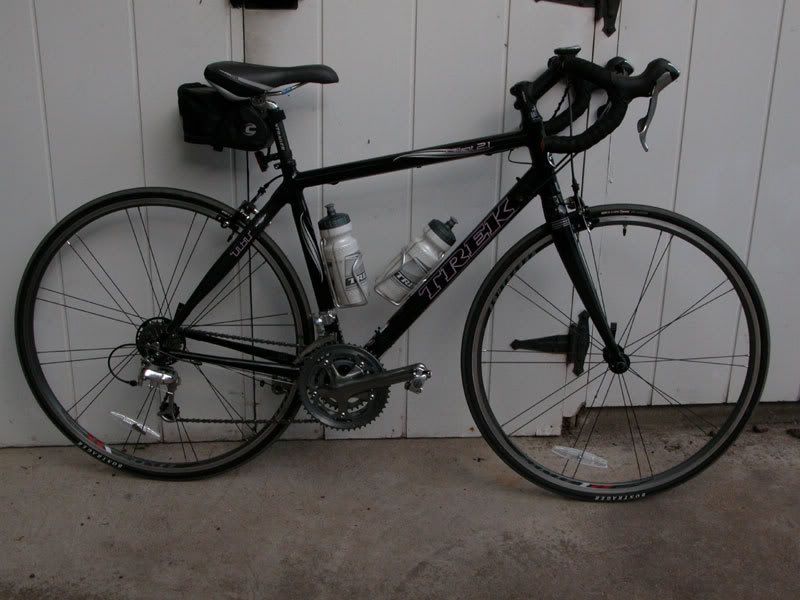
It looks sort of hunkered towards the front, I think. Partly that's the tilted toptube, a feature of the "comfort" geometry that results in the handlebars being relatively high compared to the saddle. (Mine are about the same height.) And partly that's because the distance between the saddle and the handlebar stem is slightly shorter because it's a woman's specific geometry.
But dang, this is one fun bike! I rode up a hill yesterday going to a meeting, and I was just grinning when I got to the top. (The people at the meeting were kind about my biking togs, too.) I felt like a kid out riding today, happy to get out and get into rhythm and clear my mind for the next meetings.
It's just too bad I couldn't afford a full set of spokes!
I had some time at noon, and the bike was in the office, so I went out for a quick ride and settled for a snack bar for lunch instead of a burger.
I talked to a friend who's a much more serious biker than I am about biking the other day about how just fun it is to ride a really fun bike. Mine fits me pretty darned well now, and sometimes it just feels so right when I ride that it's magical. It's like legs and lungs, just pushing and breathing.
Today was like that for part of the ride. I'm not the most athletic person, but sometimes I hit a really good rhythm and it just feels really good and free.
I love the way you can see so much of the machinery of a bike, and how focused a bike's design is on turning the rider's energy into forward motion. (Still, I've read, a lot of energy is lost to heat. Even so, a good biker on a good bike is really energy efficient. I'm not that biker.)
Here's the magic machine. My friend L took the picture, and I'm posting it with her permission.
It looks sort of hunkered towards the front, I think. Partly that's the tilted toptube, a feature of the "comfort" geometry that results in the handlebars being relatively high compared to the saddle. (Mine are about the same height.) And partly that's because the distance between the saddle and the handlebar stem is slightly shorter because it's a woman's specific geometry.
But dang, this is one fun bike! I rode up a hill yesterday going to a meeting, and I was just grinning when I got to the top. (The people at the meeting were kind about my biking togs, too.) I felt like a kid out riding today, happy to get out and get into rhythm and clear my mind for the next meetings.
It's just too bad I couldn't afford a full set of spokes!
Thursday, August 30, 2007
Random Observations from Meetings
I've been spending way too much time in meetings this past week. I'm pretty good at meetings where we're trying to do a fairly specific task. I can focus well and all. I'm less good at meetings where we discuss things, even though I think the topic of discussion is really important. I lose focus, get impatient and such.
Some of these are disguised slightly. But the basics are there.
Why is it that some people are always five to ten minutes late to a committee meeting, not because they're rushing from something else, but because they're standing outside the office talking to someone? I need to learn not to take the lateness personally, especially when I'm chair, because it's not personal, just a timing thing some folks have. (I'm sort of obsessive about being on time for meetings and such, though not necessarily about other things.)
Why is it that the person talking most about the importance of interpersonal relations and sensitivity is also the person who regularly stomps on other peoples' feelings in public?
Why is it that the person complaining loudly about helicopter parents is also the person who has to leave campus by 3:30 pm to be at home when her teenager gets home from school? And why is a married woman bragging that her (also faculty) husband "babysits" sometimes?
(To be honest, I'm very torn about dealing with other peoples' parenting issues. I respect the responsibility that comes with parenting. I think we should have good, affordable child care on campus for students, staff, and faculty. But I don't want to have to schedule meetings to accomodate child care issues, nor do I think child care issues should always trump other issues.)
Why are we renting a "Men's Club" hall to have a meeting where we discuss privilege and diversity? Why do some people give us dirty looks when several of us mention that there are a lot of dead animals on the walls. And why is one of the dead animal parts on the wall the rearend of a deer with his/her tail raised? (I didn't climb on a chair to get a really good look.)
I worry when a person I respect as intelligent and able can't seem to take meeting notes without stopping us every few minutes to go back over something, repeatedly. Best case scenario, lack of sleep or something. Worst case? Way worse.
Some people always have to talk even if their baileywick has nothing to do with the topic under discussion. I fear becoming one of those people. I worry that people will think I'm over the edge because I bring up some issue more than once.
(People think I'm over the edge because I ride my bike around. I also sing to my bike when I make it up a hill or something. "Oooo, you make me sing, whatever this world can give to me, Oooo, you make me ride now, bikey, ooo you make me sing! Your my best bike!" What? Why are you looking at me like that?)
When I got home this evening and looked out over the deck, I realized that my deck planter plants looked pretty darned sad. They get dry fast, especially the sunflowers. I watered, and an hour and a half later, they're all looking much better. Plants can be amazing that way! Go go sunflowers!
Edited to add one last thing: We have a committee basically called something like the Contra-Obfuscation Collective. Yeah. COC. Speak Acronym!
Wednesday, August 29, 2007
Something
I did something right, yesterday. This happens rarely enough that it's worth noting.
Today, a person with some authority said that I'd convinced him/her, and that s/he'd talked to the two other higher ups involved, and they agreed despite their initial reservations.
Dang. I actually did something right.
Today, a person with some authority said that I'd convinced him/her, and that s/he'd talked to the two other higher ups involved, and they agreed despite their initial reservations.
Dang. I actually did something right.
Tuesday, August 28, 2007
Head Banging and High School English
I was on campus and saw one of our graduate students doing some paperwork or something. Like many of our grad students, Rob is doing a teaching credential and working towards an MA. He was excited because he'd done some student teaching this past semester.
Rob seems like a good guy. He wants to be a good teacher. He's concerned about justice and equality in his teaching.
I asked what he'd taught, and, alas, not being much of an actor, I winced when he started telling me about the joys of teaching Salinger's The Catcher in the Rye. He saw my reaction, and asked about it.
I detested The Catcher in the Rye when I was in high school. I just wasn't interested.
Later, when I thought about it after some years of doing literature, I realize that I hated it because we were taught it as if we were supposed to somehow identify with Holden Caulfield, and I just wasn't good at identifying with a prep school boy from the 50s.
Face it, I knew even in my deep innocence then that any female who'd run around doing the things Caulfield does in the novel would have been raped and probably dead.
I explained my reaction to Rob, and he momentarily protested (because really, no one was raped in the 50s... and then he realized that wasn't so). Rob grew disappointed and asked how I'd approach teaching the novel. Err, I wouldn't, really, but if I had to, I'd teach it as an example of how one sort of white masculinity works and gets represented in given contexts. I'd discourage students from identifying with Caulfield, and instead try to get them to think critically about why this book gets taught to them.
And yes, this is why I don't teach high school. (One reason, at least.)
I acknowledged to Rob that it would be difficult to work this way in a high school. And then he surprised me and said that the master teacher he'd worked with had been really open minded, ready to really challenge the status quo at the school, and welcomed his ideas for teaching the American Lit class.
Aha, I said, then that gives you a great opportunity to use The Catcher in the Rye as a contrast to other sorts of representation and experience, right? Set up Caulfield in contrast with the narrator of The Woman Warrior to talk about family relationships and growing up issues/choices, or show how Salinger's representation of masculinity in the 50s differs from Wright's or Ellison's in the 40s, or Malcolm X's autobiography in the 50s/60s! There's a world of great possibility!
So I asked what else they'd taught.
One book was by a woman. No books were by people of color or first generation immigrants.
How the heck is that sort of syllabus supposed to represent the "American Experience" in any meaningful way?
I worry that Rob thought he and his master teacher were challenging sexism, racism, the patriarchy, or anything else. The master teacher? Also a student of ours.
What the heck are we teaching these teachers in our ed courses? And why aren't we teaching them to think on even a basic level about the canon they teach?
Some days, I despair. If these are our teachers, and they're teaching the local students, I despair. And I know I'd hate English studies as much today as I did when I was in high school. That makes me sad.
Monday, August 27, 2007
Secret Lives of Faculty Revealed
What really happens at faculty retreats?
Singalong! (To the tune of "The Wells Fargo Wagon" from Oklahoma)
Faculty:
Oh ho the new students are a'comin' down the street,
Oh please let them come see me!!
Oh ho the new students are a'comin' down the street,
I wish, I wish they know they should study!
Chemist:
I got a chem'stry major for working in my lab!
Biologist:
In spring I have collaborative research!
Medievalist:
And once I got a Chaucer student readin'!
Education Advisor:
Admissions sent me sixty new advisees and a printout with their names!
Faculty:
Oh ho the new students are a'comin' now
Are they red hots or wastrels?
Americanist:
One could love Faulkner!
Profesor de Espanol:
Or Spanish!
Geologist:
Or mineralogy!
Philosopher:
Or it could be!
Faculty as one:
Yes, it could be,
Yes, you're right it surely could be!
Philosopher:
Someone special!
Faculty as one:
Someone very, very special now!
Philosopher:
For my class!
Faculty:
Oh ho, the new students are a comin' down the hall
Oh don't let them pass my class!
Oh ho, the new students are a comin' down the hall
Where oh where did I lose my syllabus?
Linguist:
I taught a sem'nar in Semantics last September,
Biologist:
And I'm up for some Embryology!
Physicist:
I'm gonna split an atom any day!
GLBT Alliance (with four part harmony, and feeling):
The provost promises some funding for our new center!
New Tenure Track Hire:
Oh ho, the new students are a comin' down the hall
I don't know how I can ever wait to see
They could be study'ing with someone who is
Full professor, but they could be, someone special
For my class!
Faculty:
Oh ho, you new students keep a comin'
Oh ho, you new students keep a comin'
Oh ho, you new students don't you dare make a stop
Until you sit in my class!
Sunday, August 26, 2007
How Did I Let This Happen?
I have at least five hours of meetings scheduled for every single day this week.
Why is it that when something is labeled a "retreat," I think retreating would probably be a good idea?
Since I posted about our class availability issue, I've learned a whole lot about how our admissions folks handle things to meet the target number they're given in the fall (for the next fall's admissions, for both first year and transfer students). The accuracy with which they can hit their targets is astounding.
And, I've learned who is really responsible for making sure there are enough seats available for students through the university.
I still haven't learned what, if anything, can be done to make the seat planning process more effective, though.
Friday, August 24, 2007
Campus Speakers
My campus invites a variety of speakers to come to campus to speak to our community (on and off campus). I tend to encourage my students to go to at least one campus speaker, as part of my efforts to get them to try some of the variety of intellectual pursuits available around campus.
In the past several years, I've noticed a trend, coincident with the "student life" folks' growing emphasis on "alcohol education." Evidently, there's a huge market in "Hollywood Has-Beens with Substance Abuse Problems" who go on speaking tours every fall, travelling from college to college, university to university, expounding on the ills of alcohol and whatever other substances they really like(d).
If campus rumors are true, a recent Hollywood Has-Been who spoke on campus then went out drinking with some of the "student life" folks, ending up quite drunk in a local student bar. I must admit, I'm unconvinced that having a Hollywood Has-Been speak convinces any of our students not to drink underage or to excess, or not to try whatever the substance du jour is on campus.
This fall, we have a Hollywood Has-Been coming to campus. The other speaker is a child of a famous couple who's going to speak on an imaginary non-being. Think unicorns. And no, the speech isn't along the lines of "Unicorns in the Graphic Art of Medieval France," or "Popular Marketing and Unicorns: Lessons in Selling to Pre-Teen Girls." Nope, it's more along the lines of "Unicorns!"
Two speakers. What do these speakers contribute to the intellectual life of the university?
I called the appropriate office today to suggest a speaker (the guy who puts together PostSecret is now speaking on campuses; that could be way cool), and by the by mentioned my disappointment with the speakers for this term. The person on the other end of the line said that s/he'd heard a lot of complaints. I hope they listen to the complaints!
I won't be encouraging my students to go to these talks this semester, alas.
Does anyone know if there's even the slightest bit of evidence that the Hollywood Has-Been speaker model contributes anything to changing student drinking behavior?
Our students are utterly cynical about the Hollywood Has-Beens, cynical far beyond me.
Thursday, August 23, 2007
It's not just English and/or the Humanities
Pharyngula has got a post today about the numbers of biology PhDs coming through the pipeline compared with the numbers of tenure track jobs out there, and the numbers are pretty darned dismal.
Myers jokingly asks if the young biology PhDs are all waiting for him to die.
When I was on the market, my grad cohort had joking fantasies about Legionnaire's disease somehow getting into the air conditioning/heating systems of the big MLA hotels. (It's famous for afflicting folks at a convention and attacks middle-aged and older folks harder. It's the perfect MLA horror film disease!)
At least English folks don't usually have to do endless post-docs. It sounds like biology post-docs up the opportunity cost of doing a biology PhD hugely. On the other hand, biology PhDs tie in a bit more directly with industry opportunities than English PhDs. (Unless someone knows a major industry that wants to hire a resident Shakespearean?)
Wednesday, August 22, 2007
Uh Oh
Twice in the past two days I've said things that were, well, less than politically self-protective.
I asked a rather pointed question in a public meeting. When one person was asked to respond, he stood with his arms tightly crossed over his chest, toeing the party line.
And tonight, I talked too openly at a gathering about a problem. With a dean. Who is sort of part of the problem.
In neither case can I blame alcohol or anything like that, just built up frustration.
If tenure is worth anything, then it's worth being able to ask questions and tell a dean that there is indeed a problem. For too long, in too many situations, I've hunkered down and kept my mouth shut, just trying to survive and get by.
Even with tenure, it's way scarier when you don't care enough about getting by to hunker down any more.
Yes or No?
A student emailed me about overloading into a course.
On one hand, I really want to stick tough and say no. We've set course number limits where we have for good reasons, and those reasons haven't changed. When we overload classes, we dilute the educational experience of all the students in the class.
The student didn't get registered in a timely manner for whatever reason. One potential reason is that in order to register, students have to pay a deposit up front. For students who are most hard up, that deposit's hard to pay. Students rarely mention that reason, however, either because that's not the reason they didn't get registered, or because they're too embarassed to acknowledge that as a reason.
Of course, we offer fewer courses because the taxpayers are less and less willing to fund public education, and being a state school, we depend in good part on tax funding.
Ideally, we would fill every seat in every class ever term. That would mean 100% efficiency for course enrollment.
Ideally, every full-time student would be able to take a full schedule of courses every term (according to their plans and such).
If we met those two ideals, then full time students would finish in four years. When they can't fill their schedule appropriately, students take longer. When they change their minds a bunch, they may also take longer. Lots of things can contribute to students taking longer than four years to graduate. As an educator, I'm not troubled by students who graduate in five or even six full-time years.
But most taxpayers don't want to fund students for more than a minimum; many taxpayers would rather stop funding the state university system altogether, it seems. And so the system budget shrinks, and the numbers of seats we can offer shrink, but we need to maintain enrollment on our campus.
The thing is, so long as taxpayers think of a university education primarily as a private good, something that benefits the graduate, then minimizing support for the state system makes sense to them. If a taxpayer sees a university education as being in large part a public good, something that benefits the community as well as the graduate, then paying for the system makes better sense. Tax-based funding for public education has dropped across the board in the US, and that drop suggests that fewer people see education as a public good. I hear lawmakers at all levels talk about cutting taxes and I wonder at where we're headed. And I sometimes wonder how many of our students' parents think of a college education as a public good.
But in between the rock and the hard place are instructors and students. So I have to decide to allow the student to overload my class or not.
And while part of me wants to stick to the numbers, the other part of me sympathizes greatly with the student. I certainly don't want to take out my frustrations about the system, taxpayers, legislators, and poor administrative planning on the student.
How do I balance the lowered educational experience of the other people already registered with this student's educational experience? The class is already packed; how much does adding one more reduce everyone's experience? How much might this particular student add? Or not?
Monday, August 20, 2007
Administrivia
I got to the office with plans to accomplish two biggish projects (figuring out and setting the agenda for a committee I'm chairing at least temporarily, and roughing out the syllabus for my writing class), and one small task (checking my books in the bookstore) today before taking off to reread Perkin Warbeck. (That Ford guy isnt' half bad!)
I started in on figuring out the committee stuff. After an hour or so, I walked over to check books in the bookstore with a colleague and got coffee on the way back. All my books were in order (yay!), but my colleague was able to get a potential problem fixed BEFORE it became a real problem! (YAY!)
(Hint to new instructors: always check with your bookstore a couple weeks before classes start. Walk in, look at the books, and make sure things are what they should be. It is MUCH easier to fix potential problems two weeks before students arrive than to try to deal with them when students can't get the book you need for the first week. I've also found bookstore folks super helpful two weeks ahead because they aren't overwhelmingly busy AND because they can fix things before they become problems. One of the best things I ever learned about teaching.)
I returned to the office and got back to figuring out the committee stuff. And when I looked up, it was after 4pm.
The first good news is that we have a great administrative assistant over in the college office, and she's so great at helping me figure stuff out, work out solutions, and such. I need to get her some serious dark chocolate. My department's administrative assistants make life good here, too. Administrative assistants can make or break an office in so many ways!
The second good news is that I have some really helpful colleagues. Little things can make my life so much easier, and today several of my colleagues stepped up and took care of things with some simple email requests, things that weren't their responsibility, but that they could and did take care of. Yay colleagues!
The third good news is that I'm pretty sure I've got a good handle on chairing this committee this year.
The bad news: Perkin Warbeck will have to wait longer, which is bad because Stanley has just been arrested!
Trivia: I have this weird thing about Ferdinando Stanley, Lord Strange. I just love the idea of someone being called "Lord Strange" (even if it wasn't pronounced that way). Pathetic, I know!. I actually looked him up in the DNB and read up on him once, and he seems pretty interesting (that was pre-Wikipedia, of course). And then he died young!
(Perkin Warbeck's Stanley is Lord Chamberlain William Stanley, brother of Thomas Stanley, then 1st earl of Derby, and thus a great something uncle to Ferdinando, or something.)
Quick, without looking, who is the Lord Chamberlain of "The Lord Chamberlain's Men" fame, and what other peer shared the name (with variant spelling sometimes) and was married to a quite famous female author in the period? (by period, let's go from, say 1580-1642).
Lord Chamberlain, name and peerage:
Other peer, name and peerage:
Famous female author and work(s):
Which ties back to Ferdinando Stanley how?
Sunday, August 19, 2007
Rain
Seems like the rain we've been missing for most of the summer started coming yesterday, and is going to keep on coming. Too late for crops (I've read), too much for the rivers.
One of the local stations says it's a 100 year event. Ugh.
One of the local stations says it's a 100 year event. Ugh.
For Christine
I read that a cleric soloed AoW. (Yeah, after spawning and soloing a Statue and Idol). It took just over 40 minutes. 900K hp.
I remember toes to the wall, eyes down, counting and hitting my mini-CH again and again when NO did AoW, and then us, and holy cow. I don't miss the toes to the wall thing, not at all, or the CH chains. I do miss some folks, though.
I remember toes to the wall, eyes down, counting and hitting my mini-CH again and again when NO did AoW, and then us, and holy cow. I don't miss the toes to the wall thing, not at all, or the CH chains. I do miss some folks, though.
Which Chronology?
I'm teaching a class this coming term on early modern English history plays. I'm excited, and a bit nervous, since there are a ton of plays I haven't taught before on the syllabus.
I keep looking at the syllabus and thinking about how I'm arranging it.
I started off with the plays in chronological order of probable writing/performance. That's useful in terms of theatrical history. But most of my students aren't likely to be really strong in terms of political history, so how confusing is it to read, say, a play about Richard III before a play about Richard II?
And theatrical history-wise, will my students really make strong distinctions between plays written for the Theatre and plays written for the Globe? I don't, generally. How about Blackfriars? (And we'll be doing plays written as much for other theaters/conditions.)
So, I'm thinking of organizing sort of broadly in theatrical history terms:
Early/Academic/Pre-professional Theater
Professional Theater/Armada/Nationalism
Professional Theater/Later/Jacobean
~~~~~~~~~~~~
I'm also thinking of having a short student presentation for each play: a five minute introduction to the writer (when known), early production history, publication history, maybe contextual stuff?
Maybe another quick introduction to the historical figure(s) in the play.
And then a longer discussion leading group who will be responsible for choosing a couple passages they want to talk about. I haven't felt particularly successful with getting students to lead discussions in the past, so I'm thinking that asking them to focus on a couple of passages they think are really interesting, and then working through those passages together with their questions and ideas might work. Ideas, folks?
~~~~~~~~~~~
I've never done a class with so many non-single author plays before!
Friday, August 17, 2007
Once More Unto the Bike, Dear Friends
The other day, I rode for the first time with a group.
I'd gone by a bike store in a nearby town recently, and asked about bike groups in the area, and they'd given me a lead. There are a number of biking groups in the area, but I hadn't known how to get in touch with them. The lead they gave me was for a group of women who ride.
I was worried about being strong enough to keep up and stuff, but I got up my nerve and called. There are three groups the woman I talked with rides with, one morning, one afternoon, and one weekend. The morning group sounded the least scary and soonest, so I joined them for a ride this week.
It went surprisingly well! I'm excited. It was fun to ride and chat, and I did fine keeping up. (I don't think they were slowing down for me.) We did 30+ miles, and while I was nice and tired after, I wasn't unpleasantly tired. We started out towards the country roads south of town, went through a tiny town I'd only heard of, and then circled to come into our town from a different direction, and got on the bike trail. We cut off the bike trail to avoid the center of town and rode back to where we'd met and parked.
South of town, we have hills. I've come to like hills once I'm up them. I look at them and think, hey, I rode up that, and I'm happy like a little kid. And then I get to ride down the other side and up the next one. (NB. These are little rolling hills, not mountainous hills, not the Rockies, Sierras, Adirondacks, Alps, etc.) Riding down, I'm trying not to be scared. Wheee!
I asked, and the women said I'd be fine with the other two groups, too. That's good, because once school responsibilities start, I won't be able to ride with the morning group, alas. But I hope to see these women again!
Sometimes on rides, I realize how far I've come, how much stronger and more in shape I am than I was when I started biking regularly a couple years ago. There's a hill off the side of the bike trail; after I'd been riding a bit, I would ride up and back down the hill as a bit of extra "training," a way to challenge myself. And it was a challenge.
The other day, near the end of the group ride, we headed up that same hill in order to avoid going through the center of town, and we just spun up it, none of us slowing much, because compared to the other hills we'd ridden that day, it was short and not too steep. I laughed, and told the woman I was riding next to about using it as a big training hill before, and she laughed, too.
Today, I went out for a short ride, just a relaxed ride. But the bike felt good. It just felt good, and I started going faster, and then I wanted to see how fast I could keep going. And I set a new Bardiac record for 10 miles: 17 mph average. For me, that's blazing fast, and a big improvement over my best speed at the beginning of the summer (when I was thrilled to average 16mph for 10-15 miles). And it felt good; I got into a rhythm of breathing with about every few pedal strokes and at certain points, it was just my legs and breathing, rhythm. I finished with five slower miles, though I think I could have kept up the speed for another five. There's tomorrow...
Tomorrow, if the weather looks okay, I'm going to try another group ride with the larger, weekend group. I'm told that they ride from some point in the area (broadly speaking), go get food, and then ride back. It looks like tomorrow's ride is planned at about 40 miles.
Thursday, August 16, 2007
Rock Meets Hard Spot
I work at a public university in a state which has seen economic rough times more than good of late. We've made a lot of cuts at the university, and they've hurt. We've raised class sizes, put off building maintenance (and actual building). We've cut tenure lines and hired adjuncts. We have some great adjuncts, but they're not paid adequately and we don't ask them to do committee work and such (though sometimes they do anyway). We're not in an area with a lot of grad programs, so we can't just hire someone ABD to teach a class twice a week, either. People pretty much have to be living here or move here to teach for us. The area doesn't attract a lot of random PhDs.
We've pushed enrollments to the point where we edging into less effective teaching (or gone over the edge). For example, if research were to show that the ideal class size for teaching first year composition or writing is 15-20, then once you push over 20, you're likely to be educating each of those 21+ students a little less well. Our regular first year writing classes run 28-30 students; we all think this is more than ideal, but it's the balance we've managed to work out given budgeting and such. Physically, 28-30 people is fine in some classrooms, but very tight in the space of other classrooms. Science labs only have so many lab spots; computer labs only have so many computer stations.
Grading changes drastically when you add extra students to a writing class; that's obvious. It's less obvious how class activities change. I can still run a pretty good class discussion up to about 35 students (our lit class enrollments); much beyond that and my class discussions are less and less effective. Even at 35, a student who doesn't want to be noticed doesn't get called on much, especially if there are a few engaged and energetic students in the class. But if you want to do presentations of any sort, adding students makes that less and less manageable. Some group work seems to go well with any size class, while other sorts of group work don't.
(Classes that are too small are another issue, one that I've not come up against much.)
What I'm trying to get at is that we're running pretty lean.
~~~~~~~~~~~~~~~
We faculty folk got an email the other day, informing us that X first year students didn't attend summer orientation and so haven't registered, but all the classes of appropriate levels are full.
We're not an open enrollment university, so these students didn't suddenly decide to enroll at the last minute; the admissions folks have known the numbers since they got letters of intent way back in late spring. Thus, even if these X students had gone to orientation, classes would have filled up before the last X students in orientation got a chance to enroll.
In other words, someone didn't plan well way back in spring to reconcile the numbers of students with the classroom seats we need for those students. And, of course, those students don't just take one class, they average something between four and five classes a term. So that's 4X seats we need. And they should have known that last spring.
You know, last spring when they could have tried to hire on some extra adjuncts? Last spring when they could have offered instructors already on the payroll an overload class for extra pay?
But those solutions cost money.
So instead, this email asked us all to open our lower level classes for just one or two extra students. If everyone just adds a few spots, the email pleads, these students will have plenty of room.
Remember, though, we're already at (or beyond) the upper limit of class size for effective teaching; we've been there for many years. Each student I overload at this point likely makes the class less effective for every student. So it's not just a matter of my being willing to do extra grading work. It's a matter, to use the administrative lingo, of student outcomes. And it's all about students, right?
Want to guess how many times I've gotten similar emails?
Here's what I've never seen, though:
I've never seen an administrator stand up and say, "I'm responsible for making sure we have enough seats for all our entering students, but I didn't do a good job."
And so I've never seen an administrator stand up and say, "I didn't do my job well; here's how I'm going to do this job better next year. You can hold me accountable."
I can't say how much I would admire and respect an administrator who stood up and took responsibility and who then took responsibility for changing things so we don't do this every year.
Tuesday, August 14, 2007
Make Me Crazy
I was talking with a colleague from a different department today, chatting along about classes and such, and she started in on what poor writers our students are in her classes. And then about what poor students our students are in a more generalized sense; they don't study enough, read enough, aren't smart enough.
I hate this. I'm not perfect, and I'm sure you can find more than one occasion here where I've taken a student or more to task. Some things students do drive me absolutely bonkers.
But I still hate hearing someone put down our students, or students in general, and I especially hate it from faculty folks and graduate student teachers.
First, if you made it into/through a MFA/PhD or other terminal program, you probably aren't a typical student. You're an outlier on the curve of what it takes to get into/through an academic program. (That doesn't mean you're smarter than someone who left the program, though. And it probably guarantees you'll make less income.) That other students make choices you didn't doesn't mean they're wrong or making bad choices, though sometimes people DO make bad choices.
Second, if you read academic histories or read back in notes of department meetings or whatever, you'll quickly learn that from the first classes, instructors have complained about their students not being as good, dedicated, studious, whatever as the instructors were back in the day.
If we take these complaints seriously, then we're on a long slow curve downward, and the end of civilization is nigh. Of course, it was nigh when colleges and universities let literature be taught in English departments, instead of sticking to philology, way back when. And it was nigh when Yale went through its crisis in the early 19th century. (Not So Secret: In private, Ivy profs complain about their students, too.)
If there's any rule in education it's that people in education are always talking about the crisis in education.
Third, have you looked at the papers you turned in as a first year college student? If they're like mine, they'll horrify you. People talk about grade inflation, but it's incredibly hard to tell if the upward trend in GPAs means that we're grading easier OR if students are actually doing better work. Or perhaps we're doing a better job teaching?
Most of the people I've heard complain bitterly about students come from fairly privileged backgrounds. They went to Grand Old Ivy, and now they're teaching at Public School X, or SLAC Y, and they're certain that their students are horrible compared to themselves as students. And they're certain that their students are at PS X or SLAC Y because they don't merit admission to GOI.
There's an assumption here that drives me crazy: some students get into GOI because they're so absolutely outstanding and full of merit that they earned a full scholarship to Grand Old Ivy out of Underprivileged High. But most didn't. Most got in because they had some relatively rare opportunities and did well with them. Acceptance into GOI isn't solely based on academic merit, not when our unbeloved Shrub went, and not now. (Heck, at one time "merit" to get into Grand Old Ivy basically meant you were a white male from a prosperous family. Women weren't admitted, nor people of color, no matter how smart or hard-working.)
Our best students here at NorthWoods can compete anywhere. I know this because they earn some pretty amazing national honors. And they earn them without the benefits of GOI's name on their applications.
~~~~~~~~~~~~~~~~~
There's also the killer problem, the one I don't bring up in conversation with my colleague, Debbie from Grand Old Ivy, because despite tenure, I still retain minimal social skills. Debbie went to GOI, and then GOI2 for her PhD. And yet, despite what she considers her obvious superiority, here she is teaching at NorthWoods U. If she's really all that, shouldn't she be back at GOI with a named chair and all?
The thing is, there are few jobs at GOI, and most GOI phuds, even with all the benefits of the GOI background, aren't going to teach there. And of all the well-qualified, meritorious potential students, a lot won't imagine GOI even as a possibility for application.
I'm not saying that all students are wonderfully studious, or nearly as studious as I might wish them to be. But I am saying that I recognize my own nerdiness/geekiness in surviving in academics, that I recognize that I was disappointing to numerous instructors, that I chose to watch TV sometimes instead of study (or to pretend that I could do both at the same time).
And I recognize that I didn't get to college all or perhaps even mostly on my own merit, but had social advantages and opportunities that a lot of students in my generation didn't have.
So I try to remind myself not to put down my students as a group, but to see that they're individuals, and that their worth and value has nothing to do with their abilities to study, their love of Shakespeare, or their willingness to jump academic hoops for the sake of jumping academic hoops. (Sometimes, I need a kick in the keester to remember, though.)
Subscribe to:
Posts (Atom)