A week or two ago now, my friend Susan (hi Susan!) was talking on effbee about how many academics talk about "my work" so that the work is research, and doesn't include all the other sorts of work. Susan argued, effectively, I think, that we should talk about "my research" to talk about the research part, and use "my work" much more inclusively of all the work we do.
I was working on a project today. There are, say, 15 individual parts for the project, and each part includes two separate steps, and then a meeting, and then at the meeting we'll split up the parts and each of us will take some of the parts and do another step, and then we'll have another meeting and bring all the steps and parts together. That's the idea, anyway.
Today I was working on the first step, and got the first step of 10 of the parts done in about 5 hours.
This project is very much my work, in that it's my responsibility, and I need to do it, and it's no one else's responsibility, and it needs to be done, and I get paid for it and so on.
But on another level, it's not very interesting or pleasurable, and the five hours I spent today, just working on the first step, was five hours I didn't spend feeling like I was on break or working on my SAA paper, on the other paper I need to work on, on my Chaucer course, or on doing something fun.
The SAA paper, my other paper, the Chaucer course, those would have felt more like work that has personal meaning to me. This work doesn't feel like that, and it requires real concentration. After five hours of serious concentration, I was mentally tired, but physically tired of sitting.
I expect to spend several more hours on the project finishing the first step either/and tomorrow or Friday. The next step I can't do until Monday, and has to be finished by Tuesday for the meeting.
All that other work, the SAA paper, the other paper, the Chaucer course, that work also has to get done, of course. And I have some important family responsibilities that must be done. And then there's the ear ringing. I saw a doctor at the clinic last week, and she said it was probably caused by hearing loss, and probably not a brain tumor. (May I add that even when preceded by "probably not," the words "brain tumor" aren't comforting to hear at a doctor's office.)
And now having skipped several years of medical stuff (because of my basically good health and the fact that the doctor I'd seen at the big clinic before had left the clinic, and I hadn't pursued finding a new one because it seems awkward to just make an appointment when nothing's wrong, if that makes sense), I've sort of got to do this "catch up" stuff. At least it feels like I have to do the catch up stuff in order to get attention to the ringing, which is what bothers me. So appointments are taking up time, and more than that, taking up energy as I worry about them, even if there's likely to be no reason to worry. (For example, I always, always feel like I'm a failure because I can't read the lines on eye charts without corrective lenses. Heck, I can't actually SEE the chart without corrective lenses. Logically, I know that's not a moral failing, but emotionally, I feel like a failure. I've been failing eye exams for more than 40 years.)
Tomorrow, I see an audiologist and an ear, nose, and throat specialist about the ear ringing. I'm trying to tell myself that if this is caused by hearing loss, and I can resolve it by wearing hearing aids, that will be just like wearing corrective lenses. But emotionally, I feel like it's somehow another failure on my part, like I've done wrong by listening to loud music and such.
Wednesday, January 14, 2015


Saturday, January 10, 2015
Doubt
I'm filled with doubts about just about everything right now.
I've taken down the last couple of posts, including the comic, although I know the internet is forever.
And I doubt just about everything right now.
I've taken down the last couple of posts, including the comic, although I know the internet is forever.
And I doubt just about everything right now.
Tuesday, January 06, 2015
Dressing Rite
It's really cold up here in the Northwoods. Really cold.
I covered up yesterday morning and went to the office, and in the walk from my parking spot to the office, a few hundred meters, the bridge of my nose was achingly cold.
Once again, I've volunteered to help give kids cross country ski lessons this year; yesterday afternoon was our first session, and since the wind chill wasn't so bad, we held lessons, and because I'd dressed well, I was fine, a bit warm at times, but fine. If I were just skiing myself, I'd leave off a layer, but giving lessons means standing around a bit, saying encouraging things and reminding the kids to bend their knees and keep their poles back a bit.
I wore, blazon style:
a head and neck shell, and then a bright orange knit hat (it's my "I'm not a deer" hat, and also, "please dig me out of any snow drifts I ski into")
a heavy base layer, a shirt, a windbreaker, and a light jacket.
gloves (with hand warmers which I took out)
biking winter tights
wool socks, toe warmers, and ski boots
The head and neck shell is new, and I could have gone with a slightly less heavy base layer, or without the windbreaker, and I'd have been more comfortable.
While I was warm enough skiing, and had the heat on in the car (with the seat heater), once I was inside and slowly taking off clothes as my warmth evened out, I got really cold, like shivering a bit at times cold. It wasn't that my hands or feet were cold, but more the core was cold somehow. I ate (and I wasn't starving because I'd eaten a good late lunch), got under a quilt with buckwheat warmers, but I was still uncomfortably cold. Only when I got into a warm bath did I get warm, and then I was nicely warm through bedtime and until I woke up this morning.
I've had that happen to me after cold bike rides on occasion, too. (What I'm describing isn't scary cold, but just sort of minorly uncomfortable cold.)
This morning, I went to push snow off the driveway (just a little, very fluffy snow, the kind you get when you get a little and it's really cold), and wore my heavy boots. These boots are basically rated "go play in the arctic" and they're huge, but really warm and cozy. So I got my Northwoods morning workout.
Here's what I'd like to see in clothing: outer wear that's got better options for layering, because it seems like I can put on a base layer, and a shirt, and windbreaker (very light, nylon), and then I have a choice of a light jacket (which I choose) or a big down coat, which would quickly get way too hot for skiing. I need something that's a little warmer to start, but then would allow me to open a vent or something as I get warmed up.
I covered up yesterday morning and went to the office, and in the walk from my parking spot to the office, a few hundred meters, the bridge of my nose was achingly cold.
Once again, I've volunteered to help give kids cross country ski lessons this year; yesterday afternoon was our first session, and since the wind chill wasn't so bad, we held lessons, and because I'd dressed well, I was fine, a bit warm at times, but fine. If I were just skiing myself, I'd leave off a layer, but giving lessons means standing around a bit, saying encouraging things and reminding the kids to bend their knees and keep their poles back a bit.
I wore, blazon style:
a head and neck shell, and then a bright orange knit hat (it's my "I'm not a deer" hat, and also, "please dig me out of any snow drifts I ski into")
a heavy base layer, a shirt, a windbreaker, and a light jacket.
gloves (with hand warmers which I took out)
biking winter tights
wool socks, toe warmers, and ski boots
The head and neck shell is new, and I could have gone with a slightly less heavy base layer, or without the windbreaker, and I'd have been more comfortable.
While I was warm enough skiing, and had the heat on in the car (with the seat heater), once I was inside and slowly taking off clothes as my warmth evened out, I got really cold, like shivering a bit at times cold. It wasn't that my hands or feet were cold, but more the core was cold somehow. I ate (and I wasn't starving because I'd eaten a good late lunch), got under a quilt with buckwheat warmers, but I was still uncomfortably cold. Only when I got into a warm bath did I get warm, and then I was nicely warm through bedtime and until I woke up this morning.
I've had that happen to me after cold bike rides on occasion, too. (What I'm describing isn't scary cold, but just sort of minorly uncomfortable cold.)
This morning, I went to push snow off the driveway (just a little, very fluffy snow, the kind you get when you get a little and it's really cold), and wore my heavy boots. These boots are basically rated "go play in the arctic" and they're huge, but really warm and cozy. So I got my Northwoods morning workout.
Here's what I'd like to see in clothing: outer wear that's got better options for layering, because it seems like I can put on a base layer, and a shirt, and windbreaker (very light, nylon), and then I have a choice of a light jacket (which I choose) or a big down coat, which would quickly get way too hot for skiing. I need something that's a little warmer to start, but then would allow me to open a vent or something as I get warmed up.
Monday, January 05, 2015
Fishing With Explosives
Reading stuff from the Stationers' Register and thinking about them has me thinking. I basically read through a year's entries, and then some others, looking mostly at newsy stuff. Reading through got me thinking about how easily folks sometimes slip from the singular even to thinking that if it was done once, it was probably done more than once, to thinking that it was probably pretty darned common, and everyone did it.
When I was younger, I knew someone (probably 10 or so years older than I was then) who'd blown most of a hand off fishing with explosives long before I'd met him. When I knew him though, and in the context I knew him, everyone seemed to know how he'd blown off his hand, and no one seemed to think it was much worth mentioning (except the one other person in the context who was almost as young and naive as I was). Using explosives is a horribly efficient way to fish, evidently. The shock goes through the water, damaging swim bladders, killing fish one and all, so that they float to the top and the fisher scoops up the ones s/he wants. It's environmentally really, really bad, of course, and pretty dangerous, but my thinking went: well, if one person fished with explosives, then probably other people do it, and maybe it's even fairly common.
Now, I have no idea how common it is. I never heard blasts, and I imagine fishing with explosives would get expensive fast, wouldn't it? And be pretty dangerous. So, that might lead me to think it's far less common, and this guy was a real anomaly.
If you were to look at the historical record someday, you might see a hospital record of the injury. If it had gotten into a legal record somehow, there might be that. Or there might be no record whatsoever. And this is something that happened in the age of newspapers, television, radio, and so forth, but I really, really doubt it made it into any sort of written record in the news media because of where and when it happened.
And how would you read whatever record you found, if there were one?
Would it be, wow, here's this weird fishing technique?
Would it be, if one person does this, others must have, too?
Would it be, if others must have done this, too, then it was probably fairly common, common enough not to be noteworthy except by a person recalling it much later?
We "all know" about the Portuguese nuns, but the very weirdness tells us that the prosecution is pretty darned unique. What that doesn't tell us is what sorts of sexual activities were or weren't unique, or did or didn't count as sexual, even.
And what I don't know about what was happening in a county of England in the early 17th century, well, one could write volumes and volumes.
But I'm pretty sure that what this pamphlet records as news didn't happen at all. Hrm.
When I was younger, I knew someone (probably 10 or so years older than I was then) who'd blown most of a hand off fishing with explosives long before I'd met him. When I knew him though, and in the context I knew him, everyone seemed to know how he'd blown off his hand, and no one seemed to think it was much worth mentioning (except the one other person in the context who was almost as young and naive as I was). Using explosives is a horribly efficient way to fish, evidently. The shock goes through the water, damaging swim bladders, killing fish one and all, so that they float to the top and the fisher scoops up the ones s/he wants. It's environmentally really, really bad, of course, and pretty dangerous, but my thinking went: well, if one person fished with explosives, then probably other people do it, and maybe it's even fairly common.
Now, I have no idea how common it is. I never heard blasts, and I imagine fishing with explosives would get expensive fast, wouldn't it? And be pretty dangerous. So, that might lead me to think it's far less common, and this guy was a real anomaly.
If you were to look at the historical record someday, you might see a hospital record of the injury. If it had gotten into a legal record somehow, there might be that. Or there might be no record whatsoever. And this is something that happened in the age of newspapers, television, radio, and so forth, but I really, really doubt it made it into any sort of written record in the news media because of where and when it happened.
And how would you read whatever record you found, if there were one?
Would it be, wow, here's this weird fishing technique?
Would it be, if one person does this, others must have, too?
Would it be, if others must have done this, too, then it was probably fairly common, common enough not to be noteworthy except by a person recalling it much later?
We "all know" about the Portuguese nuns, but the very weirdness tells us that the prosecution is pretty darned unique. What that doesn't tell us is what sorts of sexual activities were or weren't unique, or did or didn't count as sexual, even.
And what I don't know about what was happening in a county of England in the early 17th century, well, one could write volumes and volumes.
But I'm pretty sure that what this pamphlet records as news didn't happen at all. Hrm.
Sunday, January 04, 2015
Bibliographic Happiness
I'm working on a paper about a pamphlet for SAA, and reading about pamphlets in the period, as you do when working on a genre you aren't well into, if that makes sense. As I was reading, I saw a reference to a transcript of the Stationers' Register, and my mind went "zing!"
So I started off looking to see if there's a copy of the transcript in the state system, and since there wasn't, if there is at a library a friend can access, and along the way, I found that there's a copy available ON LINE! And formally, it's A Transcript of the Registers of the Company of Stationers of London. 1554-1640. (I've linked the third volume, because that's where I was playing, but there are other volumes, and volumes for the years after 1640, even.)
I have to say, it's fascinating, just fascinating. I found the entry for the text I'm working with, and then an entry for a seemingly related text entered by a different stationer. So then I went to EEBO and tried to find that, but couldn't. It either isn't in EEBO (I need to check the STC on line, still), or copies didn't survive, or it never actually got into print.
And then I started looking at other entries by the stationer who entered my text, and that was interesting, and then I looked for the stationer on EEBO. It looks like the stationer had a fairly short time period in which he entered texts, and didn't enter tons of them, either. Tomorrow, I'll go visit the DNB and see what I can learn about him. And the other stationer, too, to see what's what. My initial impression is that he lasted a whole lot longer in the trade.
A few hours playing bibliography on my computer and I learned and thought about the text a bit more sophisticatedly. And I'm happy about that. (Of course, what I learn down this path will probably end as a footnote of one sentence.)
Once again, I'm so grateful to the bibliographers, in this case, one Edward Arber, FSA (Fellow of the Society of Antiquaries, I think that means), who published this in 1876. (If you scroll through the first several pages, you'll see that the copy that's been digitized is numbered and signed by Arber, number 227 of 230 copies, privately printed.
So I started off looking to see if there's a copy of the transcript in the state system, and since there wasn't, if there is at a library a friend can access, and along the way, I found that there's a copy available ON LINE! And formally, it's A Transcript of the Registers of the Company of Stationers of London. 1554-1640. (I've linked the third volume, because that's where I was playing, but there are other volumes, and volumes for the years after 1640, even.)
I have to say, it's fascinating, just fascinating. I found the entry for the text I'm working with, and then an entry for a seemingly related text entered by a different stationer. So then I went to EEBO and tried to find that, but couldn't. It either isn't in EEBO (I need to check the STC on line, still), or copies didn't survive, or it never actually got into print.
And then I started looking at other entries by the stationer who entered my text, and that was interesting, and then I looked for the stationer on EEBO. It looks like the stationer had a fairly short time period in which he entered texts, and didn't enter tons of them, either. Tomorrow, I'll go visit the DNB and see what I can learn about him. And the other stationer, too, to see what's what. My initial impression is that he lasted a whole lot longer in the trade.
A few hours playing bibliography on my computer and I learned and thought about the text a bit more sophisticatedly. And I'm happy about that. (Of course, what I learn down this path will probably end as a footnote of one sentence.)
Once again, I'm so grateful to the bibliographers, in this case, one Edward Arber, FSA (Fellow of the Society of Antiquaries, I think that means), who published this in 1876. (If you scroll through the first several pages, you'll see that the copy that's been digitized is numbered and signed by Arber, number 227 of 230 copies, privately printed.
Friday, January 02, 2015
Fake Medievalist
I'm teaching Chaucer's Canterbury Tales in spring semester, as I do about every other year. I love teaching Chaucer's CT. It's a blast.
But.
I'm not a real medievalist, and it's hard to feel like I'm caught up enough on CT or Middle English stuffs to do a good job.
Last year, when I put in to teach it, and also had a course release coming, the chair said that it might be better if I taught the other 3 credit course, a lower level GE, than the Chaucer course, an upper level, mostly majors, but also GE. And I told her that if I didn't teach Chaucer, then I probably wouldn't put in to teach it again. (Since I'm the only one who ever puts in to teach it, it would disappear from our curriculum totally.) And she looked at me like I was nuts, which might be so, because I don't want to cut off my own nose to spite my face, so to speak, and asked why. And I told her that it's hard to feel caught up enough if I teach it every other year, and less than that wouldn't be worth the time to try to get caught up. And she gave me the look that an English Ed person who thinks they can teach everything in any literature because they've taught high school gives those of us who've specialized in lit, and asked what I meant. And I said, well, I keep up in Shakespeare and early modern, and I try to keep reasonably up on critical theory, and about composition stuffs, and Chaucer added to that was a lot. And she gave me a look like I'm an incompetent, and said maybe, and then it turned out that I got the Chaucer, so that made me happy.
Back to the fake medievalist problem. Every time I prep CT (and at this point, I'd have a ton more work to do to prep Troilus and Criseyde, which I've never taught), I try to read a book or two, and a few critical essays to get a feel for things. Yesterday, I finished Paul Strohm's Chaucer's Tale, which I found very readable and a pleasure, except for two small issues; more on those in a moment.
At several points within the text, Strohm mentions The Romance of the Rose, and then points out that Chaucer translated it but that the text is lost. And my brain went, but it's in my Riverside! How could it be lost. It's right there.
Except, my Riverside isn't right here, it's being rebound! (In buckram, which is a fun word to say!)
So then I checked Wikipedia, and it talked a bit about problems of the text, and that most scholars think that there are at least three poets represented in the Middle English translation, and while one of them may be Chaucer, the others probably aren't. This isn't something new, either, but an old controversy, dating from the late 19th century, based primarily on linguistic sorts of evidence.
And once again, I was reminded that I'm very much a fake medievalist, because I don't remember ever reading anything about it.
To be fair, I've only ever taken one class where we read the Romaunt (that's the Middle English translation), an undergraduate course I took before I was even thinking about enrolling in a PhD program, where we read Chaucer's translation of Boethius, along with a modern translation, the Romaunt, and Troilus and Criseyde, too. (It's the course I bought my Riverside for, even, so that's old!) So maybe the professor talked about it, or maybe I was supposed to read the introduction, but I don't remember it coming up, nor would I likely have understood the import at that stage of my studies. (Honestly, I had a hard time with Boethius!) (And that's the only course I've ever read T&C for, too; no wonder I wouldn't feel confident teaching it.)
So, yes, I'm a fake medievalist. What else should I read in the next several weeks to help me do a decent job with CT in spite of my only playing a medievalist on TV?
A bit about Strohm's book. It's so readable and fun, and really gives a sense that I might understand medieval London a bit.
I have two critiques, though. The first is that I wanted Strohm to be just a bit more chronological, to remind me of dates just a tad more, so that I wouldn't have to flip back and try to remember that this happened in October 1386, and that other happened in July 1386. It seemed like 1386 is a mess, and the way he told the story didn't clarify the mess for me as much as I might wish.
The second is that the book pretty much stops at 1386. I think that's because scholars really don't have any idea where Chaucer was after that for a good long while. But I don't remember Strohm telling the reader how he knows that Chaucer was in Kent. There might be reason for him to be in Kent, but how do we know? So I wanted more of that. And then I wanted more on the move to Westminster, and on what Thomas Chaucer, his son, was up to in those years. And more on the leadup to Henry IV's takeover.
Coincidentally, one of the books on CD I picked up at the local library recently (and am listening to as bedtime listening) is William Rosen's Third Horseman: Climate Change and the Great Famine of the 14th Century. (For someone who doesn't like spy thrillers or murder mysteries, the pickings are slim in the CD section. I could get 20 books on CD about cat murders, or abc murders, but hardly any other fiction. So I often listen to history and biography and such, which is interesting and good stuff!)
So I've been up to my ears (see what I did there!) in the Edwards I and II, and a bit of III, and some Richard II.
But.
I'm not a real medievalist, and it's hard to feel like I'm caught up enough on CT or Middle English stuffs to do a good job.
Last year, when I put in to teach it, and also had a course release coming, the chair said that it might be better if I taught the other 3 credit course, a lower level GE, than the Chaucer course, an upper level, mostly majors, but also GE. And I told her that if I didn't teach Chaucer, then I probably wouldn't put in to teach it again. (Since I'm the only one who ever puts in to teach it, it would disappear from our curriculum totally.) And she looked at me like I was nuts, which might be so, because I don't want to cut off my own nose to spite my face, so to speak, and asked why. And I told her that it's hard to feel caught up enough if I teach it every other year, and less than that wouldn't be worth the time to try to get caught up. And she gave me the look that an English Ed person who thinks they can teach everything in any literature because they've taught high school gives those of us who've specialized in lit, and asked what I meant. And I said, well, I keep up in Shakespeare and early modern, and I try to keep reasonably up on critical theory, and about composition stuffs, and Chaucer added to that was a lot. And she gave me a look like I'm an incompetent, and said maybe, and then it turned out that I got the Chaucer, so that made me happy.
Back to the fake medievalist problem. Every time I prep CT (and at this point, I'd have a ton more work to do to prep Troilus and Criseyde, which I've never taught), I try to read a book or two, and a few critical essays to get a feel for things. Yesterday, I finished Paul Strohm's Chaucer's Tale, which I found very readable and a pleasure, except for two small issues; more on those in a moment.
At several points within the text, Strohm mentions The Romance of the Rose, and then points out that Chaucer translated it but that the text is lost. And my brain went, but it's in my Riverside! How could it be lost. It's right there.
Except, my Riverside isn't right here, it's being rebound! (In buckram, which is a fun word to say!)
So then I checked Wikipedia, and it talked a bit about problems of the text, and that most scholars think that there are at least three poets represented in the Middle English translation, and while one of them may be Chaucer, the others probably aren't. This isn't something new, either, but an old controversy, dating from the late 19th century, based primarily on linguistic sorts of evidence.
And once again, I was reminded that I'm very much a fake medievalist, because I don't remember ever reading anything about it.
To be fair, I've only ever taken one class where we read the Romaunt (that's the Middle English translation), an undergraduate course I took before I was even thinking about enrolling in a PhD program, where we read Chaucer's translation of Boethius, along with a modern translation, the Romaunt, and Troilus and Criseyde, too. (It's the course I bought my Riverside for, even, so that's old!) So maybe the professor talked about it, or maybe I was supposed to read the introduction, but I don't remember it coming up, nor would I likely have understood the import at that stage of my studies. (Honestly, I had a hard time with Boethius!) (And that's the only course I've ever read T&C for, too; no wonder I wouldn't feel confident teaching it.)
So, yes, I'm a fake medievalist. What else should I read in the next several weeks to help me do a decent job with CT in spite of my only playing a medievalist on TV?
A bit about Strohm's book. It's so readable and fun, and really gives a sense that I might understand medieval London a bit.
I have two critiques, though. The first is that I wanted Strohm to be just a bit more chronological, to remind me of dates just a tad more, so that I wouldn't have to flip back and try to remember that this happened in October 1386, and that other happened in July 1386. It seemed like 1386 is a mess, and the way he told the story didn't clarify the mess for me as much as I might wish.
The second is that the book pretty much stops at 1386. I think that's because scholars really don't have any idea where Chaucer was after that for a good long while. But I don't remember Strohm telling the reader how he knows that Chaucer was in Kent. There might be reason for him to be in Kent, but how do we know? So I wanted more of that. And then I wanted more on the move to Westminster, and on what Thomas Chaucer, his son, was up to in those years. And more on the leadup to Henry IV's takeover.
Coincidentally, one of the books on CD I picked up at the local library recently (and am listening to as bedtime listening) is William Rosen's Third Horseman: Climate Change and the Great Famine of the 14th Century. (For someone who doesn't like spy thrillers or murder mysteries, the pickings are slim in the CD section. I could get 20 books on CD about cat murders, or abc murders, but hardly any other fiction. So I often listen to history and biography and such, which is interesting and good stuff!)
So I've been up to my ears (see what I did there!) in the Edwards I and II, and a bit of III, and some Richard II.
Thursday, January 01, 2015
Happy New Year!
Here's wishing everyone a happy new year. I hope we have a breakout of peace in the world, but I'm not holding my breath.
A rundown for 2014. It's been a busier, more eventful year than I realized before I started this post.
Goal for 2015: good health and happiness, being a good friend, being a better teacher and colleague.
Professional:
I taught a totally new senior seminar and learned a lot.
And I taught my usual two comp courses, an unusual two Shakespeare courses (usually I teach one, sometimes none). Had a course release for committee work, which helped a lot, considering how much work the committee was.
Goals for 2015: Finish two current projects, teach better
Birding: The best birds of the year were Snowy Owls, Northern Hawk Owl, a Garganey (at the end of the post), Warblers galore! Yellow-headed Blackbirds. Sora, Swainson's Thrush, and a YHB! Brown Pelicans and Sooty Shearwaters (also Dolphins!), Pigeon Guillemots and Western Gulls Wow, it was a really good birding year for me, wasn't it? I saw a lot of new birds, and learned a good bit along the way.
Trip: California in summer, Hearst Castle, and Elephant Seals! (And some birds, too! See above.)
Goal for 2015: Maybe take a camera class, see more spring birds, more snowy owls, and see the Hawk Owl again.
Biking
Bike odometer: 10763. That means I've ridden over 10K miles on my bike. That's a lot when you think about it.
2014: 1022 miles (76 hours)
2013: 700 miles (52 hours)
2012: 1296 miles (89 hours)
2011: 460 miles (29 hours) (in UK from July to December)
2010: 1020 miles (66 hours)
2009: 2380 miles (166 hours)
2008: 1425 miles (97 hours) (in Japan from January to early June)
2007: 2011 miles* (There may have been more miles, before I started using the bike journal thingy, but I seem to have started using it in mid-May, so probably not tons of miles.)
One thing that's fun about a blog is that it's searchable, so you can look back fairly easily. Here's what I had to say when I started looking for a new bike, and a post after my first ride, both back in 2007. I'd say that bike's been a pretty good investment.
Goal for 2015: Bike 1500 miles, and have more fun!
Kayaking
I bought a new kayak in May. And named it, the Retirement Fund.
Goal for 2015: Enjoy more kayaking!
Gardening
I had some planting beds put in the south side of my yard, and planted a veggie garden for the first time. Here's what it looked like on May 8th or so.

And here's what it looked like in August.

Goal for 2015: Be a little more realistic about planting, and enjoy it as much!
Gardening, the Artichoke Project
Last winter, I managed to keep a couple of artichoke plants alive through the winter.
This winter, I've brought in five pots, and am trying again. I've added light, but so far, I have a bug problem I can't seem to shake, though not spider mites this time. When we had a break in the weather, and things were just above freezing, I put them out for a couple of days, hoping to kill off the bugs. But it doesn't seem to have worked.
What my friend and I have learned: we should put the plants out as early as possible, and bring them in late. Bringing them in late, after a couple of frosts, may help kill off the bugs. My friend reports that her plants don't seem to have bugs, and that's what she did, and mine do, and I didn't bring mine in as late as she did. We're hoping that putting them out early, even if we have to cover them some, will give them more "winter" and thus get them to produce more chokes in summer.
And finally, I started some forced bulbs the other day, so in a couple of months, I may have tulips and daffodils!

A rundown for 2014. It's been a busier, more eventful year than I realized before I started this post.
Goal for 2015: good health and happiness, being a good friend, being a better teacher and colleague.
Professional:
I taught a totally new senior seminar and learned a lot.
And I taught my usual two comp courses, an unusual two Shakespeare courses (usually I teach one, sometimes none). Had a course release for committee work, which helped a lot, considering how much work the committee was.
Goals for 2015: Finish two current projects, teach better
Birding: The best birds of the year were Snowy Owls, Northern Hawk Owl, a Garganey (at the end of the post), Warblers galore! Yellow-headed Blackbirds. Sora, Swainson's Thrush, and a YHB! Brown Pelicans and Sooty Shearwaters (also Dolphins!), Pigeon Guillemots and Western Gulls Wow, it was a really good birding year for me, wasn't it? I saw a lot of new birds, and learned a good bit along the way.
Trip: California in summer, Hearst Castle, and Elephant Seals! (And some birds, too! See above.)
Goal for 2015: Maybe take a camera class, see more spring birds, more snowy owls, and see the Hawk Owl again.
Biking
Bike odometer: 10763. That means I've ridden over 10K miles on my bike. That's a lot when you think about it.
2014: 1022 miles (76 hours)
2013: 700 miles (52 hours)
2012: 1296 miles (89 hours)
2011: 460 miles (29 hours) (in UK from July to December)
2010: 1020 miles (66 hours)
2009: 2380 miles (166 hours)
2008: 1425 miles (97 hours) (in Japan from January to early June)
2007: 2011 miles* (There may have been more miles, before I started using the bike journal thingy, but I seem to have started using it in mid-May, so probably not tons of miles.)
One thing that's fun about a blog is that it's searchable, so you can look back fairly easily. Here's what I had to say when I started looking for a new bike, and a post after my first ride, both back in 2007. I'd say that bike's been a pretty good investment.
Goal for 2015: Bike 1500 miles, and have more fun!
Kayaking
I bought a new kayak in May. And named it, the Retirement Fund.
Goal for 2015: Enjoy more kayaking!
Gardening
I had some planting beds put in the south side of my yard, and planted a veggie garden for the first time. Here's what it looked like on May 8th or so.
And here's what it looked like in August.
Goal for 2015: Be a little more realistic about planting, and enjoy it as much!
Gardening, the Artichoke Project
Last winter, I managed to keep a couple of artichoke plants alive through the winter.
This winter, I've brought in five pots, and am trying again. I've added light, but so far, I have a bug problem I can't seem to shake, though not spider mites this time. When we had a break in the weather, and things were just above freezing, I put them out for a couple of days, hoping to kill off the bugs. But it doesn't seem to have worked.
What my friend and I have learned: we should put the plants out as early as possible, and bring them in late. Bringing them in late, after a couple of frosts, may help kill off the bugs. My friend reports that her plants don't seem to have bugs, and that's what she did, and mine do, and I didn't bring mine in as late as she did. We're hoping that putting them out early, even if we have to cover them some, will give them more "winter" and thus get them to produce more chokes in summer.
And finally, I started some forced bulbs the other day, so in a couple of months, I may have tulips and daffodils!
Wednesday, December 31, 2014
New Assignment?
Like most instructors, I'm constantly trying to think of better assignments for various courses. This time around, I'm thinking about my junior level Canterbury Tales course. I'm quite happy with the word paragraph assignment that Sisyphus (at Academic Cog) shared with me a while back. That gets students writing regularly, focusing closely on the text, and makes up about 5-7 pages of writing for the semester.
But I'm looking for a longer assignment, one that will challenge students, but not be out of reach. The thing is, they're learning Middle English in the course, and our library resources are limited, and I'm not a real medievalist, so I don't feel like asking them to do a full on research paper is right. When I did, some while ago, they tended to either find one tiny idea and then look for critical essays to support that idea, or they'd find a critical essay and like that idea, and try to rework it. In any case, they weren't really researching anything new. (That contrasts with my senior seminar students, who can usual do something new because I tend to teach several less canonical texts, and they can find new things to think and argue about those texts.)
I had a conversation not too long ago with our honors guy, about a student's potential project, and he had an idea of asking a student to find a critical essay and then read everything the paper cited, and then write a paper talking about the critical conversation represented in the original essay. Now that seemed like a great idea, and I started thinking about it in case the student wants to do a project, and then I thought maybe that would work for the longer project for the course. So yesterday, I started looking at crucial essays written in the past ten years about the various tales, and I realized that it's probably unrealistic to expect my students to do that sort of project. For one thing, most of the critical essays cite 40 or so other texts, many of them medieval, some Latin, and many very theoretical (Derrida, for example). They looked like really interesting essays, but my students just aren't strong enough readers of criticism to work with them very well.
I'm thinking of using one of them, though, to work with students on reading critical essays, and then building an assignment from there. In the past, I've given students a list of topics and had them do basic lit reviews, and I think I might go with that.
I'd love to hear about what sorts of assignments people give for lit students to help them build towards real research skills.
But I'm looking for a longer assignment, one that will challenge students, but not be out of reach. The thing is, they're learning Middle English in the course, and our library resources are limited, and I'm not a real medievalist, so I don't feel like asking them to do a full on research paper is right. When I did, some while ago, they tended to either find one tiny idea and then look for critical essays to support that idea, or they'd find a critical essay and like that idea, and try to rework it. In any case, they weren't really researching anything new. (That contrasts with my senior seminar students, who can usual do something new because I tend to teach several less canonical texts, and they can find new things to think and argue about those texts.)
I had a conversation not too long ago with our honors guy, about a student's potential project, and he had an idea of asking a student to find a critical essay and then read everything the paper cited, and then write a paper talking about the critical conversation represented in the original essay. Now that seemed like a great idea, and I started thinking about it in case the student wants to do a project, and then I thought maybe that would work for the longer project for the course. So yesterday, I started looking at crucial essays written in the past ten years about the various tales, and I realized that it's probably unrealistic to expect my students to do that sort of project. For one thing, most of the critical essays cite 40 or so other texts, many of them medieval, some Latin, and many very theoretical (Derrida, for example). They looked like really interesting essays, but my students just aren't strong enough readers of criticism to work with them very well.
I'm thinking of using one of them, though, to work with students on reading critical essays, and then building an assignment from there. In the past, I've given students a list of topics and had them do basic lit reviews, and I think I might go with that.
I'd love to hear about what sorts of assignments people give for lit students to help them build towards real research skills.
Saturday, December 27, 2014
Adults Be Crazy
I know, because I am one.
I'm spending some time with a couple young adults this break; one is just in college, one a couple of years out. The one in college has matured a lot in the past few months. If I ask hir to do something, it just gets quietly done, not hesitating, fretting, just quietly done. Zie doesn't SEE things that need to be done, mostly, isn't thinking ahead about what needs to be done, but if I ask, they get done, and done appropriately.
The younger teen, on the other hand, is way less confident, doesn't see stuff even when asked, fusses a bit (but still, very cooperative for a teen). There's a sort of vague quality to hir doing stuff, even something as basic as mixing pancake batter, which most adults (in my pancake mixing experience) do rather quickly by hand, takes five minutes, and isn't quick at all in hir hands. The younger one gives me that "adults be crazy" look. A lot.
I never wanted to be a parent, and am very happy with my decisions that way, but interacting with these teens, I think I could have been a decent parent to teens, but not when I was much younger. (A baby would have left me crying on the floor, though.)
I guess what I don't think a lot about day to day but have noticed in interacting with the teens, is that at some point in my life, I went from being that younger teen to being someone who notices when something needs done, who feels pretty capable of getting things done, and who does stuff. It's not that, for example, I like putting gas in the car, but I keep an eye on the gas gauge, plan a bit ahead about getting gas, and get the gas without fussing or worrying.
(I do feel more anxious if someone else is going to be needing to eat what I'm cooking, though, for example. I guess I'm confident about doing stuff for myself, but less confident about doing stuff when other people might have a strong opinion about it?)
And now, for your viewing pleasure, more snowy owl pictures.


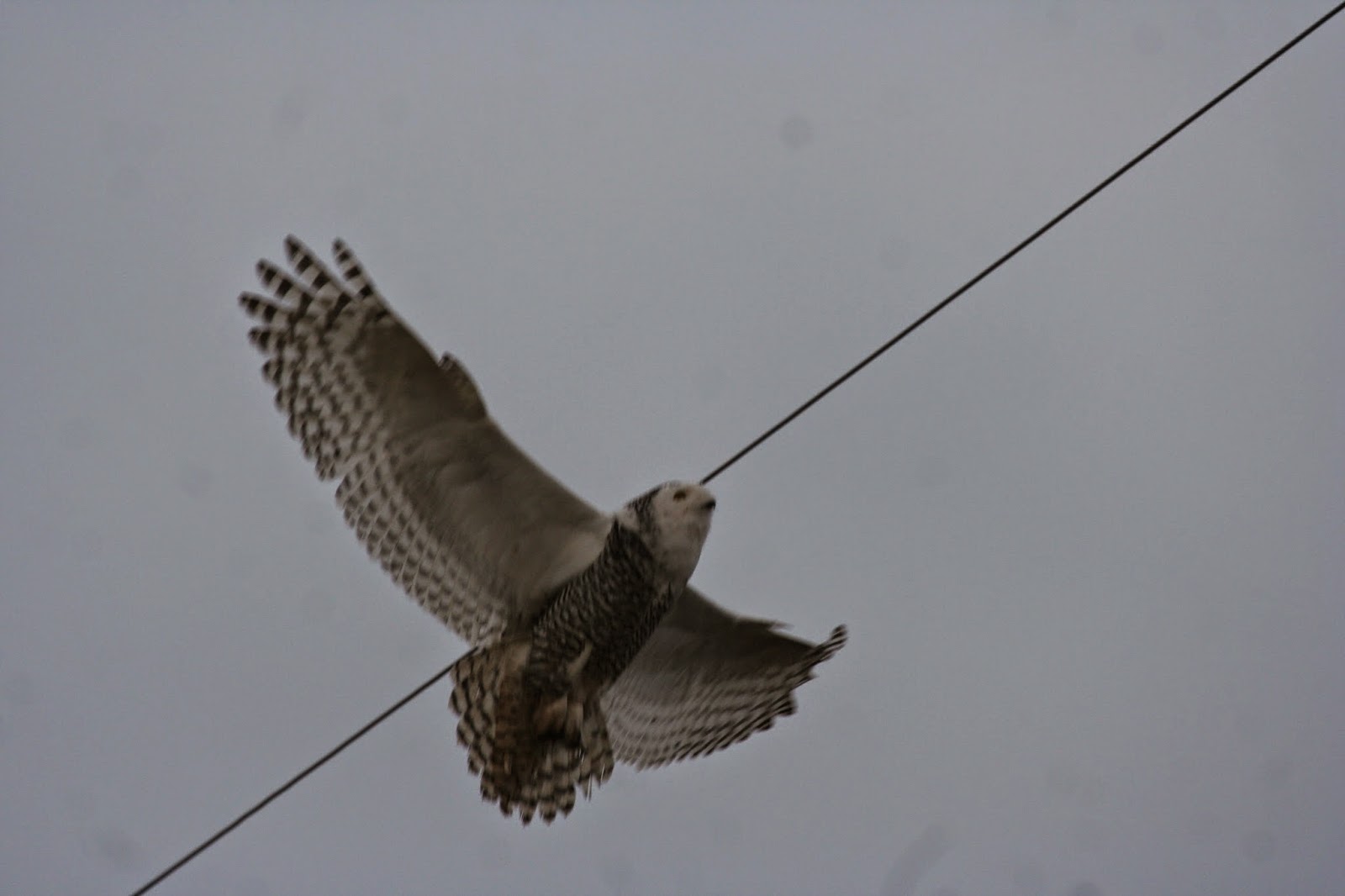


I'm spending some time with a couple young adults this break; one is just in college, one a couple of years out. The one in college has matured a lot in the past few months. If I ask hir to do something, it just gets quietly done, not hesitating, fretting, just quietly done. Zie doesn't SEE things that need to be done, mostly, isn't thinking ahead about what needs to be done, but if I ask, they get done, and done appropriately.
The younger teen, on the other hand, is way less confident, doesn't see stuff even when asked, fusses a bit (but still, very cooperative for a teen). There's a sort of vague quality to hir doing stuff, even something as basic as mixing pancake batter, which most adults (in my pancake mixing experience) do rather quickly by hand, takes five minutes, and isn't quick at all in hir hands. The younger one gives me that "adults be crazy" look. A lot.
I never wanted to be a parent, and am very happy with my decisions that way, but interacting with these teens, I think I could have been a decent parent to teens, but not when I was much younger. (A baby would have left me crying on the floor, though.)
I guess what I don't think a lot about day to day but have noticed in interacting with the teens, is that at some point in my life, I went from being that younger teen to being someone who notices when something needs done, who feels pretty capable of getting things done, and who does stuff. It's not that, for example, I like putting gas in the car, but I keep an eye on the gas gauge, plan a bit ahead about getting gas, and get the gas without fussing or worrying.
(I do feel more anxious if someone else is going to be needing to eat what I'm cooking, though, for example. I guess I'm confident about doing stuff for myself, but less confident about doing stuff when other people might have a strong opinion about it?)
And now, for your viewing pleasure, more snowy owl pictures.
Wednesday, December 24, 2014


Monday, December 22, 2014
Courthouse
I went to the county courthouse today to pay my real estate taxes.
While I was at the counter, someone came to inquire about where to file divorce papers, and someone else came and looked lost, and so on. And it occurred to me that while for the people working there, the county courthouse is a place to work, and probably there are good days and bad days, otherwise, paying real estate taxes is probably the most pleasant reason for someone else to be there. It's not like paying taxes is my favorite, but I'm paying taxes because I'm lucky enough to own (well, with the bank) property. And I'm not getting a divorce, or making some less pleasant payment. (And let's face it, I like having roads to drive on, schools to educate local kids, and so forth. I'd gladly pay more in taxes for better schools and road maintenance.)
Paying taxes in my town is probably a lower key affair than in some places. I walked into the building, was called to the window counter by a worker almost immediately, gave her my paperwork, and so forth.
There was a really lovely photo up on the wall, and I mentioned how lovely it was, and the worker said yes, she really liked it, too. And then she mentioned that one of her grandkids, just graduating from college, had majored in photography, and took some great pictures, too. So I said I bet she was really proud, and she told me about some other grandkids, and I congratulated her, and she beamed.
And then my taxes were paid, and I left, and the counter was empty until someone else went to pay stuff. (There were two workers at the counter, and they pretty much invited people up to the counter as soon as they walked in, so it wasn't like our little conversation was holding up a long line.)
My annual visit to the county courthouse done, I went on my way to turn in grades. Paying my taxes sort of marks the end of fall semester every year.
While I was at the counter, someone came to inquire about where to file divorce papers, and someone else came and looked lost, and so on. And it occurred to me that while for the people working there, the county courthouse is a place to work, and probably there are good days and bad days, otherwise, paying real estate taxes is probably the most pleasant reason for someone else to be there. It's not like paying taxes is my favorite, but I'm paying taxes because I'm lucky enough to own (well, with the bank) property. And I'm not getting a divorce, or making some less pleasant payment. (And let's face it, I like having roads to drive on, schools to educate local kids, and so forth. I'd gladly pay more in taxes for better schools and road maintenance.)
Paying taxes in my town is probably a lower key affair than in some places. I walked into the building, was called to the window counter by a worker almost immediately, gave her my paperwork, and so forth.
There was a really lovely photo up on the wall, and I mentioned how lovely it was, and the worker said yes, she really liked it, too. And then she mentioned that one of her grandkids, just graduating from college, had majored in photography, and took some great pictures, too. So I said I bet she was really proud, and she told me about some other grandkids, and I congratulated her, and she beamed.
And then my taxes were paid, and I left, and the counter was empty until someone else went to pay stuff. (There were two workers at the counter, and they pretty much invited people up to the counter as soon as they walked in, so it wasn't like our little conversation was holding up a long line.)
My annual visit to the county courthouse done, I went on my way to turn in grades. Paying my taxes sort of marks the end of fall semester every year.
Friday, December 19, 2014
Thoughts on "Comparing Living Standards Over Time"
I saw a link over on Mike the Mad Biologist's link review (something he puts up almost every day), and followed it to an article "Comparing Living Standards Over Time." (Take a quick look, and also look at the comments, too, if you want.)
So, the basic question is: would it be better to live on an income of $100K in 1964 or 2014.
The article notes that an income of $100K in 1964 was a whole lot, but that you wouldn't have access to some technologies we're all really dependent on now.
And then it talks about how if you were asked the same question but the amount was $20K in either year, you'd be way better off in 1964 on $20K, the point it's trying to make being that the technological stuff is mostly available to people who have lots more disposable income, and so the extra income would be better for someone with the $20K then.
And then the commenters start to talk.
1964. No thanks. And it's not the technologies I'd miss. It's basic civil rights for African Americans, for women, for GLBTQ folks. I mean, we're not at all perfect now, but thank dog it's not 1964. Let's think about the Voting Rights Act (1965), Title IX (1972), the end of "Don't Ask, Don't Tell" (2011), and so forth. Maybe we should also think about Vietnam? (Yes, we're also in deep military crappola now.)
I didn't see anything, not a single thing, in the article about how race or gender or sexuality might affect one's thinking about 1964 vs 2014, and I looked but didn't see a single comment talk about it either. (Okay, I looked down towards the bottom, and there's one comment, from "Honkie Please.") In response, someone comments that of course they're all white men commenting, and that women had it better then than now.
And that, that is one of the big things wrong with the internet: it's totally dominated by patriarchal, straight, white, male jerks.
So, the basic question is: would it be better to live on an income of $100K in 1964 or 2014.
The article notes that an income of $100K in 1964 was a whole lot, but that you wouldn't have access to some technologies we're all really dependent on now.
And then it talks about how if you were asked the same question but the amount was $20K in either year, you'd be way better off in 1964 on $20K, the point it's trying to make being that the technological stuff is mostly available to people who have lots more disposable income, and so the extra income would be better for someone with the $20K then.
And then the commenters start to talk.
1964. No thanks. And it's not the technologies I'd miss. It's basic civil rights for African Americans, for women, for GLBTQ folks. I mean, we're not at all perfect now, but thank dog it's not 1964. Let's think about the Voting Rights Act (1965), Title IX (1972), the end of "Don't Ask, Don't Tell" (2011), and so forth. Maybe we should also think about Vietnam? (Yes, we're also in deep military crappola now.)
I didn't see anything, not a single thing, in the article about how race or gender or sexuality might affect one's thinking about 1964 vs 2014, and I looked but didn't see a single comment talk about it either. (Okay, I looked down towards the bottom, and there's one comment, from "Honkie Please.") In response, someone comments that of course they're all white men commenting, and that women had it better then than now.
And that, that is one of the big things wrong with the internet: it's totally dominated by patriarchal, straight, white, male jerks.
Random Thoughts at the End of the Semester
- Last night was the last Colbert Report. I think we liberal arts folks are going to miss the obvious, beautiful examples of satire Colbert provided. I hope his next effort is as smart and fun. And I hope someone else comes in the slot with great stuff.
- Death by a thousand paper cuts: why is it when I think I've finished a stack, someone turns in late stuff. Or gets sick and can't take the final. Or has a car problem and can't make it to campus. And why is it that the person who turns in stuff late says something along the lines of, "I'm turning this in late." And nothing along the lines of, "I emailed you about my difficulty, and want to thank you for giving me permission to turn the assignment in late."
I'm sympathetic to folks with illness or car problems, but it doesn't mean I like having to write a make up exam. I'm less sympathetic to folks who just turn in stuff late.
- I've now graded the three biggest, hardest stacks of work. I have (or will have at the end of the day) three more stacks, none of which requires the feedback the first three stacks did. Feedback takes a long time. Assigning a grade takes less time.
- Because it's easier than grading, I'm thinking about stuff for a class next semester. I'm thinking of doing an assignment where students would read a critical essay, and then read all the work the essay cited. I'd have to do a really good job finding good essays, so that they'd have stuff available to them (so, nothing that requires a reading knowledge of Latin, and nothing that requires a trip to the British Library or public records offices).
- My last final is today, starting at 3pm. Someone has to get the time, I suppose. Ugh.
- One of my friends at a different school had her students turn in their work on the school system (you know, the system for having course stuff), responded to the work on the system, and entered grades on the system. The system lost every single thing. EVERY SINGLE THING. It is as if she did none of that work. (I can't swear that she didn't miss a step of hitting submit somewhere, or something, but I can honestly say that no one has ever missed that step in a paper grade book.)
Thursday, December 18, 2014
Ringing
For the past, maybe 10 days or two weeks, I've had a constant ringing in my ears. Not really ringing, more a steady, high-pitched sound, not horribly loud, but loud enough. It's bad enough that I have a sort of constant low-grade headache and queasiness.
After about two days, it went away for a while, and then came back, and it's been steady ever since.
Ugh.
I checked the web, and it said that sometimes it's a symptom of high blood pressure, so I went to the mall, and after sitting quietly for a couple of minutes, mine measured at about 125/180, which is higher than it should be, but not scary high, I don't think.
I haven't worn earphones or plugs in a long, long time (think a couple years for plugs, and longer by far for earphones). I haven't been at anything really loud.
The web site also said that sometimes it's from an aspirin overdose, but I haven't taken aspirin in years.
I sometimes have a nightcap, and I stopped that for a week, but the ringing continued.
Finally, today I called to try to make an appointment at the clinic. The doctor I saw there before moved a while back, and I haven't been sick since, so I haven't gone, so now I have an appointment to see a new (to me) doctor there, in January. I sure hope the ringing stops before then, because it's irritating.
(The web thing said that it wasn't usually a sign of horribleness, and the person making an appointment at the clinic didn't say I should go to the emergency room ASAP either. So I'm not really worried, but more frustrated. It's hard to concentrate this way.)
After about two days, it went away for a while, and then came back, and it's been steady ever since.
Ugh.
I checked the web, and it said that sometimes it's a symptom of high blood pressure, so I went to the mall, and after sitting quietly for a couple of minutes, mine measured at about 125/180, which is higher than it should be, but not scary high, I don't think.
I haven't worn earphones or plugs in a long, long time (think a couple years for plugs, and longer by far for earphones). I haven't been at anything really loud.
The web site also said that sometimes it's from an aspirin overdose, but I haven't taken aspirin in years.
I sometimes have a nightcap, and I stopped that for a week, but the ringing continued.
Finally, today I called to try to make an appointment at the clinic. The doctor I saw there before moved a while back, and I haven't been sick since, so I haven't gone, so now I have an appointment to see a new (to me) doctor there, in January. I sure hope the ringing stops before then, because it's irritating.
(The web thing said that it wasn't usually a sign of horribleness, and the person making an appointment at the clinic didn't say I should go to the emergency room ASAP either. So I'm not really worried, but more frustrated. It's hard to concentrate this way.)
Tuesday, December 16, 2014
Teaching Citation
I feel that I've failed a bit in teaching citation this semester. Some of my students have gotten into the habit of citing, at least, so I don't think I've failed there, at least. (And to be honest, if I could get every student to get in the habit of citing in academic contexts, I'd feel pretty good.)
The failure's a bit deeper than that, and comes from my sense of some of the research papers I've been reading this week. The students know they need to cite. But on some level, they don't know why they need to cite. Or, perhaps more to the point, they don't know why they're incorporating someone else's argument so that they need to cite it.
As we discussed a few months ago, we cite people's work for many different reasons. But some of my students don't seem to really understand any of those reasons. So they include something about someone else's work in the paper, and cite it appropriately, but it really doesn't contribute to their argument. It's just there. Maybe they think having it there will lend "credibility" to their own argument, but since it's not contributing, it doesn't work that way, even.
Back to grading jail.
The failure's a bit deeper than that, and comes from my sense of some of the research papers I've been reading this week. The students know they need to cite. But on some level, they don't know why they need to cite. Or, perhaps more to the point, they don't know why they're incorporating someone else's argument so that they need to cite it.
As we discussed a few months ago, we cite people's work for many different reasons. But some of my students don't seem to really understand any of those reasons. So they include something about someone else's work in the paper, and cite it appropriately, but it really doesn't contribute to their argument. It's just there. Maybe they think having it there will lend "credibility" to their own argument, but since it's not contributing, it doesn't work that way, even.
Back to grading jail.
Sunday, December 14, 2014
"People Change Towards You"
I've had a couple friends move into various administrative type positions over the years, and a common refrain I've heard is that they were told that "people change towards you." And they tell me it's true that people change towards them. Things just aren't the same.
So I've tried to be pretty aware of how I change towards people as they've gone into administration. And I think it's true. Some things I do change. For example, I don't easily share personal problems because it feels like every conversation is "official." And if I share that I'm having difficulty with a class, that's going to be on the person's mind if they review me, or see my application for something, and so on. If I tell them I'm feeling lousy, then the response is all official and not what I'm probably looking for, the sympathetic "gosh, I'm sorry, I hope you feel better soon! Have some chicken soup." So if a friend who's gone into administration feels that I've pulled back, that's a reasonable observation, I think.
But what I don't hear from the administrative folks is that they, too, change. For one, they seem to quickly lose touch with the rhythm of the teaching semester. I've had administrative friends suggest I take a week off in the middle of the semester to do a group vacation, for example.
And this week, there's another:
In the stone ages, my department used to give a "common" grammar type exam in comp courses. Everyone hated it, and we voted it away not long after I came, but when it was there, it was on the first Monday of finals week, at 8am, and then we'd have a departmental potluck for lunch that day, too. We were all on campus anyway, and the emeriti and spouses would come, and we'd all blow off some steam, and then get back to grading jail. (I'm sure it was even easier when most of the faculty were married men whose spouses would cook the potluck and bring it still hot from the oven.)
The practice faded away because without the common exam we weren't all on campus on Monday, and we're all busy, and about half of us are women who don't have a spouse to obligingly cook and bring our potluck dish, and so on.
The new chair decided to bring back the tradition. I think some of the emeriti really missed it.
I signed up because I want to be supportive of the new chair, but I'm irritated that I'll have to get up early to get to campus to get parking, spend at least half a day on campus getting far less grading done than I would at home, figure out food to bring (I've done that, at least).
Judging from the nudges we got from the departmental staff folks, sign ups were slow. And the sign up sheet wasn't very full when I put my name on there. I think this is one of those things we should let go of, and let us do our jobs without demanding that we socialize on campus, officially.
May I also note that it irritates me slightly that the married faculty couples (both in the department) bring one dish, prepared by the female partner. The married men in my department seem largely incapable of turning on a stove or oven; the ones who are married to non-department members always seem to note that their wives made their dish, unless they've chosen to bring cheese on a platter, in which case they may have made the purchase.
So I've tried to be pretty aware of how I change towards people as they've gone into administration. And I think it's true. Some things I do change. For example, I don't easily share personal problems because it feels like every conversation is "official." And if I share that I'm having difficulty with a class, that's going to be on the person's mind if they review me, or see my application for something, and so on. If I tell them I'm feeling lousy, then the response is all official and not what I'm probably looking for, the sympathetic "gosh, I'm sorry, I hope you feel better soon! Have some chicken soup." So if a friend who's gone into administration feels that I've pulled back, that's a reasonable observation, I think.
But what I don't hear from the administrative folks is that they, too, change. For one, they seem to quickly lose touch with the rhythm of the teaching semester. I've had administrative friends suggest I take a week off in the middle of the semester to do a group vacation, for example.
And this week, there's another:
In the stone ages, my department used to give a "common" grammar type exam in comp courses. Everyone hated it, and we voted it away not long after I came, but when it was there, it was on the first Monday of finals week, at 8am, and then we'd have a departmental potluck for lunch that day, too. We were all on campus anyway, and the emeriti and spouses would come, and we'd all blow off some steam, and then get back to grading jail. (I'm sure it was even easier when most of the faculty were married men whose spouses would cook the potluck and bring it still hot from the oven.)
The practice faded away because without the common exam we weren't all on campus on Monday, and we're all busy, and about half of us are women who don't have a spouse to obligingly cook and bring our potluck dish, and so on.
The new chair decided to bring back the tradition. I think some of the emeriti really missed it.
I signed up because I want to be supportive of the new chair, but I'm irritated that I'll have to get up early to get to campus to get parking, spend at least half a day on campus getting far less grading done than I would at home, figure out food to bring (I've done that, at least).
Judging from the nudges we got from the departmental staff folks, sign ups were slow. And the sign up sheet wasn't very full when I put my name on there. I think this is one of those things we should let go of, and let us do our jobs without demanding that we socialize on campus, officially.
May I also note that it irritates me slightly that the married faculty couples (both in the department) bring one dish, prepared by the female partner. The married men in my department seem largely incapable of turning on a stove or oven; the ones who are married to non-department members always seem to note that their wives made their dish, unless they've chosen to bring cheese on a platter, in which case they may have made the purchase.
Saturday, December 13, 2014
Northern Hawk Owl
In addition to reports of lots of Snowy Owls irrupting into the upper Midwest, we've got a Northern Hawk Owl! So I took a little field trip away from grading and got lucky!
And the owl was very cooperative.


And the owl was very cooperative.
Friday, December 12, 2014
Special Studies
I got a polite email the other day from a student enrolled in my Chaucer course who wants to do a special study thing through the honors program so that it counts as an honors course for hir degree; zie asked if we could meet.
I looked at the agreement form on the honors website, and it looks like the instructor and student need to agree on something that will make it count for honors. The form suggested that the student might do an extra paper or project, might teach a segment of the course, might do research, or extra journal writing, and so forth.
So I emailed the student back, happy to meet, and suggested that zie talk to the head of the program about what sorts of things students did. When zie came in, zie said the program head had basically shown hir the form with its suggestions and that was it for suggestions.
I'm at a loss.
I asked hir if zie had interests in medieval lit, or in a specific theoretical approach, but zie said no. Zie thought zie'd read some Chaucer in high school, but couldn't remember if zie had read in Middle English or not.
Zie is qualified to take the course, no question. But zie is not so qualified that I can imagine hir coming up with a project beyond what the course will require of all students. Nor does zie seem qualified to teach a segment of the course.
I really don't think it's my job to think of a project.
I suggested that the student go back to the program director and ask what he'd do if a student who'd taken only a single intro course in Spanish, and were in an upper level Don Quixote in translation course wanted to do this sort of project.
In an ideal world, I'd have a lab where I could slot the student to measure some plant growth or something, and that would count for the extra work. But in the humanities world, it's hard to see how to do this sort of thing without it being a lot more work on my part. And unless this student's exceptional (some are!), it's hard to see the student actually doing meaningful work on Chaucer without a huge amount of extra work on my part. And honestly, I don't see most students being willing and able to do a huge amount of extra work. Some are, and I'm happy to work with them. But most aren't.
Has anyone else done a similar sort of thing with humanities? Can I ask for project suggestions?
I looked at the agreement form on the honors website, and it looks like the instructor and student need to agree on something that will make it count for honors. The form suggested that the student might do an extra paper or project, might teach a segment of the course, might do research, or extra journal writing, and so forth.
So I emailed the student back, happy to meet, and suggested that zie talk to the head of the program about what sorts of things students did. When zie came in, zie said the program head had basically shown hir the form with its suggestions and that was it for suggestions.
I'm at a loss.
I asked hir if zie had interests in medieval lit, or in a specific theoretical approach, but zie said no. Zie thought zie'd read some Chaucer in high school, but couldn't remember if zie had read in Middle English or not.
Zie is qualified to take the course, no question. But zie is not so qualified that I can imagine hir coming up with a project beyond what the course will require of all students. Nor does zie seem qualified to teach a segment of the course.
I really don't think it's my job to think of a project.
I suggested that the student go back to the program director and ask what he'd do if a student who'd taken only a single intro course in Spanish, and were in an upper level Don Quixote in translation course wanted to do this sort of project.
In an ideal world, I'd have a lab where I could slot the student to measure some plant growth or something, and that would count for the extra work. But in the humanities world, it's hard to see how to do this sort of thing without it being a lot more work on my part. And unless this student's exceptional (some are!), it's hard to see the student actually doing meaningful work on Chaucer without a huge amount of extra work on my part. And honestly, I don't see most students being willing and able to do a huge amount of extra work. Some are, and I'm happy to work with them. But most aren't.
Has anyone else done a similar sort of thing with humanities? Can I ask for project suggestions?
Thursday, December 11, 2014
The Void
Yesterday, my senior seminar was doing a proofreading exercise on their final papers. The papers were formally due yesterday, too, though I'd said I'd happily accept them until whatever time I left the office Friday afternoon. Indeed, I also told them that while I'm happy with neatly handwritten corrections to proofreading problems, they could also take their work home and make the changes electronically, and then turn in the hard copies until Friday.
Still, about a third of the papers got turned in yesterday. A few didn't because there was a proofreading problem the student just didn't want to hand correct.
In our casual conversation towards the end of the class session, when I told them that I'd be handing their papers back during the final exam period, and that we'd discuss what they learned, a couple of them commented on how unusual it is to get final papers back, and how happy they are about it.
They talked about turning in papers they'd worked really hard on and not getting any feedback or even knowing how they'd done on the paper. They find this understandably frustrating.
From the professorial point of view, of course, it's way easier to read the paper, put a grade on, add it to the record, and move on than it is to read the paper, think about what might be useful feedback, give feedback, put a grade on, add it to the record and then move on. It can take me as long to think about and give useful feedback as it takes to read the paper and put a grade on it. Longer, even, because giving useful feedback is intellectually difficult work, often.
And, as a professor, I know that if half of my students will never pick up their paper, but I've put feedback on it, I've wasted a whole lot of time. And I can't predict which half. So what a lot of people do (including me, at times) is make papers due during finals, so there's no way anyone can expect to get them back during finals week, and then tell students that I'll give them feedback if they'll come to my office and ask. And very few students do that. The thinking is that it will be easy to give that feedback if they do come, but of course it isn't easy, and I tended to begrudge the time.
My solution nowadays is to try to return papers during finals week. But that means I have a hard, hard week ahead.
I'd better get to it.
Still, about a third of the papers got turned in yesterday. A few didn't because there was a proofreading problem the student just didn't want to hand correct.
In our casual conversation towards the end of the class session, when I told them that I'd be handing their papers back during the final exam period, and that we'd discuss what they learned, a couple of them commented on how unusual it is to get final papers back, and how happy they are about it.
They talked about turning in papers they'd worked really hard on and not getting any feedback or even knowing how they'd done on the paper. They find this understandably frustrating.
From the professorial point of view, of course, it's way easier to read the paper, put a grade on, add it to the record, and move on than it is to read the paper, think about what might be useful feedback, give feedback, put a grade on, add it to the record and then move on. It can take me as long to think about and give useful feedback as it takes to read the paper and put a grade on it. Longer, even, because giving useful feedback is intellectually difficult work, often.
And, as a professor, I know that if half of my students will never pick up their paper, but I've put feedback on it, I've wasted a whole lot of time. And I can't predict which half. So what a lot of people do (including me, at times) is make papers due during finals, so there's no way anyone can expect to get them back during finals week, and then tell students that I'll give them feedback if they'll come to my office and ask. And very few students do that. The thinking is that it will be easy to give that feedback if they do come, but of course it isn't easy, and I tended to begrudge the time.
My solution nowadays is to try to return papers during finals week. But that means I have a hard, hard week ahead.
I'd better get to it.
Wednesday, December 10, 2014
Shame and eternal shame, nothing but shame
The words are from Bourbon, in Shakespeare's Henry V, talking about the impending loss by the French to the English at the battle of Agincourt. I don't think there was eternal shame in losing the battle, certainly not in being a character that talks about losing the battle.
But there may be eternal shame, nothing but shame, in the way the US government has tortured captives.
Here's the BBC page on the report.
Here's a floor statement from John McCain, someone I rarely agree with politically. McCain says,
Unlike McCain, I think "unnecessary" really isn't the point. I don't think we can excuse the US government's use of torture even if we assert that the US gained a single bit of useful information. Torture is wrong, and we were wrong to use it.
Here's a bit more from McCain:
And I'm ashamed that I've done nothing to insist that the US government not hold prisoners without charging them or giving them a fair trial. We've all known about Guantanamo and the torture for years. Let's not lie to ourselves or anyone else about "not knowing."
These values are central to the US Constitution, as central as values of free speech and freedom from governmental establishment of religion. Just to remind ourselves:
We, the people of the United States, have allowed the government and its agents to act illegally for far, far too long, to our shame and eternal shame. What can we do to make change?
But there may be eternal shame, nothing but shame, in the way the US government has tortured captives.
Here's the BBC page on the report.
Here's a floor statement from John McCain, someone I rarely agree with politically. McCain says,
I have long believed some of these practices amounted to torture, as a reasonable person would define it, especially, but not only the practice of waterboarding, which is a mock execution and an exquisite form of torture. Its use was shameful and unnecessary; and, contrary to assertions made by some of its defenders and as the Committee’s report makes clear, it produced little useful intelligence to help us track down the perpetrators of 9/11 or prevent new attacks and atrocities.I think McCain's right here: the practices amounted to torture, and were shameful.
Unlike McCain, I think "unnecessary" really isn't the point. I don't think we can excuse the US government's use of torture even if we assert that the US gained a single bit of useful information. Torture is wrong, and we were wrong to use it.
Here's a bit more from McCain:
“But in the end, torture’s failure to serve its intended purpose isn’t the main reason to oppose its use. I have often said, and will always maintain, that this question isn’t about our enemies; it’s about us. It’s about who we were, who we are and who we aspire to be. It’s about how we represent ourselves to the world.
“We have made our way in this often dangerous and cruel world, not by just strictly pursuing our geopolitical interests, but by exemplifying our political values, and influencing other nations to embrace them. When we fight to defend our security we fight also for an idea, not for a tribe or a twisted interpretation of an ancient religion or for a king, but for an idea that all men are endowed by the Creator with inalienable rights. How much safer the world would be if all nations believed the same. How much more dangerous it can become when we forget it ourselves even momentarily.I'm ashamed because I haven't done something to stop the torture. I still don't know what I could have done, but I'm ashamed that I've done nothing.
And I'm ashamed that I've done nothing to insist that the US government not hold prisoners without charging them or giving them a fair trial. We've all known about Guantanamo and the torture for years. Let's not lie to ourselves or anyone else about "not knowing."
These values are central to the US Constitution, as central as values of free speech and freedom from governmental establishment of religion. Just to remind ourselves:
My question is, to avoid shame and eternal shame, what can I, a citizen of these United States, do to stop the government and its agents from torturing and illegally holding prisoners, depriving them of liberty, without charges or a fair, public trial?Fifth Amendment
No person shall be held to answer for a capital, or otherwise infamous crime, unless on a presentment or indictment of a Grand Jury, except in cases arising in the land or naval forces, or in the Militia, when in actual service in time of War or public danger; nor shall any person be subject for the same offence to be twice put in jeopardy of life or limb; nor shall be compelled in any criminal case to be a witness against himself; nor be deprived of life, liberty, or property, without due process of law; nor shall private property be taken for public use without just compensation.
Sixth Amendment
In all criminal prosecutions, the accused shall enjoy the right to a speedy and public trial, by an impartial jury of the State and district wherein the crime shall have been committed; which district shall have been previously ascertained by law, and to be informed of the nature and cause of the accusation; to be confronted with the witnesses against him; to have compulsory process for obtaining witnesses in his favor; and to have the assistance of counsel for his defence.
We, the people of the United States, have allowed the government and its agents to act illegally for far, far too long, to our shame and eternal shame. What can we do to make change?
Tuesday, December 09, 2014
The Quiet Before...
I made a rookie mistake this semester. Yep. I made the due dates for the biggest projects in all three of my courses on the last Friday of classes, as it happens, this Friday. So, I've pretty much done all the grading that can be done until I get those in. (I will have peer revision/draft day grades for one course, but can't do those until I get in their feedback papers.)
So, for now, I'm sort of waiting for the deluge.
I should be working on my SAA paper, of course. Yes. And I am, slowly. But I should be pushing that a whole lot harder.
Time to get to that!
So, for now, I'm sort of waiting for the deluge.
I should be working on my SAA paper, of course. Yes. And I am, slowly. But I should be pushing that a whole lot harder.
Time to get to that!
Monday, December 08, 2014
It's Official
I have a half share in a big snow blower, which is sitting in my garage at this very moment. (I'm sharing with some neighbors, which is great, let me say.)
I guess I really am a midwesterner now.
Also, I had a conversation this morning about forcing bulbs.
Uffda.
I guess I really am a midwesterner now.
Also, I had a conversation this morning about forcing bulbs.
Uffda.
Friday, December 05, 2014
Damned if You Do...
The Underwater Basketweaving Department was having such a lively discussion of assessment today that I could hear it from my 9th story office.
All the UB majors choose a submajor, so what may have at one time been considered just "Underwater Basketweaving major" is now the "Comprehensive Underwater Basketweaving" major. And there's also "Creative Underwater Basketweaving," "Technical Studies in Underwater Basketweaving," and so forth. About half the courses that all the majors take are basically comprehensive courses.
The "comprehensive" faculty tends to teach pretty much all the students, while only a small subset takes "technical studies" courses, since the technical studies submajor has maybe 15 majors at any given time, and comprehensive has 150. So, pretty much everyone takes one or another senior course in "Understanding Contexts of Underwater Basketweaving" in whatever context area the faculty member does. So, when a deepwater UB historian is teaching it, then deepwater is the context. And so on.
The argument seems to have been about this: the comprehensive folks have to assess how the comprehensive submajor program is doing, and the logical place to do this is in the senior context courses, since all their submajors take these. But lots of other submajors take them, too.
Thus, if the course is assessing outcome X, where X is supposed to be learned in a bunch of comprehensive courses, and there are 15 comprehensive submajors and 5 other submajors, the assessment is going to be potentially problematic, no? What if in the assessment, the 15 comprensive submajors all do "good job" on outcome X, but the other 5 do "not a good job"?
Either they just run the data as is, and find out that they're only doing 75%, and that's not good enough, right? Damned.
Or they tease out the data, but then they're told that since the other course is supposed to teach students outcome X (something like, say, piano playing, that's likely to be much better if you've practiced again and again as opposed to having a lesson and thinking you're ready for Carnegie Hall), then they're damned because they aren't teaching the other submajors well enough. Damned.
Or they tease out the data and find out that the other submajors do just as well as the comprehensive submajors. Then obviously, those other comprehensive courses aren't necessary at all, and they can just cut those out of the curriculum, and students will "achieve the outcome" with the one course no matter their submajor. Damned.
In times of budget cuts, which are plentiful around here, the comprehensive folks are going to be damned either way. And, of course, they're doubly damned because since they're the only courses where all the submajors take courses too, they're also responsible for the whole program assessment.
All the UB majors choose a submajor, so what may have at one time been considered just "Underwater Basketweaving major" is now the "Comprehensive Underwater Basketweaving" major. And there's also "Creative Underwater Basketweaving," "Technical Studies in Underwater Basketweaving," and so forth. About half the courses that all the majors take are basically comprehensive courses.
The "comprehensive" faculty tends to teach pretty much all the students, while only a small subset takes "technical studies" courses, since the technical studies submajor has maybe 15 majors at any given time, and comprehensive has 150. So, pretty much everyone takes one or another senior course in "Understanding Contexts of Underwater Basketweaving" in whatever context area the faculty member does. So, when a deepwater UB historian is teaching it, then deepwater is the context. And so on.
The argument seems to have been about this: the comprehensive folks have to assess how the comprehensive submajor program is doing, and the logical place to do this is in the senior context courses, since all their submajors take these. But lots of other submajors take them, too.
Thus, if the course is assessing outcome X, where X is supposed to be learned in a bunch of comprehensive courses, and there are 15 comprehensive submajors and 5 other submajors, the assessment is going to be potentially problematic, no? What if in the assessment, the 15 comprensive submajors all do "good job" on outcome X, but the other 5 do "not a good job"?
Either they just run the data as is, and find out that they're only doing 75%, and that's not good enough, right? Damned.
Or they tease out the data, but then they're told that since the other course is supposed to teach students outcome X (something like, say, piano playing, that's likely to be much better if you've practiced again and again as opposed to having a lesson and thinking you're ready for Carnegie Hall), then they're damned because they aren't teaching the other submajors well enough. Damned.
Or they tease out the data and find out that the other submajors do just as well as the comprehensive submajors. Then obviously, those other comprehensive courses aren't necessary at all, and they can just cut those out of the curriculum, and students will "achieve the outcome" with the one course no matter their submajor. Damned.
In times of budget cuts, which are plentiful around here, the comprehensive folks are going to be damned either way. And, of course, they're doubly damned because since they're the only courses where all the submajors take courses too, they're also responsible for the whole program assessment.
Dress Up
Last month some time, someone administrative from the services side sent around an email requesting that everyone on campus dress in campus colors every Friday. This morning, I saw a little poster put up about it.
Folks, I'm an adult. If I want to dress in colors and such, fine. But this semi-official "everyone dress like we're high school students" stuff is just irritating.
And yesterday, a faculty member sent around an email requesting that everyone wear "ugly sweaters" or other "holiday" garb, including a list that was very Christian-centered.
Also, I'm not Christian. For six to eight weeks a year, I get slammed with Christmas stuff. Last Friday, for example, I turned on NPR in the morning to a Christmas song, and I immediately turned it off. I have no idea why they had a Christmas song playing (between segments, maybe?), but I just couldn't bear it.
And I don't have any sweaters I consider ugly. I've gotten rid of sweaters I considered ugly, but they're no longer taking up my closet space.
Why, oh why, are we at a public institution being BSed into wearing Christmas crap?
I don't know how to respond. Christians here are so effing repressive that any complaint will be made into a war on Christmas thing.
Folks, I'm an adult. If I want to dress in colors and such, fine. But this semi-official "everyone dress like we're high school students" stuff is just irritating.
And yesterday, a faculty member sent around an email requesting that everyone wear "ugly sweaters" or other "holiday" garb, including a list that was very Christian-centered.
Also, I'm not Christian. For six to eight weeks a year, I get slammed with Christmas stuff. Last Friday, for example, I turned on NPR in the morning to a Christmas song, and I immediately turned it off. I have no idea why they had a Christmas song playing (between segments, maybe?), but I just couldn't bear it.
And I don't have any sweaters I consider ugly. I've gotten rid of sweaters I considered ugly, but they're no longer taking up my closet space.
Why, oh why, are we at a public institution being BSed into wearing Christmas crap?
I don't know how to respond. Christians here are so effing repressive that any complaint will be made into a war on Christmas thing.
Wednesday, December 03, 2014
Filling In
We have this policy here, which basically says that if an instructor is missing class, they need to take a sick day (totally reasonable) and find someone else to cover the class. Or at least be there. (At least, if there's advance notice. So if you wake up vomiting with a fever, you can just email the department staff and ask them to let the classes know you're ill that day.)
So typically, say someone knows they have to take their kid to some special thing (getting tonsils out, perhaps), which is totally reasonable. Or even if they have a conference (in which case, they wouldn't take a sick day). They send an email out to the whole department asking if people will step up and cover x, y, and z classes on specific days and times. And then, in the tonsils type case, they have something prepped, and the covering person carries that out.
As you might guess, the same people generally answer the call, with a small cadre answering often, a slightly larger cadre answering sometimes, and most people never answering at all. You might also guess the gender issues. Fathers rarely seem to need to be with their kids to get the tonsils out. Mothers do. Very few men answer the call (I could name two here that often do, so some are super good).
I'm in the slightly larger cadre that answers sometimes. And today is going to be one of those times. I get to go take roll and be the responsible party (see, doesn't that make you laugh?) while the tech folks teach the class how to do some computer programmy thing (it totally makes sense in the context of this assignment sort of thing, even if it sounds wonky).
Officially, we take the sick leave (or so I assume, because when I'm sick I take sick leave... but usually that's the morning of thing, so I don't bother trying to get coverage, and even then, only every few years because I'm very, very lucky).
The students, it's hoped, don't miss out totally on classtime, and learn whatever it is they're supposed to be learning.
But the people who fill in, just fill in. There's no official recognition, no overtime, nada. There's usually a thank you from the person whose class you took, and that's nice. But the extra hour out of your day to do extra work is considered necessary by the powers that be, but unrecognized. They'd get cranky at the person whose class it was if they didn't get coverage, but the people who do that extra work don't get anything for it. (And since people who've never bothered to lift a finger for anyone else ask for and get coverage, it's not a reciprocal thing.)
There's no sense that covering ten times will get you a notch higher on the merit pay thing, for example. The chair, if zie knows, may be momentarily grateful, but then it's done. Much better to use the extra time to work on your own stuff which may be recognized.
I'm just a little frustrated at myself because I really don't want to do this today, but I said I would, and I will, and I know it's sort of going to throw things off the rest of the day. And I'm cranky today because of some stress.
Okay, enough complaining. Time to get everything ready so that it doesn't throw off my day for real.
How do your schools handle coverage of this sort?
So typically, say someone knows they have to take their kid to some special thing (getting tonsils out, perhaps), which is totally reasonable. Or even if they have a conference (in which case, they wouldn't take a sick day). They send an email out to the whole department asking if people will step up and cover x, y, and z classes on specific days and times. And then, in the tonsils type case, they have something prepped, and the covering person carries that out.
As you might guess, the same people generally answer the call, with a small cadre answering often, a slightly larger cadre answering sometimes, and most people never answering at all. You might also guess the gender issues. Fathers rarely seem to need to be with their kids to get the tonsils out. Mothers do. Very few men answer the call (I could name two here that often do, so some are super good).
I'm in the slightly larger cadre that answers sometimes. And today is going to be one of those times. I get to go take roll and be the responsible party (see, doesn't that make you laugh?) while the tech folks teach the class how to do some computer programmy thing (it totally makes sense in the context of this assignment sort of thing, even if it sounds wonky).
Officially, we take the sick leave (or so I assume, because when I'm sick I take sick leave... but usually that's the morning of thing, so I don't bother trying to get coverage, and even then, only every few years because I'm very, very lucky).
The students, it's hoped, don't miss out totally on classtime, and learn whatever it is they're supposed to be learning.
But the people who fill in, just fill in. There's no official recognition, no overtime, nada. There's usually a thank you from the person whose class you took, and that's nice. But the extra hour out of your day to do extra work is considered necessary by the powers that be, but unrecognized. They'd get cranky at the person whose class it was if they didn't get coverage, but the people who do that extra work don't get anything for it. (And since people who've never bothered to lift a finger for anyone else ask for and get coverage, it's not a reciprocal thing.)
There's no sense that covering ten times will get you a notch higher on the merit pay thing, for example. The chair, if zie knows, may be momentarily grateful, but then it's done. Much better to use the extra time to work on your own stuff which may be recognized.
I'm just a little frustrated at myself because I really don't want to do this today, but I said I would, and I will, and I know it's sort of going to throw things off the rest of the day. And I'm cranky today because of some stress.
Okay, enough complaining. Time to get everything ready so that it doesn't throw off my day for real.
How do your schools handle coverage of this sort?
Tuesday, December 02, 2014
Not Quite Random
Here's the smartest thing I've seen written about Thanksgiving this year. It's worth reading: "On Racism at Thanksgiving."
I have two courses this semester where the final project is the last grade and there's no final exam. In both of them, I feel like my job right now is to help the students do a really great project, and not to try to teach them much new stuff. That means conferencing rather than holding class, to some extent. (Not totally, since we also have peer revision work and such.)
My other course has a final project coming due, but also a final exam, and we're still working on learning new stuff. And that's fine.
I did a good bit of grading over the break, and plenty of goofing off, and a few house chores, and it was all in all very good. I'm very happy I didn't travel far.
I applied for that thing I mentioned before, the special thing. I'm not hugely invested, which is good, because around here a lot of special things end up being decided long before actual applications are invited, and inviting applications is just a formality. It's one of the reasons we've had a steady stream of good old boys moving up into positions through other positions.
NPR this morning is running two stories very capitalistically interested, but so very different. The first is a story about, basically, what a bummer it is for small oil producing businesses that the price of oil has dropped. There's no mention of how that drop makes some other businesses more profitable (those who transport goods, for example), or how the drop helps people who buy gas for their cars.
The other is a story about, basically, what a cool thing it is that some folks are buying US produced grass rather than Mexican produced grass, and how the US grass is of higher quality, and now that grass is legal in some US states, the prices of grass have dropped, and that's hurting Mexican producers.
My NPR takeaway: It's bad when US producers are hurt by dropping prices, and good when Mexican producers are hurt. It's good when regular-joe people can get grass more cheaply, and unnoticed (read: bad) when regular-joe people can get gas more cheaply.
I recognize there are lots of complications to both stories. The gas price drop is, as I understand it, partly driven by frac-sand oil production, which is scarily bad for the environment. And gas being really cheap means people tend to drive more. Pot growing has also been traditionally bad environmentally, especially when it's done illegally. I don't know if it would be better if grass were so legal (and cheap) that it were farmed like soy or something. And then there's the drug cartel problem. That's scary as hell.
In a perfect world, run by Queen Bardiac, gas would be expensive enough to incentivize other forms of energy production and use, and we'd somehow find ways to make those forms more environmentally sound.
And pot would be inexpensive enough to make farmers need to do math to decide whether to grow it, or hemp, or soy, or whatever other crops they might grow, and inexpensive enough that no one would be willing to go to jail by growing it on National Park lands or by being violent about it.
I have two courses this semester where the final project is the last grade and there's no final exam. In both of them, I feel like my job right now is to help the students do a really great project, and not to try to teach them much new stuff. That means conferencing rather than holding class, to some extent. (Not totally, since we also have peer revision work and such.)
My other course has a final project coming due, but also a final exam, and we're still working on learning new stuff. And that's fine.
I did a good bit of grading over the break, and plenty of goofing off, and a few house chores, and it was all in all very good. I'm very happy I didn't travel far.
I applied for that thing I mentioned before, the special thing. I'm not hugely invested, which is good, because around here a lot of special things end up being decided long before actual applications are invited, and inviting applications is just a formality. It's one of the reasons we've had a steady stream of good old boys moving up into positions through other positions.
NPR this morning is running two stories very capitalistically interested, but so very different. The first is a story about, basically, what a bummer it is for small oil producing businesses that the price of oil has dropped. There's no mention of how that drop makes some other businesses more profitable (those who transport goods, for example), or how the drop helps people who buy gas for their cars.
The other is a story about, basically, what a cool thing it is that some folks are buying US produced grass rather than Mexican produced grass, and how the US grass is of higher quality, and now that grass is legal in some US states, the prices of grass have dropped, and that's hurting Mexican producers.
My NPR takeaway: It's bad when US producers are hurt by dropping prices, and good when Mexican producers are hurt. It's good when regular-joe people can get grass more cheaply, and unnoticed (read: bad) when regular-joe people can get gas more cheaply.
I recognize there are lots of complications to both stories. The gas price drop is, as I understand it, partly driven by frac-sand oil production, which is scarily bad for the environment. And gas being really cheap means people tend to drive more. Pot growing has also been traditionally bad environmentally, especially when it's done illegally. I don't know if it would be better if grass were so legal (and cheap) that it were farmed like soy or something. And then there's the drug cartel problem. That's scary as hell.
In a perfect world, run by Queen Bardiac, gas would be expensive enough to incentivize other forms of energy production and use, and we'd somehow find ways to make those forms more environmentally sound.
And pot would be inexpensive enough to make farmers need to do math to decide whether to grow it, or hemp, or soy, or whatever other crops they might grow, and inexpensive enough that no one would be willing to go to jail by growing it on National Park lands or by being violent about it.
Wednesday, November 26, 2014
Holiday Music
It's time for some holiday music, appropriate to Thanksgiving.
Here's a video. You should listen. Really.
Here's wishing you a Thanksgiving dinner that can't be beat if you so indulge.
Here's a video. You should listen. Really.
Here's wishing you a Thanksgiving dinner that can't be beat if you so indulge.
Tuesday, November 25, 2014
Grand Jury and Feguson
Ferguson.
I watched the news announcement last night, and knew from the way the man in charge went through things that there'd be no indictment, and there wasn't.
What I didn't know, until friends started posting about such things, is that it's actually really rare for a grand jury in the US to return a "no true bill" finding. (Here's a source: FiveThirtyEight: "It's Incredibly Rare for a Grand Jury to do What Ferguson's Just Did") According to this article,
The Nation has an article up about "Why It's Impossible to Indict a Cop."
And Think Progress has an article up where "Legal Experts Explain Why the Ferguson Grand Jury Was Set Up for Failure."
It's a busy day here, as always, but I'm feeling ignorant and subdued. I really don't understand the Grand Jury process at all (though I've been learning a lot in the past few days).
I have a feeling that I'm witnessing, though from afar, one of those moments that's going to be very important in history. Or maybe I just hope that this will be one of those moments where you point back and say, "a big change began as a result of this."
I watched the news announcement last night, and knew from the way the man in charge went through things that there'd be no indictment, and there wasn't.
What I didn't know, until friends started posting about such things, is that it's actually really rare for a grand jury in the US to return a "no true bill" finding. (Here's a source: FiveThirtyEight: "It's Incredibly Rare for a Grand Jury to do What Ferguson's Just Did") According to this article,
The data suggests he was barely exaggerating: According to the Bureau of Justice Statistics, U.S. attorneys prosecuted 162,000 federal cases in 2010, the most recent year for which we have data. Grand juries declined to return an indictment in 11 of them.The article goes on to note that you can't directly compare a Federal and State Grand Juries, but it still gives a sense that it's really rare for a Grand Jury not to indict someone when a prosecutor argues they should.
The Nation has an article up about "Why It's Impossible to Indict a Cop."
And Think Progress has an article up where "Legal Experts Explain Why the Ferguson Grand Jury Was Set Up for Failure."
It's a busy day here, as always, but I'm feeling ignorant and subdued. I really don't understand the Grand Jury process at all (though I've been learning a lot in the past few days).
I have a feeling that I'm witnessing, though from afar, one of those moments that's going to be very important in history. Or maybe I just hope that this will be one of those moments where you point back and say, "a big change began as a result of this."
Sunday, November 23, 2014
Relief
I spent the weekend at my siblings, hearing one of the kids play a concert.
I'm supposed to go there for Thanksgiving, too.
But the drive beats me up. It's not horrible, but it's long enough that I want to relax after, and not do work. But the work needs to be done.
My in law and I were watching a Netflix show (since I subscribe), and enjoying it, and talking about how we could watch more over the Thanksgiving weekend. But then my sibling said that no, the TV would be on football. My in law suggested that there wouldn't be that much football, but my sibling insisted that there will be three games on Thanksgiving, and they will be on, one after the other, on the TV.
As I drove back today, going slow because the fog was intermittently nasty, I just felt grumpy and headachy.
And when I got back, one of my friends had invited me to Thanksgiving, and it sounds casual and relaxed, and there will be chatting, and laughter, and good potluck food.
So I just decided to accept my friends' invitation. And as soon as I did, I just felt so much better.
I have no urge to drive a long ways, sit around while my sibling dominates the family room with football on TV, and then drive a long ways home, and hope to get some of the work I have to get done done.
Now I have to call my sibling and tell the news. Or call my in law, who's likely to be the only person disappointed, but I know zie will be fine.
My driving this weekend was more stressful than usual:
1. About two weeks ago, the left turn signal started not working sometimes. It's about half the time, and if it doesn't work, I can flip it again and it will work. Still, it's irritating, and I've been trying to find a time to get the car in.
2. On the way, my check engine light went on. It's done this before, and the car repair people say not to worry about it. Why have the light and then say not to worry? I do worry.
3. I discovered that one of my rear brake lights is out.
4. My CD player isn't working. It's got two CDs stuck in there (it holds up to six), and it won't do anything now. That meant instead of listening to a book on CD, I had to find radio stations to listen to. There are WAY too many religious and country stations for my taste, and way too few rock stations, and no Spanish language stations that I can find.
I'm supposed to go there for Thanksgiving, too.
But the drive beats me up. It's not horrible, but it's long enough that I want to relax after, and not do work. But the work needs to be done.
My in law and I were watching a Netflix show (since I subscribe), and enjoying it, and talking about how we could watch more over the Thanksgiving weekend. But then my sibling said that no, the TV would be on football. My in law suggested that there wouldn't be that much football, but my sibling insisted that there will be three games on Thanksgiving, and they will be on, one after the other, on the TV.
As I drove back today, going slow because the fog was intermittently nasty, I just felt grumpy and headachy.
And when I got back, one of my friends had invited me to Thanksgiving, and it sounds casual and relaxed, and there will be chatting, and laughter, and good potluck food.
So I just decided to accept my friends' invitation. And as soon as I did, I just felt so much better.
I have no urge to drive a long ways, sit around while my sibling dominates the family room with football on TV, and then drive a long ways home, and hope to get some of the work I have to get done done.
Now I have to call my sibling and tell the news. Or call my in law, who's likely to be the only person disappointed, but I know zie will be fine.
My driving this weekend was more stressful than usual:
1. About two weeks ago, the left turn signal started not working sometimes. It's about half the time, and if it doesn't work, I can flip it again and it will work. Still, it's irritating, and I've been trying to find a time to get the car in.
2. On the way, my check engine light went on. It's done this before, and the car repair people say not to worry about it. Why have the light and then say not to worry? I do worry.
3. I discovered that one of my rear brake lights is out.
4. My CD player isn't working. It's got two CDs stuck in there (it holds up to six), and it won't do anything now. That meant instead of listening to a book on CD, I had to find radio stations to listen to. There are WAY too many religious and country stations for my taste, and way too few rock stations, and no Spanish language stations that I can find.
Wednesday, November 19, 2014
Quiz Time
It's been a long time, but here's a stick figure lit quiz! What's the text of the day?

And the next question: why do my students hate it so much?
And the next question: why do my students hate it so much?
Sunday, November 16, 2014
Visiting
I visited a colleague's class on Friday as part of the personnel review process. It was really good. There was smart conversation about some interesting texts. When I have classes go that well, I feel pretty darned good about things.
And tonight, I'm prepping to fill in tomorrow for a different colleague who's ill. Fortunately, it's comp, and we're all supposed to teach comp in basically the same way using the same basic program. Frustrating in some ways, but it means that there's a shared vocabulary. And, theoretically, if someone walks into my class on a given day, they should find themselves in familiar territory, and within a few days, give or take, of their own class. That is, at this time of the semester, we're all doing the Blue Project, and probably finishing that up and starting the Green Project. So, my class has peer editing its Blue Project, and has the assignment for the Green one, and we'll begin working on the Green while they put the finishing touches on the Blue and then turn it in. Voila.
Except the course I'm filling in on tomorrow seems to have cut one of the projects completely.
I don't really know what's up (the chair and head of comp stuffs do), but it makes me feel like my own abundant inadequacies with this comp program aren't quite as inadequate as I sometimes think.
In other news, tomorrow is the anniversary of a VERY big day in history. Or at least it was big when it happened.
It's also the anniversary of a mildly famous concert which became, in one form or another, the name of an album that contributed to a rock and roller's rise to fame and fortune.
Anyone want to take a shot at the anniversary game?
And tonight, I'm prepping to fill in tomorrow for a different colleague who's ill. Fortunately, it's comp, and we're all supposed to teach comp in basically the same way using the same basic program. Frustrating in some ways, but it means that there's a shared vocabulary. And, theoretically, if someone walks into my class on a given day, they should find themselves in familiar territory, and within a few days, give or take, of their own class. That is, at this time of the semester, we're all doing the Blue Project, and probably finishing that up and starting the Green Project. So, my class has peer editing its Blue Project, and has the assignment for the Green one, and we'll begin working on the Green while they put the finishing touches on the Blue and then turn it in. Voila.
Except the course I'm filling in on tomorrow seems to have cut one of the projects completely.
I don't really know what's up (the chair and head of comp stuffs do), but it makes me feel like my own abundant inadequacies with this comp program aren't quite as inadequate as I sometimes think.
In other news, tomorrow is the anniversary of a VERY big day in history. Or at least it was big when it happened.
It's also the anniversary of a mildly famous concert which became, in one form or another, the name of an album that contributed to a rock and roller's rise to fame and fortune.
Anyone want to take a shot at the anniversary game?
Wednesday, November 12, 2014
Trending
Back in the stone ages, when I was a student, it was pretty common to have class MWF from 3-4. And not unheard of to have a lab on Friday from 2-5, even.
It was common enough that the Geology department had a legendary course, Geology 500, which met every Friday at 5pm for departmental beer and chat.
In more recent times, Thursday has become the new Friday, and around here, at least, it's rare for us to have a class on Fridays that goes later than 2pm. I taught a MWF 1-2pm course last semester, and the classroom wing was nearly empty except for me and my students.
I feel the urges, too. Most of us in my department can manage a "non-teaching" day during the week, working around our usual 11 credit hour load. For folks on a MWF basic schedule, that usually means you choose either Tuesday or Thursday for the "non-teaching" day.
Folks who teach most of their classes on Tuesdays and Thursdays usually choose either Monday or Friday for their "non-teaching" day; there are times when you can manage both, or sometimes one and Wednesday. It's easy to see the appeal, isn't it?
Students, too, like the same scheduling, often. That's especially true for students who try to fit a whole week of work into four days, Friday, Saturday, Sunday, and Monday, to support themselves while they work at classes on Tuesdays, Wednesdays, and Fridays. Or some of them like to "go home" a lot, and plan their schedules around those visits. Or whatever.
I think there's been a mutual movement, with faculty and students both wanting more Tuesday/Thursday courses, and fewer courses late on Fridays.
Yesterday, I was advising a student and talking with him about what courses to take in the coming semester. He's in a fairly rigid program, and has to take certain set general ed type courses. So, he'd filled in his schedule, but was on the low side of credits for the semester, especially if he wants to graduate in a timely manner.
Here's what his schedule looked like:
Monday afternoon, late, three hours, upper level option for major.
Tuesday / Thursday, starting at 9:30, running three straight courses.
Every single course he needed, except for the Monday afternoon course, was only offered during those three prime slots on Tuesdays and Thursdays, starting at 9:30. We looked at options for general ed courses, all T/T in the three prime slots. We looked at program courses, all T/T in those prime slots.
So I looked. And out of 40 some courses in my department from sophomore level up, only 10 are on Mondays, Wednesdays, and or Fridays. (Some are a late evening one day a week, and I counted those).
I think we (including me) have done ourselves a world of hurt this semester by scheduling so many of our courses against each other. In budget-driven times, I wonder if some of our courses are going to be cancelled, and those of us with contracts will suddenly be teaching more comp or something.
Here are my fingers crossed for decent enrollment in my Chaucer course!
It was common enough that the Geology department had a legendary course, Geology 500, which met every Friday at 5pm for departmental beer and chat.
In more recent times, Thursday has become the new Friday, and around here, at least, it's rare for us to have a class on Fridays that goes later than 2pm. I taught a MWF 1-2pm course last semester, and the classroom wing was nearly empty except for me and my students.
I feel the urges, too. Most of us in my department can manage a "non-teaching" day during the week, working around our usual 11 credit hour load. For folks on a MWF basic schedule, that usually means you choose either Tuesday or Thursday for the "non-teaching" day.
Folks who teach most of their classes on Tuesdays and Thursdays usually choose either Monday or Friday for their "non-teaching" day; there are times when you can manage both, or sometimes one and Wednesday. It's easy to see the appeal, isn't it?
Students, too, like the same scheduling, often. That's especially true for students who try to fit a whole week of work into four days, Friday, Saturday, Sunday, and Monday, to support themselves while they work at classes on Tuesdays, Wednesdays, and Fridays. Or some of them like to "go home" a lot, and plan their schedules around those visits. Or whatever.
I think there's been a mutual movement, with faculty and students both wanting more Tuesday/Thursday courses, and fewer courses late on Fridays.
Yesterday, I was advising a student and talking with him about what courses to take in the coming semester. He's in a fairly rigid program, and has to take certain set general ed type courses. So, he'd filled in his schedule, but was on the low side of credits for the semester, especially if he wants to graduate in a timely manner.
Here's what his schedule looked like:
Monday afternoon, late, three hours, upper level option for major.
Tuesday / Thursday, starting at 9:30, running three straight courses.
Every single course he needed, except for the Monday afternoon course, was only offered during those three prime slots on Tuesdays and Thursdays, starting at 9:30. We looked at options for general ed courses, all T/T in the three prime slots. We looked at program courses, all T/T in those prime slots.
So I looked. And out of 40 some courses in my department from sophomore level up, only 10 are on Mondays, Wednesdays, and or Fridays. (Some are a late evening one day a week, and I counted those).
I think we (including me) have done ourselves a world of hurt this semester by scheduling so many of our courses against each other. In budget-driven times, I wonder if some of our courses are going to be cancelled, and those of us with contracts will suddenly be teaching more comp or something.
Here are my fingers crossed for decent enrollment in my Chaucer course!
Monday, November 10, 2014
On Assessment
Recently, Jeffrey Alan Johnson had an interesting article in Inside Higher Ed, "On Assessing Student Learning, Faculty are not the Enemy." It's a smart article, and makes good points about how assessment isn't "neutral" and will require change in curricula. Johnson notes that administrations using assessment to demand changes in curricula is a change in the power structure; rather than faculty controlling the curriculum, administration uses assessment to control it. (Administrators may say they don't, but Johnson argues against that.)
Part of the problem Johnson notes comes in what gets assessed. If we assess Pattern Regularity in Deepwater Basketweaving, and not Basket Shaping, then faculty folks are going to be forced to focus on pattern regularity, and the basket shaping parts of the curriculum are going to fall by the wayside.
And the faculty may, given the mandate to choose to assess something that can be measured and proven, choose to assess pattern regularity, rather than basket shaping, just because it can be measured. A regular pattern may mean nothing without a well-shaped basket, of course, but we can't assess every single thing we do, because we do a whole lot in any course, so what gets assessed is going to be what can be assessed most easily because it can be measured.
Business folks are all about how you have to be able to measure something in order to manage it. That's easy if you're measuring how many widgets get produced, but considerably harder if you try to figure out the quality of different foods cooked in a restaurant, or even more, the education of a student. If you measure food quality by taste, then that's one thing, but if the consumer gets horribly sick from food poisoning four or five hours later, then the food quality was bad no matter what it tasted like. That won't make it onto the survey at the end of the dinner, though. Education is even more complicated because many people won't really gain an appreciation of their education until they've been out of college for a couple of years or more. And some students won't put things together fully until they've had a chance to mature a bit. Let's face it, Jane Austen in your 20s is good; Jane Austen in your 30s is WAY better. It's not Austen's quality that changed, it's the reader.
Johnson also talks about the dismissive ways administrators talk about faculty when they talk about assessment, as if faculty are recalcitrant children.
The comments to Johnson's article are also useful and telling.
Over at Confessions of a Community College Dean, the Dean reads Johnson's article and talks about how difficult assessment is to do when there's no obvious capstone (as in most community college programs, especially those intended for transfer). One thing he talks about is that his college has an assessment committee made up of people whose workloads are adjusted so that the assessment work counts, and those people read assignments and make recommendations to their colleagues.
If you've read here for a while, you've probably gathered that I have a negative attitude towards assessment. Reading the two articles has made me think about why. So, here, in no particular order, are some reasons I'm negative about assessment.
1) It's not actually about student learning, but rather it's always about accreditation, and especially about accreditation on a sort of business model, which sees us as turning out products (we call them "students" but assessment measures products) and asks how much value we've added as the products pass through our system.
When we're told, as I've been told lo these many times, that we have to "assess ourselves or someone else will 'do it' to us" with the "do it" being characterized in somewhat violent ways, that's coercive. And it doesn't help me be a better teacher.
2) What's important can't necessarily be measured. And what can be measured may not be all that important. If you want to measure that students can learn how to think critically by taking courses that ask them to think in different ways, to learn about thinking, and to solve problems, how do you measure critical thinking? You don't do it by telling students that you're teaching them critical thinking and then asking if they know you've been teaching them critical thinking.
I have a colleague who thinks I should write down all the goals for a semester long Shakespeare class so they can be measured. I could begin, but the list would go on and on, everything from thinking about how racialized thinking in early modern culture contributes to our own racism, to how playhouse structure matters in theatrical experience, to ... well, I don't even want to go on. How do I measure those things? Some students will learn more, and be able to integrate what they've learned about race in US history, and something good will happen. Other students in the very same class will deny that race can even matter because they think we're post-racial somehow.
3) Administrators communicate that they think faculty have never ever in our lives thought about teaching, and can't even begin to think about teaching until we've been taught the official language of assessment-speak. It may be that some few faculty never think reflectively about what the heck they're doing standing in front of 30 or 200 students, but I've never met a single faculty member who didn't talk as if they thought reflectively.
4) There's an ever-changing target, and it always involves a lot more work for faculty. I recently wrote about spending hours in department meetings figuring out how we were going to apply for our courses to move from the old general education to the new general education system, even after we've all been told that the new system was specifically designed so that the top 70 courses from across the university would be the same top 70 courses in the new system. That is, the system is designed to be almost exactly like the old system in everything but names. We fill out the forms in good faith, spending hours to get the language just as the committee has told us it wants, and then the committee comes back and says that we have to do all those forms differently because what they said they wanted isn't it after all.
5) There's an ever-changing target because the folks who claim to be assessment experts have little idea about what they're doing, and so keep constantly coming up with new ways of figuring out how to measure students as products because students as products aren't measurable.
I've been through assessment systems based on: portfolios, exit interviews, "embedded" assessment, and on and on.
6) It takes an administrator just a few seconds to demand hours of work from faculty and staff in any department, and none of that work seems at all helpful to our teaching. Time is not flexible, not really. If 20 people in my department spend an hour in a meeting working on assessment stuff, that's an hour we could be spending another way, and 20 hours altogether, which is half a work week for normal employees.
That's it. I have to work on some stuff that actually may be of use to my colleagues.
Part of the problem Johnson notes comes in what gets assessed. If we assess Pattern Regularity in Deepwater Basketweaving, and not Basket Shaping, then faculty folks are going to be forced to focus on pattern regularity, and the basket shaping parts of the curriculum are going to fall by the wayside.
And the faculty may, given the mandate to choose to assess something that can be measured and proven, choose to assess pattern regularity, rather than basket shaping, just because it can be measured. A regular pattern may mean nothing without a well-shaped basket, of course, but we can't assess every single thing we do, because we do a whole lot in any course, so what gets assessed is going to be what can be assessed most easily because it can be measured.
Business folks are all about how you have to be able to measure something in order to manage it. That's easy if you're measuring how many widgets get produced, but considerably harder if you try to figure out the quality of different foods cooked in a restaurant, or even more, the education of a student. If you measure food quality by taste, then that's one thing, but if the consumer gets horribly sick from food poisoning four or five hours later, then the food quality was bad no matter what it tasted like. That won't make it onto the survey at the end of the dinner, though. Education is even more complicated because many people won't really gain an appreciation of their education until they've been out of college for a couple of years or more. And some students won't put things together fully until they've had a chance to mature a bit. Let's face it, Jane Austen in your 20s is good; Jane Austen in your 30s is WAY better. It's not Austen's quality that changed, it's the reader.
Johnson also talks about the dismissive ways administrators talk about faculty when they talk about assessment, as if faculty are recalcitrant children.
The comments to Johnson's article are also useful and telling.
Over at Confessions of a Community College Dean, the Dean reads Johnson's article and talks about how difficult assessment is to do when there's no obvious capstone (as in most community college programs, especially those intended for transfer). One thing he talks about is that his college has an assessment committee made up of people whose workloads are adjusted so that the assessment work counts, and those people read assignments and make recommendations to their colleagues.
If you've read here for a while, you've probably gathered that I have a negative attitude towards assessment. Reading the two articles has made me think about why. So, here, in no particular order, are some reasons I'm negative about assessment.
1) It's not actually about student learning, but rather it's always about accreditation, and especially about accreditation on a sort of business model, which sees us as turning out products (we call them "students" but assessment measures products) and asks how much value we've added as the products pass through our system.
When we're told, as I've been told lo these many times, that we have to "assess ourselves or someone else will 'do it' to us" with the "do it" being characterized in somewhat violent ways, that's coercive. And it doesn't help me be a better teacher.
2) What's important can't necessarily be measured. And what can be measured may not be all that important. If you want to measure that students can learn how to think critically by taking courses that ask them to think in different ways, to learn about thinking, and to solve problems, how do you measure critical thinking? You don't do it by telling students that you're teaching them critical thinking and then asking if they know you've been teaching them critical thinking.
I have a colleague who thinks I should write down all the goals for a semester long Shakespeare class so they can be measured. I could begin, but the list would go on and on, everything from thinking about how racialized thinking in early modern culture contributes to our own racism, to how playhouse structure matters in theatrical experience, to ... well, I don't even want to go on. How do I measure those things? Some students will learn more, and be able to integrate what they've learned about race in US history, and something good will happen. Other students in the very same class will deny that race can even matter because they think we're post-racial somehow.
3) Administrators communicate that they think faculty have never ever in our lives thought about teaching, and can't even begin to think about teaching until we've been taught the official language of assessment-speak. It may be that some few faculty never think reflectively about what the heck they're doing standing in front of 30 or 200 students, but I've never met a single faculty member who didn't talk as if they thought reflectively.
4) There's an ever-changing target, and it always involves a lot more work for faculty. I recently wrote about spending hours in department meetings figuring out how we were going to apply for our courses to move from the old general education to the new general education system, even after we've all been told that the new system was specifically designed so that the top 70 courses from across the university would be the same top 70 courses in the new system. That is, the system is designed to be almost exactly like the old system in everything but names. We fill out the forms in good faith, spending hours to get the language just as the committee has told us it wants, and then the committee comes back and says that we have to do all those forms differently because what they said they wanted isn't it after all.
5) There's an ever-changing target because the folks who claim to be assessment experts have little idea about what they're doing, and so keep constantly coming up with new ways of figuring out how to measure students as products because students as products aren't measurable.
I've been through assessment systems based on: portfolios, exit interviews, "embedded" assessment, and on and on.
6) It takes an administrator just a few seconds to demand hours of work from faculty and staff in any department, and none of that work seems at all helpful to our teaching. Time is not flexible, not really. If 20 people in my department spend an hour in a meeting working on assessment stuff, that's an hour we could be spending another way, and 20 hours altogether, which is half a work week for normal employees.
That's it. I have to work on some stuff that actually may be of use to my colleagues.
Saturday, November 08, 2014
When You Just Shouldn't
My pal over in Underwater Basketweaving needs to write the basic thank you letters to the people who served on their deepwater search. It's a basic thing, partly to acknowledge the extra work these folks put in (extra work anyone on a search puts in), and partly to make sure that they get something for their file, which can be important for tenure and promotion and such. For that purpose, the UB person always CCs the chair. It just means that a copy goes into the personnel file, so that folks can see it if they look.
But this time, my UB friend says he wants to also CC the dean because he wants to make sure that the dean is aware that her decisions matter, that her putting off the decision meant that people did work for nothing, more than they would have if she'd made the decision two weeks ago, or if she'd not given hints that the search was going through.
While tempting, perhaps, this seems like a bad idea to me, and I've told him so.
What do you folks think?
But this time, my UB friend says he wants to also CC the dean because he wants to make sure that the dean is aware that her decisions matter, that her putting off the decision meant that people did work for nothing, more than they would have if she'd made the decision two weeks ago, or if she'd not given hints that the search was going through.
While tempting, perhaps, this seems like a bad idea to me, and I've told him so.
What do you folks think?
Friday, November 07, 2014
The Ax
Budgets are being cut again here at NWU; supposedly our beloved state had budget problems, and the state university system is where such problems get balanced.
We're running pretty lean here, but cuts are happening, and more are on the way.
Word is out that each department chair is having an individual budget meeting with the Dean, and getting the word on cuts, and the word is painful. So says my friend who had her meeting already.
The bad news in Underwater Basketweaving is that their job search for a Deepwater Specialist is cut. They've sent out letters to all the applicants, more than 100 of them, explaining the search's elimination. And all that time faculty put in, staff put in, to prepare and start reading the applications, all that time is gone.
Why didn't the Dean make that decision a month ago? Instead, the signals the basketweavers got was full steam ahead, until it wasn't, and then it was a complete turn around. Not a complete surprise, because everyone knew it was a possibility, but a turn around.
If the Dean decided a month ago, then that would have saved faculty time, but also the time of 100 plus candidates, all of whom spent (in all likelihood) a goodly bit of time preparing their letter for the UB department's ad.
So, I'm grumpy.
But. I'm not supposed to know. Yes, the cancelled searches seem to be being kept secret; I only know this one because I know the staff person who had the unhappy duty to send out all the cancelled job letters to the applicants.
It seems to me, the secrecy thing is really unhealthy. We're in this together, and we should all learn in a timely manner of decisions that affect us, shouldn't we?
We're running pretty lean here, but cuts are happening, and more are on the way.
Word is out that each department chair is having an individual budget meeting with the Dean, and getting the word on cuts, and the word is painful. So says my friend who had her meeting already.
The bad news in Underwater Basketweaving is that their job search for a Deepwater Specialist is cut. They've sent out letters to all the applicants, more than 100 of them, explaining the search's elimination. And all that time faculty put in, staff put in, to prepare and start reading the applications, all that time is gone.
Why didn't the Dean make that decision a month ago? Instead, the signals the basketweavers got was full steam ahead, until it wasn't, and then it was a complete turn around. Not a complete surprise, because everyone knew it was a possibility, but a turn around.
If the Dean decided a month ago, then that would have saved faculty time, but also the time of 100 plus candidates, all of whom spent (in all likelihood) a goodly bit of time preparing their letter for the UB department's ad.
So, I'm grumpy.
But. I'm not supposed to know. Yes, the cancelled searches seem to be being kept secret; I only know this one because I know the staff person who had the unhappy duty to send out all the cancelled job letters to the applicants.
It seems to me, the secrecy thing is really unhealthy. We're in this together, and we should all learn in a timely manner of decisions that affect us, shouldn't we?
Wednesday, November 05, 2014
Happy Opportunity!
I've finally (after at least a decade) get to teach Shakespeare at the upper division level!
Our lower division Shakespeare is a genre-oriented survey type course. The upper division Shakespeare is a theme-oriented course.
So, now the question is, what theme?
I'm thinking of a couple. I have a secret goal, too, which is to teach the last of the Shakespeare plays I've never taught before, Timon of Athens.
So, what themes sound fun?
Our lower division Shakespeare is a genre-oriented survey type course. The upper division Shakespeare is a theme-oriented course.
So, now the question is, what theme?
I'm thinking of a couple. I have a secret goal, too, which is to teach the last of the Shakespeare plays I've never taught before, Timon of Athens.
So, what themes sound fun?
Tuesday, November 04, 2014
Re-Formations
Like lots of schools, we here at NWU are busy reforming our general education system. In large part, this is prompted by the corporatization requirements of our accreditor, which demands that we measure output to prove that our students actually learn stuff. (Our accreditor also accredits one of the more disreputable for-profit "educational" corporations, so I might be a little cynical about it as an accrediting body.)
In part this is prompted by everyone's sudden interest in producing graduating widgets at the fastest rate possible.
At any rate, we're supposed to measure output using criteria we develop ourselves, and then prove to the Committee for Professional Output Optimized Performance and Institutional Excellence that we've measured the output so that they can prove to the accrediting organization that we've measured and are putting out the output we claim we're outputting.
And now all the stuff is phasing in.
Right. Last year, the Committee for POOPIE requested that all the "bigger" courses (that is, the courses that served the most students overall) that had previously given general education credit under the old system be put through a process to request POOPIE credit under the new system.
The new system has different categories. One is content, or C. There's content that's math, and content that's science, and content that's historically oriented, and content that's artistically oriented, and so forth. That is, we have CM, CS, CH, CA, and so on.
There's a Social category, or S, for getting students to learn about civics and so forth, with three subcategories, organization, action, and international, so SO, SA, and SI.
And then there's the Practice category, or P, which include writing (PW), arts (PA) and so on.
Each student is required to acquire a certain number of POOPIE stuff in each category. (A course can count for POOP stuff, but supposedly other, err, stuff, can also count as POOPIE stuff. This makes the housing folks happy, because they want to count dorm parties as POOPIE stuff. As they tell us, most POOP happens outside of classrooms.)
The Department of Underwater Basketweaving duly (so my contact reported) spent many hours of department meetings deciding which categories to apply in.
"Intro to Understanding Underwater Basketweaving" folks applied for CH and CA POOPIE categories, because they study both the history of underwater basketweaving and the artistic aspects of underwater basketweaving.
"Social Underwater Basketweaving" folks applied for SA and PA POOPIE categories, because they make baskets and teach about how underwater basketweaving is social action, because the personal is the political in underwater basketweaving.
Intro to Underwater Basketweaving Reed Cultivation" folks applied for CS and SA POOPIE categories, and so forth.
From what I heard from my Underwater Basketweaving friends, many hours of brainstorming went into these discussions. Over the years, the department has developed lots of general education courses to serve the university, so they had a number of courses to do applications for, and a number of them applied under CH and CA POOPIE categories. And sent them off for review in April and May, as required by the Committee on POOPIE.
And now, this year, the Committee on POOPIE is meeting regularly to decide which categories of POOPIE each course is going to qualify for based on the applications put forward by the departments.
And now, they've apparently decided that no single course can teach two Content categories (or two Practice categories, and so forth). So all the courses that had put forward as CH and CA (a fairly common request in the Underwater Basketweaving area, because the courses teach an art form and often historical contexts for the art, and so forth) have all been rejected, while the courses requesting SA and PA POOPIE categories have been accepted.
Why didn't they tell departments across campus last year that no course would be allowed to claim it taught both CH and CA content? If they had, departments across campus would have decided during all those hours of brainstorming and work which they'd apply for, and not spent time needlessly trying to word things just right in both categories.
And thus ends my tale of woe. Or, perhaps, tail of woe?
In part this is prompted by everyone's sudden interest in producing graduating widgets at the fastest rate possible.
At any rate, we're supposed to measure output using criteria we develop ourselves, and then prove to the Committee for Professional Output Optimized Performance and Institutional Excellence that we've measured the output so that they can prove to the accrediting organization that we've measured and are putting out the output we claim we're outputting.
And now all the stuff is phasing in.
Right. Last year, the Committee for POOPIE requested that all the "bigger" courses (that is, the courses that served the most students overall) that had previously given general education credit under the old system be put through a process to request POOPIE credit under the new system.
The new system has different categories. One is content, or C. There's content that's math, and content that's science, and content that's historically oriented, and content that's artistically oriented, and so forth. That is, we have CM, CS, CH, CA, and so on.
There's a Social category, or S, for getting students to learn about civics and so forth, with three subcategories, organization, action, and international, so SO, SA, and SI.
And then there's the Practice category, or P, which include writing (PW), arts (PA) and so on.
Each student is required to acquire a certain number of POOPIE stuff in each category. (A course can count for POOP stuff, but supposedly other, err, stuff, can also count as POOPIE stuff. This makes the housing folks happy, because they want to count dorm parties as POOPIE stuff. As they tell us, most POOP happens outside of classrooms.)
The Department of Underwater Basketweaving duly (so my contact reported) spent many hours of department meetings deciding which categories to apply in.
"Intro to Understanding Underwater Basketweaving" folks applied for CH and CA POOPIE categories, because they study both the history of underwater basketweaving and the artistic aspects of underwater basketweaving.
"Social Underwater Basketweaving" folks applied for SA and PA POOPIE categories, because they make baskets and teach about how underwater basketweaving is social action, because the personal is the political in underwater basketweaving.
Intro to Underwater Basketweaving Reed Cultivation" folks applied for CS and SA POOPIE categories, and so forth.
From what I heard from my Underwater Basketweaving friends, many hours of brainstorming went into these discussions. Over the years, the department has developed lots of general education courses to serve the university, so they had a number of courses to do applications for, and a number of them applied under CH and CA POOPIE categories. And sent them off for review in April and May, as required by the Committee on POOPIE.
And now, this year, the Committee on POOPIE is meeting regularly to decide which categories of POOPIE each course is going to qualify for based on the applications put forward by the departments.
And now, they've apparently decided that no single course can teach two Content categories (or two Practice categories, and so forth). So all the courses that had put forward as CH and CA (a fairly common request in the Underwater Basketweaving area, because the courses teach an art form and often historical contexts for the art, and so forth) have all been rejected, while the courses requesting SA and PA POOPIE categories have been accepted.
Why didn't they tell departments across campus last year that no course would be allowed to claim it taught both CH and CA content? If they had, departments across campus would have decided during all those hours of brainstorming and work which they'd apply for, and not spent time needlessly trying to word things just right in both categories.
And thus ends my tale of woe. Or, perhaps, tail of woe?
Sunday, November 02, 2014
Insight
I was reading through effbee posts this morning; one of my friends, a native upper Midwesterner whom I'd met in a big coastal city, and who's since moved to another not quite as big coastal city, had linked this article by Darcey Steinke on Salon about "Growing Apart on Facebook" (Link).
Mostly the article's about how Steinke moved from a smaller, Southern community to NYC, but finds the Facebook connections to her old high school friends at once alienating and thought-provoking.
But as she's talking about growing up in the 70s, she has this to say about their mothers:
I read that, and my brain went, "yes, exactly." I'm often frustrated by my Mother, but I've never quite put the frustrations together like this. I'm thinking now about how difficult it was to grow up, and have all these expectations about how the world was supposed to work, and then have your kid (me) adore Mary Tyler Moore (I fantasized about being able to have my own studio apartment someday because that seemed to me the greatest heights a woman could aspire to), and have that same kid pretty much reject the life you were leading. Now, my Mom sometimes seemed pretty unhappy in that life, stifled, but still, she also seemed happy much of the time.
The article goes on to say
Mostly the article's about how Steinke moved from a smaller, Southern community to NYC, but finds the Facebook connections to her old high school friends at once alienating and thought-provoking.
But as she's talking about growing up in the 70s, she has this to say about their mothers:
All our mothers were discombobulated. They’d been raised to be housewives, but the new culture insisted they get jobs and personal checking accounts. Seventies culture glorified working women like Mary Tyler Moore and Hill Street Blues’ Joyce Davenport. Our moms had become outmoded, female versions of Willy Loman, with a skill set no longer valued.
I read that, and my brain went, "yes, exactly." I'm often frustrated by my Mother, but I've never quite put the frustrations together like this. I'm thinking now about how difficult it was to grow up, and have all these expectations about how the world was supposed to work, and then have your kid (me) adore Mary Tyler Moore (I fantasized about being able to have my own studio apartment someday because that seemed to me the greatest heights a woman could aspire to), and have that same kid pretty much reject the life you were leading. Now, my Mom sometimes seemed pretty unhappy in that life, stifled, but still, she also seemed happy much of the time.
The article goes on to say
A few of our mothers went to work or back to school, but most of them, disoriented and threatened, put even more pressure on us, their daughters, to be traditional, to define ourselves through boyfriends and, later, husbands, to hold our looks as our most valuable asset and to uphold the sanctity of the traditional home.And that's where my Mother was different, because even though she was uncomfortable, and even though she would have preferred me to want to be traditional, to marry and be a stay at home mother, she completely supported my going to college, and joining the Peace Corps, and all the other crazy stuff I've done along the way. She's proud of me, even as she's hurt that I've rejected the sort of life she led, and even though she often seems to feel that my rejection is a condemnation of her.
Subscribe to:
Posts (Atom)